Joshua has sent spies into Jericho in The Promised Land- Joshua 2. This simple fact is so loaded with life lessons about doing research and gathering information rather than haphazardly running into things unaware; sadly, a lesson I learned too late after much trial-by-error. This lesson is echoed by Messiah King Jesus- ‘Jesus said, “Which of you, desiring to build a tower, does not first sit down and count the cost, whether he has enough to complete it?“‘ (Luke 14 vs 28).
The spies are harboured safely from the king’s men by a prostitute called Rahab. Don’t think of her as a heroine; Rahab was an opportunist. At the beginning of her mention in God’s Holy Word, she is not a heroine, but a wise woman of faith, as we discover in Joshua 2 vs 11-12. Later, she becomes known as forever heroic.
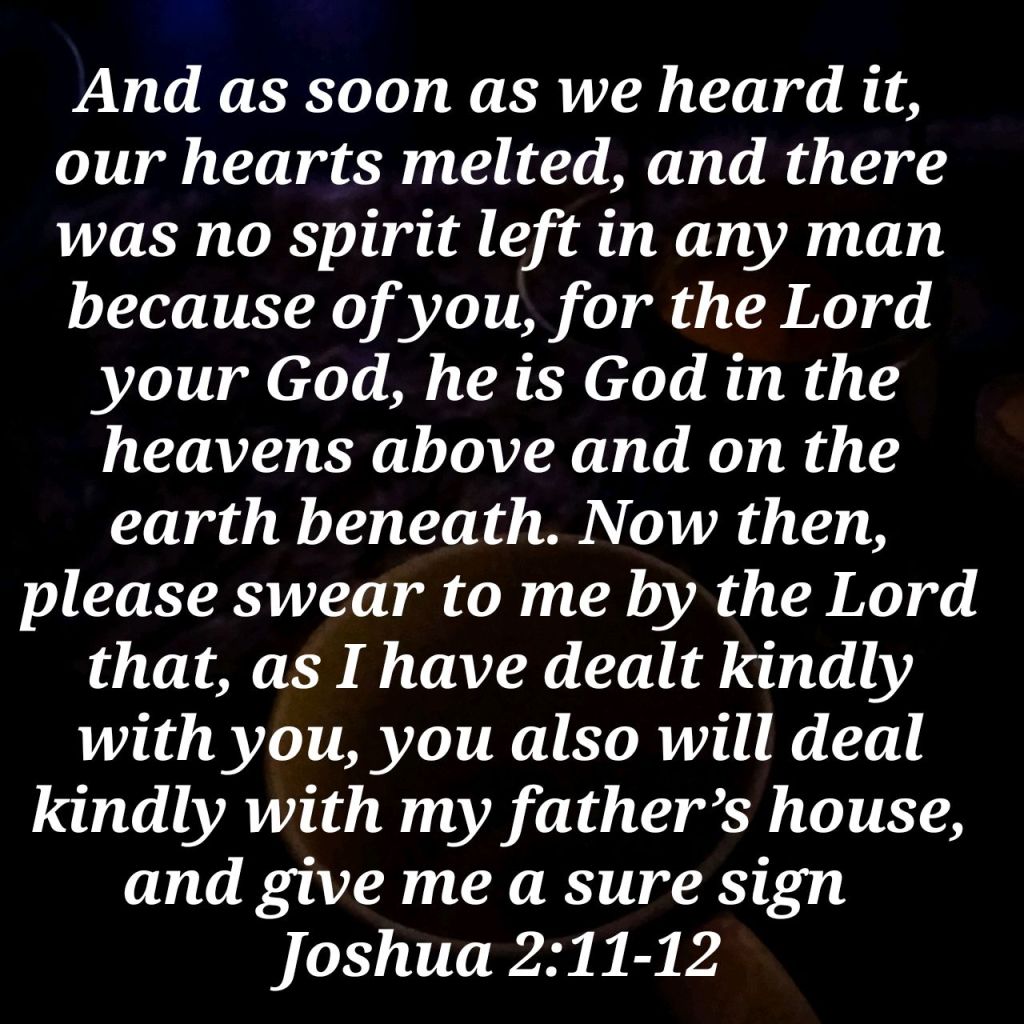
Rahab, although a working girl driven by love for her family and self-preservation, upon hearing the strength of God bringing the Israelites out from pagan slavery in Egypt and conquering much evil through them, makes a choice to not be foolish and ignore what was obviously hot news. She strikes a deal with the Israelite spies that would, and does, be a prolific case for Christ and the authorship of The Holy Bible being God. This example of Rahab, who would have been shunned for being a sex worker, having been judged harshly and knowing the agony of sexual abuse as that is par of the course, reminds us that God is not looking at our sins as the measure of worthiness to be saved or not. God is, however, looking at the sincerity of our plea to Him to save us from ourselves and the mess we have created by being in cohorts with God’s enemy. Luke 5 vs 32, Jesus reminds us that He calls out to ANYONE willing to admit and repent from their sin; “I have come to call not those who think they are righteous, but those who know they are sinners and need to repent.” In Matthew 9 vs 13, Jesus reveals a massive part of God’s character: to save, not harm. But God, being love, does not force us to choose Him. God wants us to choose Him freely, following His commands designed for our benefit. ‘The Message’ paraphrase of Matthew 9 vs 13 says beautifully, “Go figure out what this Scripture means: ‘I’m after mercy, not ( legalistic)religion.’ I’m here to invite outsiders, not coddle insiders.”– Messiah King Jesus. Rahab is not only a signpost against the toxic feminist movement that claims God is sexist but screams at us that God is calling sinners, not “saints”.
GOD WANTS A SINCERE, TRANSPARENT, AND WILLING RELATIONSHIP WITH US.
Rahab’s daringness works.
Rahab’s father’s house is a typology of Noah’s ark, which is, in turn, a typology of Jesus’ Crucifixion, Ressurection, Ascension, and Imminent Return. John 14 vs 1-3, “My Father’s house has many rooms; if that were not, would I have told you that I am going there to prepare a place for you? And if I go and prepare a place for you, I will come back and take you to be with me so that you also may be where I am.” This declaration from our stunning Messiah points us to the fact that we can change our future, as Rahab does, by making different choices. The most critical of all being- CHOOSE JESUS!!!
Rahab took the gap by negotiating freedom from the inevitable destruction of evil Jericho. In so doing, Rahab, unbeknownst at the time, would make the right choice that would change her trajectory forever. And free her from the horrendous life of prostitution.
BUT THIS IS WHERE THE STORY GETS HOT!!!
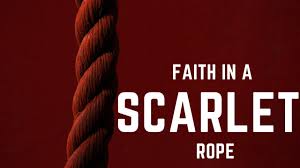
Let’s focus on Rahab’s rope. Three times in this chapter, the rope is mentioned- vs15\cord \vs 18\ lines of scarlet thread \vs 21\ scarlet line. God has a way of using things to give us messages. The Hebrew word for scarlet is שָׁנִי– shani. The word for the rope is חוּט- chut. People often call a neighbourhood’s prostitution-heavy area “the red light” district. A prostitution indicator rope customarily was the “scarlet thread”; everyone could see Rahab’s line of work. It represented the pain inextricably linked to her life—both the sorrow that had driven her to pursue that line of work and the sorrow that it had also brought her. But we can’t stop talking about that colour there. Dark red hues like scarlet and crimson are also associated with atonement. Blood is scarlet in hue, and it is the blood that washes away our guilt, shame, sin and the misery it causes. As a result, scarlet is the colour of salvation made possible by Jesus’ blood.
The word rope/cord/thread has several different connotations. Only two of the 34 times this Hebrew term is used in the Old Testament are translated as “line” or “rope.” Verse 18 and verse 21 of this chapter contain both of those. The remaining 32 times it is rendered as expectancy or hope. “Hope” is translated into it 23 times. The expectation is translated seven times. “Expected” and “longing” both occur once. As a result, the word is increasingly frequently employed to denote an expectation, longing, or hope. What a language it is when words that signify a rope or cord can also mean something completely contrary, like sadness and devastation or hope and expectation.
By default, the scarlet thread would be described as the devastation that brings sorrow that finds hope in the expectation of longing for redemption, aka Messiah King Jesus.
LOOKING AT HOW THE SCARLET WAS MADE TO COLOUR THE ROPE:
As if this rope wasn’t enough to point to God’s prophetic coming of Christ, the intricacy of God using things to tell His Story through us gets even more awesome. שָׁנִי– shani denotes the worm or its colour, also stuff dyed with it.
‘Psalm 22 vs 6: This psalm is prophetic of the cross of Jesus. And verse six says, “But I am a worm and no man…” Jesus was indeed a man on the cross. So what did the psalmist mean when he wrote, “But I am a worm?”
The Worm in Psalm 22:6
The common Hebrew word for “worm” is “rimmah,” and it is defined as a maggot or a worm. However, in Psalm 22:6, the word for “worm” is “towla”‘ or “tola’ath”.
Psa 22:6 But I am a worm [towla or tola’ath], and no man; a reproach of men, and despised of the people.
The Hebrew word “towla” or “” tola’ath” is used 43 times in the Old Testament — mainly as a colour but sometimes about a man (e.g. Job 25:6, Isa 31:14, 66:24).
Strong’s Dictionary defines this word as “a maggot (as voracious); the crimson-grub but used only (in this connection) of the colour from it, and cloths dyed therewith:–crimson, scarlet, worm.”
So the word “tola’ath” or “towla” in Psalm 22 vs 6 denotes not only a worm but also identifies it as a crimson or scarlet worm common to the Middle East and predominantly in Israel.
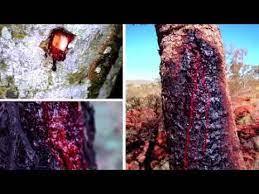
The Life Cycle of the Crimson Worm
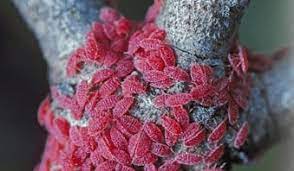
The Crimson Worm (scientific name: coccus ilicis or Kermes ilicis) looks more like a grub than a worm. However, in the lifecycle of this worm is where the remez is found. And it points to the work of Jesus on the cross.
When the female crimson worm is ready to lay her eggs, which happens only once in her life, she climbs up a tree or fence and attaches herself to it. With her body attached to the wooden tree, a rigid crimson shell forms. It is a shell so hard and so secured to the wood that it can only be removed by tearing apart the body, which would kill the worm.
The female worm lays her eggs under her body, under the protective shell. When the larvae hatch, they remain under the mother’s protective shell so the baby worms can feed on the living body of the mother worm for three days. After three days, the mother worm dies, and her body excretes a crimson or scarlet dye that stains the wood to which she is attached and her baby worms. The baby worms remain crimson-coloured for their entire lives. Thereby, they are identified as crimson worms.
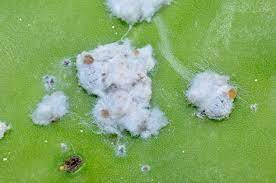
On day four, the tail of the mother worm pulls up into her head, forming a heart-shaped body that is no longer crimson but has turned into a snow-white wax that looks like a patch of wool on the tree or fence. It then flakes off and drops to the ground, looking like snow.
Isa 1 vs 18: “Come now, and let us reason together, saith the LORD: though your sins be as scarlet [shani – the root word of tola’ath], they shall be as white as snow; though they are red like crimson [tola’ath], they shall be as wool.“‘- https://reasonsforhopejesus.com/psalm-22-crimson-scarlet-worm
BUT WAIT…..
‘The Rabbis sing paeans praising Rahab for her beauty and wisdom. She acted wisely when she concealed the spies in her house, saving her entire family from the ravages of war. Her connection to the people of Israel was not merely utilitarian but ensued from her love of them and their God. She converted and married Joshua, and her descendants included renowned kohanim (members of the priestly class) and prophets. In many midrashim, Rahab comes to symbolize the positive influence Israel exerts on the surrounding Gentile nations, as well as successful conversion. Her ability to mend her ways was exemplary for ensuing generations, who used Rahab’s story to request divine mercy and pardon for their actions.’- https://jwa.org/encyclopedia/article/rahab-midrash-and-aggadah
Rahab gets mentioned in the genealogy of our High Priest- Messiah King Jesus.
To quote: ‘Salmon and Rahab were the father and mother of Boaz. Boaz and Ruth were the father and mother of Obed. Obed was the father of Jesse… Matthew 1 vs 5-16
She is one of five women mentioned in Matthew’s genealogy of Christ; they are Tamar, the wife of Judah, Rahab the wife of Salmon, Ruth the wife of Boaz, Bathsheba the wife of King David (after being the wife of Uriah), and Mary the Mother of Jesus. Besides Mary, Rahab is the only one mentioned again in the New Testament.
In James, she is shown as an example of someone justified by God and declared righteous for putting their faith into action.
You see, a man is justified by works and not by faith alone. In the same way, was not Rahab the harlot also justified by works when she received the messengers and sent them out another way? James 2 vs 24, 25‘- https://www.hopefaithprayer.com/rahab-harlot-genealogy-christ/
Undoubtedly, only God can be the author of The Holy Bible. It is impossible for so many factors in a single event to tie inextricably to a future, now historical and future, event- Messiah King Jesus, without an external consciousness/being/God to marry it together. Isn’t it funny that even Rahab’s obedience in faith points us to the words of King Jesus, John 14 vs 15, “If you love me, you will obey my commandments.”

 #Hayibo