

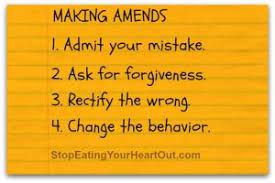
Making amends requires more than just saying sorry. It takes effort and action to repair the damage caused. By acknowledging our mistakes and taking responsibility, we can move towards a brighter future. Let us strive to go beyond apologies and make the necessary changes to improve ourselves and our relationships.
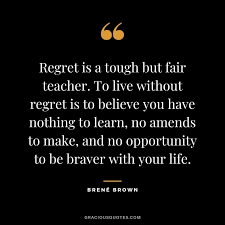
I’ve been pondering the idea of people claiming to have “no regrets”. In the quote above, Research Professor and Author Brene Brown implies that ignoring regret is like burying your head in the sand. It’s crucial to confront regret by processing emotions, gaining insight, and adjusting our behaviour. Nevertheless, we should acknowledge the imperfections of human nature, admitting that regret is inevitable but does not have to be the port we reside in. God’s Holy Word teaches us much about regret, and even more so that making amends is as essential to God’s Principles for human life as it is to God’s Story of the Salvation of Humanity through Messiah King Jesus, who is the ultimate amend. So too, is Jesus the Author of Reconciliation.
Matthew 18 vs 21, Peter said to Jesus, Lord, how often will my brother sin against me, and I forgive him? As many as seven times?” Jesus told him, “I do not say to you seven times, but seventy-seven times.”
Although I have forgiven myself, one of my regrets is that my mom never got to see me clean from drug addiction before she died. A regret that still angers me is how I let the world lie to me for so long as I tried fitting in to feel like I belonged. Nevertheless, I have learned, unlearned much, and continue seeking God’s Direction as He guides me towards His Truth. Unlike the misnomer of karma, which concludes that fatalism is the ONLY outcome for man, God offers us repentance and amends, which heals others and ourselves, thereby building bonds of love, trust, accountability, and mutuality-consciousness. Karma is a concept that sees more people wishing evil for others as passive-aggressive violence. Karma is also a psychological prison as it holds us hostage to the fear of avoiding karma. So too, is the philosophy, a form of performance- entitlement, “See what good I have done, now reward me,”- self-serving in its motive. In its essence, karmic philosophy purports reincarnation, which is not much more than wishful thinking that avoids taking full responsibility in this life, hoping for another chance. It places an anthropocentric worldview that negates God as the Authority to life and the consequences thereof, in so doing, making man deluded with self-righteousness.

In God’s Holy Word, we see Messiah King Jesus shooting down karmic philosophy by killing it with grace in Luke 19 vs 2-10. I love how Jesus extends the hand of mercy in verses 9-10, ‘”Today salvation has come to this house since he also is a son of Abraham. For the Son of Man came to seek and to save the lost.”‘

It’s important to note that in Luke 19:2-10, Zacchaeus willingly makes amends for his mistakes with a joyful heart. This is a crucial step towards recovery and building healthy relationships. Making amends allows us to stay humble by acknowledging our faults and their consequences. We begin to recognize the impact of our actions on others and take responsibility for our behaviour. With God’s merciful love, we’re given the strength to strive towards pleasing Him by transforming our conduct.

Jesus shows us how to live a life that seeks Godly Justice through rehabilitation and awareness. He also teaches us how to forgive, as he demonstrated leading up to the crucifixion. In Matthew 26 vs 52, when Jesus is arrested, and Peter tries to protect him by cutting off a soldier’s ear, Jesus reminds us that those who live by the sword will die by it and urges Peter to put it away. In the Book of Judges, chapter 1, we see these principles of amends and justice play out in a brutal account where God uses the Israelites to destroy a cruel and evil Canaanite king- Adoni-bezek- whose name means lord of lightning.
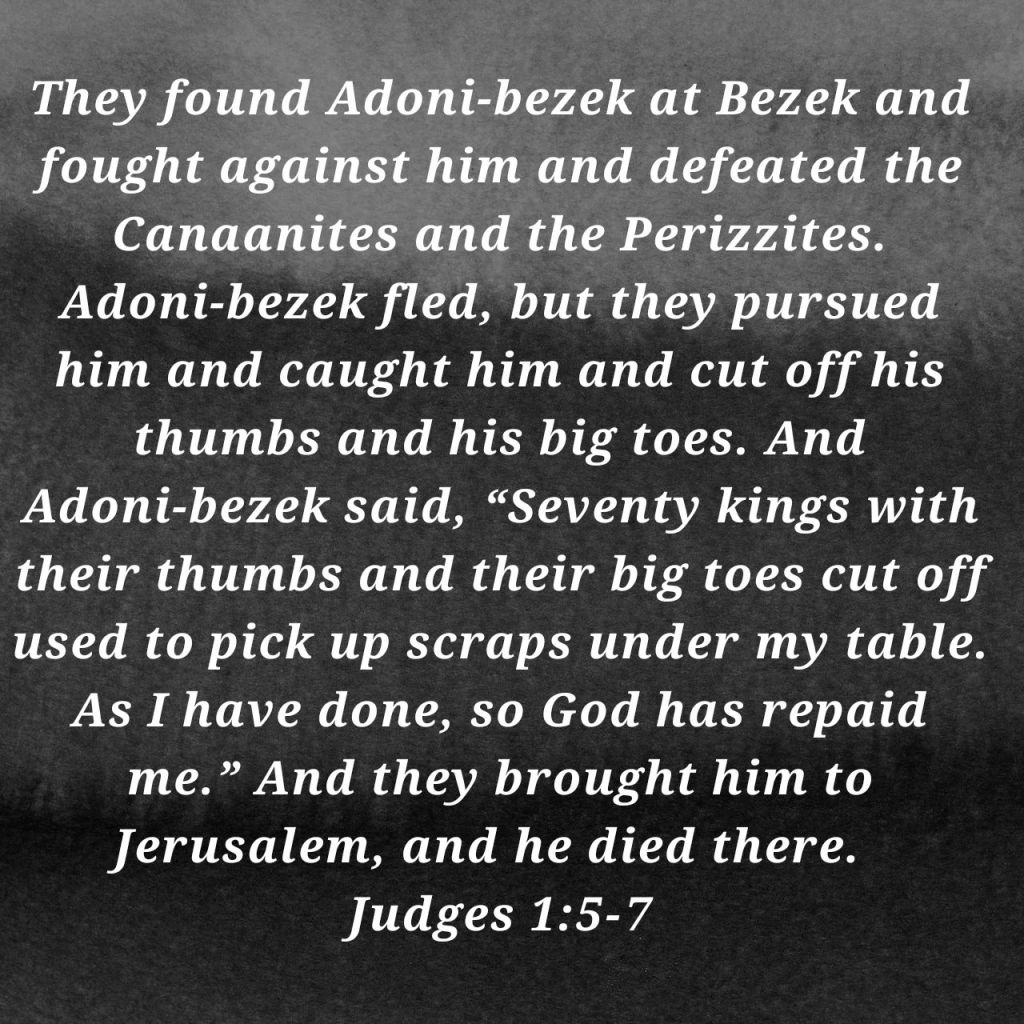
Talk about self-aggrandisement- lord of lightning. Looking at this gruesome account in historical context we see how God was making a statement about the cruelty of this king and the prevalent culture of that day that God used the Israelites to abolish.
To quote, ‘Enduring Word’ explaining Judges 1, we see that God will not tolerate human dysfunction and evil behaviour, which should cause us to repent and receive mercy.
‘i. And they found Adoni-Bezek in Bezek: The word found in this verse expresses a hostile encounter. The armies of Judah and Simeon didn’t just stumble over Adoni-Bezek.
ii. Their punishment of Adoni-Bezek may seem cruel, yet we see that it was simply justice in its truest sense. He had done this same thing to seventy kings; so now he had his own toes and fingers cut off.
iii. The punishment made Adoni-Bezek worthless as a warrior; he could trouble Israel no more as a military man. “It was a custom among those Romans who did not like a military life, to cut off their own thumbs, that they might not be called into the army. Sometimes the parents cut off the thumbs of their children, that they might not be called into the army.” (Clarke).
iv. We also see Judah and Simeon acting in an unselfish manner. They fought a battle in territory that did not directly belong to them. The city of Bezek was far to the north of Judah’s tribal lands.’- https://enduringword.com/bible-commentary/judges-1/
How many of us can strive to promote Godliness in our everyday interactions, rather than being ‘lords of lightning’, perpetuating a culture of fierce cut-throat, dog-eat-dog competition?

Proverbs 28 vs 13 , ‘Whoever conceals his transgressions will not prosper, but he who confesses and forsakes them will obtain mercy.’
As I reflect on the contrast between the identity that God has bestowed upon us and the labels that we, as flawed individuals, have created, I feel a deep desire to align myself with God’s truth. I am willing to humbly acknowledge my mistakes, unlearn the behaviours that led to those mistakes, and relearn what it means to be who God intended us to be, even if it requires some effort and personal growth. Such is life, or as the French say so romantically, “C’est la vie.”
1 Peter 2 vs 9, ‘But you are a chosen race, a royal priesthood, a holy nation, a people for his own possession, that you may proclaim the excellencies of him who called you out of darkness into his marvelous light.’

 #Hayibo