

The temple courtyard was alive with the cries of lambs, their bleating a haunting prelude to the sacrificial rituals. For first-century Jews, this was not a mere tradition but a reminder of humanity’s desperate need for atonement. This was their lifeline. The lamb was central—its innocence, purity, and death a bridge between human frailty and divine holiness. Yet today, in a world sanitized of blood and sacrifice, we struggle to understand the visceral weight of that ancient imagery. How do we, in our shallow and often indifferent modern consciousness, reclaim such depth? How do we reawaken the urgency of understanding the lamb as the lifeline from 1st century consciousness?
“As Keener points out, “For John’s audience, the lamb would immediately evoke the idea of sacrifice, deeply rooted in Jewish temple worship.”¹ Imagine the lambs offered each morning and evening, their blood shed as a continual plea for mercy.² The Passover lamb, pure and spotless, etched deliverance into the collective memory of Israel but has it faded from ours?
Modern culture may scoff at the “barbaric” concept of sacrifice, yet we are no less in need of deliverance. The sacrifices we make today—whether in relationships, careers, or self-denial—are often fragmented, lacking the singular purpose of atonement. “The cross does not eliminate suffering; it redeems it,” posits Lewis.³ This reimagination invites us to translate ancient awe into contemporary terms, connecting the Lamb of God to the selfless love that still brings redemption today.⁴ Only then can we begin to see that this Lamb still bears the sins of the world, even ours.
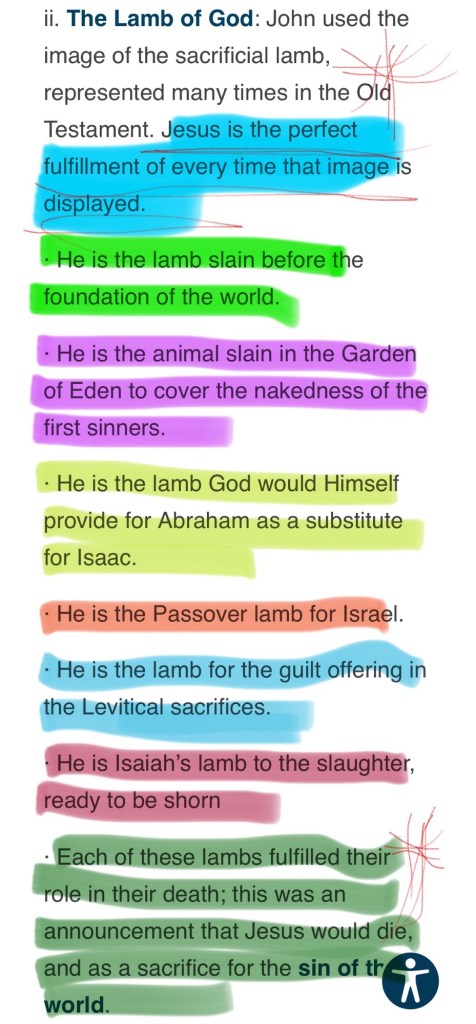
But what if this sacrifice was not a reaction to human sin but part of God’s plan all along? Before creation was spoken into existence, before the stars were hung in the sky, Jesus knew. Revelation 13:8 speaks of the Lamb slain from the foundation of the world. This is no poetic flourish but the staggering reality that the cross was always part of God’s redemptive plan.⁵ What kind of love is this? “The cross was not a divine afterthought. It is at the centre of the gospel, and the gospel is at the centre of God’s eternal plan,” elaborates Stott, drawing our consciousness to God’s intentionality.⁶
This pre-creation knowledge wasn’t merely intellectual; it was deeply relational. Jesus didn’t just know the pain of the cross—He bore it in anticipation, carrying the weight of humanity’s sin before humanity even existed. Motyer expounds that, “The servant bears the iniquity of others, an act of substitution unparalleled in ancient thought.”⁷ How does this knowledge sit with us? If we knew the extent of the pain awaiting us, would we carry ourselves with dignity and resolve? Or would we, like so many, shrink under the weight of inevitability?
Jesus’ prayer in Gethsemane echoes through time, revealing the tension between divine foreknowledge and human submission: “Let this cup pass from Me; nevertheless, not as I will, but as You will” (Matt. 26:39). He knew, and yet He chose obedience. His foreknowledge wasn’t a burden; it was love in its purest, most sacrificial form. Yet, as humans, we often wonder—would we carry ourselves with such courage if we knew what was coming?
Imagine for a moment that you knew every joy and every sorrow awaiting you. Would you live boldly, or would you falter? Would you embrace your purpose, or would fear dictate your every step? “Faith begins precisely where reason leaves off,” writes Kierkegaard.⁸ Yet even Abraham, the father of faith, must have trembled as he climbed Mount Moriah with Isaac. Kierkegaard furthers this, stating that, “Abraham’s willingness to sacrifice Isaac was not resignation but infinite trust in God.”⁹ Trust, not knowledge, carried him forward.
And yet, unlike Abraham, Jesus carried not just the weight of one moment but the full knowledge of His suffering—scorn, lashes, and crucifixion. “Christ’s atonement is substitutionary: He bears the punishment for our sins in our place,” Grudem explains.¹⁰ This isn’t just endurance; it is the transformative surrender of divine love. Jesus reframes suffering as redemptive, offering us a model of courage and trust in the face of the unknown. Nouwen poses, “Redemption comes not through escaping suffering, but through God’s transformative presence within it.”¹¹ His example dares us to ask: can we surrender our fear and trust that even in suffering, God is at work?
This brings us to the eternal relevance of the Lamb of God. The Lamb is not bound by time or culture. In the first century, lambs symbolized innocence, purity, and substitution, offering atonement through their blood. “The lamb sacrificed every morning and evening in the temple represented continual atonement for the sins of Israel,” clarifies Wright.¹² But Jesus redefines the lamb, embodying its role as both the fulfillment of prophecy and the hope of eternity. “The term ‘Lamb of God’ brings together the sacrificial imagery of the Old Testament and the eschatological hope of a redeemer,” expounds Edersheim, inviting us into deeper awe of God’s conquests to redeem us.¹³
In Revelation, the Lamb stands victorious, slain yet reigning. Brown emphasises that “The Lamb is the central figure of Revelation, symbolizing both sacrifice and victory.”¹⁴ This duality—a lamb that conquers—is the paradox of the Gospel. “The Lamb’s worthiness to open the scroll signifies His unique role in God’s redemptive plan,” delves Brown into the duality fulfilled in Christ alone.¹⁵ This Lamb isn’t confined to history; He is the eternal mediator, the one who redeems not just individuals but all of creation.¹⁶
Perhaps it begins with humility: recognizing that our achievements cannot bridge the chasm of sin. Perhaps it requires awe: standing in the shadow of a love so vast it defies comprehension. Bauckham reveals that, “The worship of the Lamb in Revelation symbolizes the ultimate recognition of His redemptive work.”¹⁷ As we await the return of the conquering King, we find hope in the Lamb who still takes away the sin of the world. “The Lamb is both slain and victorious, uniting the themes of sacrifice and conquest in a single figure,” concludes Beale.¹⁸ That not-so-cute Lamb should rather be carried into consciousness as the Conquering Lifeline—with greater urgency than the panic of a dying phone battery while driving to a petrol station on fumes, in the pitch of night, through a foreign neighbourhood we shouldn’t be in.
Practical Application

To “Behold the Lamb” today is to reclaim the awe of the cross. It is to acknowledge our desperate need for redemption in a world that denies it. Let us see the Lamb not as a relic of the past but as the living embodiment of love, sacrifice, and victory. Let us behold Him, worship Him, and walk boldly in the hope He provides.
Prayer

Father God,
We come to behold Your Lamb—not as a distant figure, but as our present Redeemer. Teach us to trust You with our burdens, knowing You carried the heaviest for us. May we live in awe of Your love and in the hope of Your eternal victory.
In Your Holy Name King Jesus,
Amen.
References

1. Craig S. Keener, The Gospel of John: A Commentary (Grand Rapids: Baker Academic, 2010), 445.
2. Alfred Edersheim, The Temple: Its Ministry and Services (Peabody: Hendrickson Publishers, 1994), 41.
3. C. S. Lewis, The Problem of Pain (New York: HarperOne, 2001), 134.
4. N. T. Wright, Simply Christian (New York: HarperOne, 2006), 78.
5. Wayne Grudem, Systematic Theology: An Introduction to Biblical Doctrine (Grand Rapids: Zondervan, 1994), 568.
6. John R. W. Stott, The Cross of Christ (Downers Grove: IVP, 2006), 187.
7. J. Alec Motyer, The Prophecy of Isaiah: An Introduction and Commentary (Downers Grove: IVP, 1993), 434.
8. Søren Kierkegaard, Fear and Trembling, trans. Alastair Hannay (London: Penguin Classics, 1985), 43.
9. Ibid., 84.
10. Wayne Grudem, Systematic Theology, 570.
11. Henri J. M. Nouwen, The Return of the Prodigal Son (New York: Image, 1992), 86.
12. N. T. Wright, Simply Christian, 92.
13. Alfred Edersheim, The Temple, 73.
14. Raymond E. Brown, The Gospel According to John (New York: Doubleday, 1966), 57.
15. G. K. Beale, The Book of Revelation: A Commentary on the Greek Text (Grand Rapids: Eerdmans, 1999), 321.
16. Ibid., 323.
17. Richard Bauckham, The Theology of the Book of Revelation (Cambridge: Cambridge University Press, 1993), 103.
18. G. K. Beale, The Book of Revelation, 321.

 #Hayibo