


The Chinese-born artist James He Qi’s ”Peace, Be Still” (1998) depicts Christ stilling the waters in bold colors that recall stained-glass window. He blends Chinese folk customs and modern western art.
Introduction
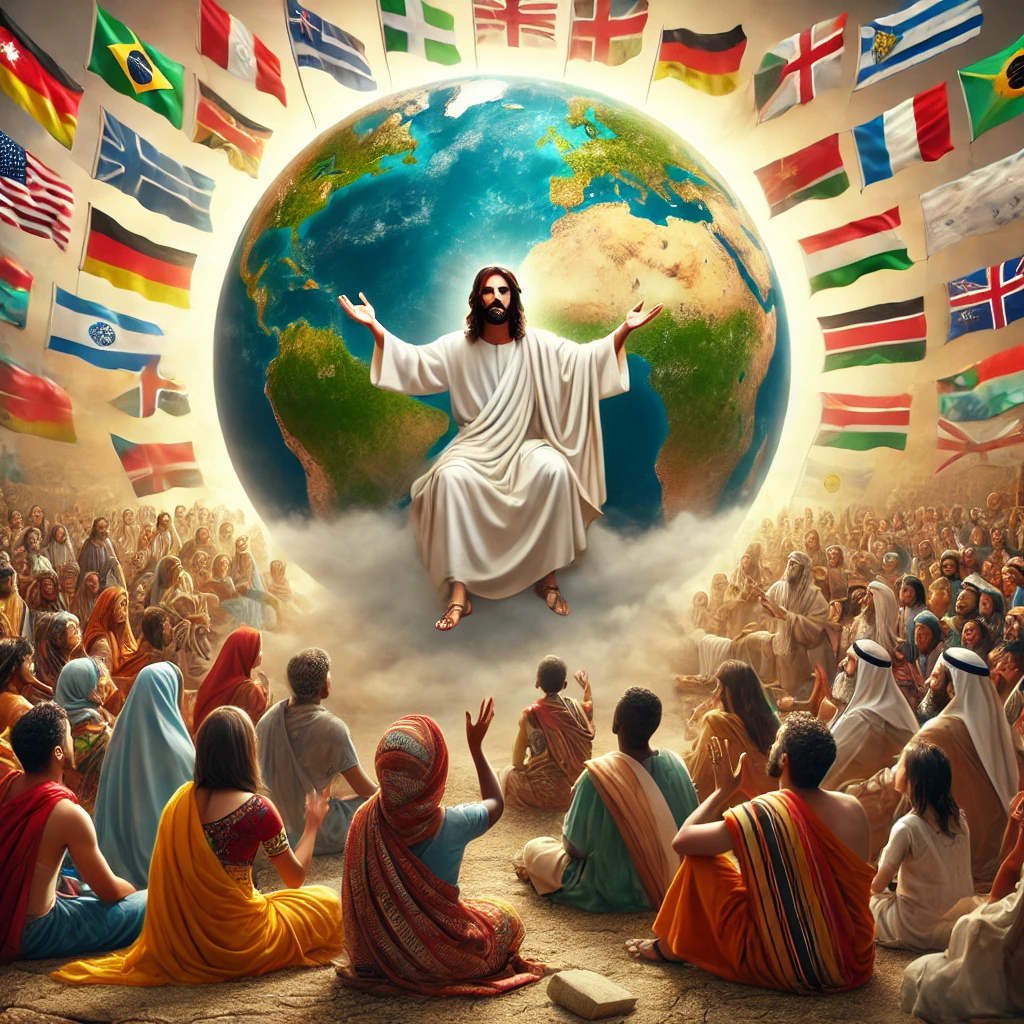
Western freedoms, rooted in Christianity, are often criticised by those benefiting from them.¹ Jesus Christ’s teachings have shaped concepts like equality, dignity, and individual rights, forming the moral foundation of Western civilisation.² Critics argue that Enlightenment values, rather than Christianity, are responsible for Western freedoms.³ However, these values, such as equality and justice, are deeply rooted in Christian principles.⁴ The influence of Jesus’ teachings extends beyond the West, offering solutions to global issues such as inequality, injustice, and oppression.⁵
This blog examines the historical role of Christianity in shaping Western freedoms, compares it with other belief systems, addresses critiques, and demonstrates how Jesus’ teachings provide answers to the world’s pressing challenges.⁶
Historical Foundations of Western Freedoms
The doctrine of imago Dei—that all humans are made in the image of God—introduced the revolutionary idea of inherent human dignity.⁷ This is evident in Genesis 1:27 and reflected in Jesus’ teachings, such as Galatians 3:28, which declares that all people are equal in Christ.⁸ These biblical principles laid the foundation for human rights and justice systems in the West.
The Sermon on the Mount (Matthew 5–7) inspired ethical frameworks, while Luke 4:18–19 emphasised Jesus’ mission to liberate the oppressed.⁹ Key historical milestones, such as the Magna Carta and the abolition of slavery, were grounded in Christian principles.¹⁰ Rodney Stark highlights that Christian values fostered not only moral but also economic and political progress.¹¹
Thinkers like C.S. Lewis believed Christianity provided the moral framework for human rights.¹² David Bentley Hart emphasised that modern concepts of equality and justice are distinctly Christian ideas.¹³ Additionally, Larry Siedentop argued that Western liberalism and the focus on individual dignity arose from Christian theology.¹⁴
Comparison with Other Belief Systems
The distinctiveness of Western freedoms becomes clear when compared with societies shaped by other belief systems. Islamic nations governed by Sharia law often impose strict restrictions on freedoms, especially for women and minorities.¹⁵ Hinduism perpetuates social hierarchies through the caste system, directly opposing Christianity’s emphasis on equality.¹⁶
Secular ideologies have also struggled to uphold consistent moral frameworks for dignity and rights. Critics like Yuval Noah Harari claim that religion, including Christianity, hinders progress.¹⁷ Richard Dawkins argues that secularism, not Christianity, enabled modern freedoms.¹⁸ However, Alister McGrath counters that secular values, such as individual autonomy, are rooted in Christian theology.¹⁹
It is a profound irony that many who live in the freedoms and privileges afforded by Western societies often fail to appreciate their origins. While openly criticising the very systems that protect their rights, they benefit from structures of democracy, justice, and individual autonomy shaped by Christian teachings. This attitude reflects a cultural amnesia, where the roots of these freedoms are dismissed or forgotten. As Tom Holland observes in Dominion, “The comfort of modern liberties allows a detachment from their historical cost.” Similarly, Vishal Mangalwadi, in The Book That Made Your World, argues, “Western critics are like heirs squandering an inheritance without understanding the sacrifices made to earn it.” Such critiques often ignore the transformative influence of Jesus’ teachings, which championed human dignity, equality, and compassion, and instead focus solely on the West’s imperfections. This arrogance fails to acknowledge that no human system is flawless and that the West’s openness to self-correction is itself a product of its Christian heritage. Without gratitude or perspective, such criticisms risk undermining the very freedoms they take for granted. Tom Holland notes that many Enlightenment thinkers borrowed ideas from Christian ethics while attempting to distance themselves from the faith.²⁰
Jesus the Foundation of Freedom
Jesus’ teachings revolutionised societal values. His message of forgiveness, love, and justice redefined relationships and institutions.²¹ The imago Dei ensured that all people, regardless of race, gender, or status, were valued equally.²² Jonathan Edwards and John Wesley, inspired by biblical principles, led movements that challenged slavery and inequality.²³
Tom Holland’s Dominion demonstrates how Christian morality embedded compassion, humility, and justice into Western civilisation.²⁴ Rodney Stark adds that Christianity’s ethical teachings uniquely enabled the development of democratic institutions.²⁵ Furthermore, N.T. Wright highlights how Jesus’ resurrection inaugurated a new way of living, where equality and freedom became attainable ideals.²⁶
Critiques of Christianity’s Role in the West
Critics often claim that Western freedoms owe more to Enlightenment rationalism than to Christianity.²⁷ Steven Pinker attributes progress to science and reason, while dismissing the role of faith.²⁸ Edward Said critiques Christianity’s complicity in colonialism, arguing that it often served as a tool of oppression.²⁹ However, these critiques fail to recognise Christianity’s self-correcting nature and its role in reform movements.³⁰
Christian abolitionists like William Wilberforce fought slavery based on biblical convictions.³¹ Francis Schaeffer argues that Christianity’s influence in Western culture encouraged moral progress and reform, even in the face of its historical flaws.³² William Cavanaugh rebuts the notion that religion inherently fosters violence, noting that secular ideologies have also been culpable for widespread atrocities.³³
The Uniqueness of Christianity
Christianity’s principles of equality, dignity, and justice remain unparalleled.³⁴ Rodney Stark highlights that Christian ethics uniquely fostered advancements in education, healthcare, and governance.³⁵ David Bentley Hart affirms that the idea of equality before the law stems directly from Christian doctrine.³⁶
Stanley Hauerwas emphasises the Church’s role in promoting reconciliation and peace in divided societies.³⁷ Miroslav Volf highlights that Jesus’ teachings on forgiveness and reconciliation offer unique solutions to conflict resolution.³⁸ Moreover, Paul Marshall notes that Christianity continues to promote religious freedom and tolerance globally.³⁹
Global Relevance of Jesus’ Teachings
Jesus’ teachings address modern global challenges, such as poverty, injustice, and inequality.⁴⁰ Cornel West argues that Christian ethics are essential for achieving social justice.⁴¹ Timothy Keller affirms that justice rooted in the gospel provides answers to systemic inequality.⁴²
Christianity’s emphasis on love and service inspires movements for change. John Perkins, a civil rights activist, draws on biblical principles to advocate for racial reconciliation.⁴³ Kevin Vanhoozer demonstrates how Jesus’ teachings challenge individualism by promoting community and shared responsibility.⁴⁴
Christian hospitality, as Matthew Kaemingk observes, offers a framework for addressing immigration and multicultural tensions.⁴⁵ Tom Holland concludes that Christianity’s enduring influence is its capacity to inspire hope and transformation in every generation.⁴⁶
Conclusion
Christianity, through Jesus’ teachings, has shaped Western freedoms and continues to address global challenges. Critics often overlook the profound impact of Christian values on governance, justice, and human rights.⁴⁷ Recognising Jesus as the foundation of dignity and equality provides a pathway to a more just and equitable world.⁴⁸ His teachings remain relevant and transformative, offering hope for individuals and societies alike.⁴⁹ As the world faces ongoing challenges, Jesus remains the ultimate answer.⁵⁰
Practical Application
• Reflect on the freedoms you enjoy, recognising their Christian roots.
• Study Jesus’ teachings to understand how they offer solutions to societal issues.
• Embody Christ’s principles of love, justice, and reconciliation in your daily life.
Prayer

Dear Lord,
Thank You for the freedom and dignity You have given us. Help us to live by Your teachings, advocating for justice, compassion, and reconciliation. May Your truth inspire us to be agents of change in a broken world.
In Jesus’ Holy name,
Amen.
References

1. Matthew 5–7.
2. John 8:36.
3. Galatians 3:28.
4. Genesis 1:27.
5. Luke 4:18–19.
6. C.S. Lewis, Mere Christianity. London: HarperCollins, 1952.
7. Alister McGrath, Christianity’s Influence on Western Values. Oxford: Blackwell, 2010.
8. Vishal Mangalwadi, The Book That Made Your World. Nashville: Thomas Nelson, 2011.
9. Tom Holland, Dominion: The Making of the Western Mind. London: Little, Brown, 2019.
10. David Bentley Hart, The Experience of God: Being, Consciousness, Bliss. New Haven: Yale University Press, 2013.
11. Richard Dawkins, The God Delusion. London: Bantam Press, 2006.
12. Yuval Noah Harari, Sapiens: A Brief History of Humankind. London: Vintage, 2014.
13. Steven Pinker, Enlightenment Now: The Case for Reason, Science, Humanism, and Progress. New York: Viking, 2018.
14. Rodney Stark, The Victory of Reason. New York: Random House, 2005.
15. Edward Said, Orientalism. New York: Pantheon Books, 1978.
16. William Wilberforce, Real Christianity. London: Hodder & Stoughton, 1797.
17. Paul Marshall, Religious Freedom in the World Today. Lanham: Rowman & Littlefield, 2008.
18. Timothy Keller, Generous Justice. New York: Dutton, 2010.
19. Miroslav Volf, Exclusion and Embrace. Nashville: Abingdon Press, 1996.
20. John Perkins, Let Justice Roll Down. Ventura: Regal, 1976.
21. Kevin Vanhoozer, Faith Speaking Understanding. Louisville: Westminster John Knox Press, 2014.
22. Matthew Kaemingk, Christian Hospitality and Muslim Immigration. Grand Rapids: Eerdmans, 2018.
23. Larry Siedentop, Inventing the Individual: The Origins of Western Liberalism. Cambridge: Harvard University Press, 2014.
24. Charles Taylor, A Secular Age. Cambridge: Belknap Press of Harvard University Press, 2007.
25. Stanley Hauerwas, The Peaceable Kingdom: A Primer in Christian Ethics. Notre Dame: University of Notre Dame Press, 1983.
26. Francis Schaeffer, How Should We Then Live? The Rise and Decline of Western Thought and Culture. Wheaton: Crossway, 1976.
27. Rodney Stark, For the Glory of God: How Monotheism Led to Reformations, Science, Witch-Hunts, and the End of Slavery. Princeton: Princeton University Press, 2003.
28. N.T. Wright, Simply Christian: Why Christianity Makes Sense. New York: HarperOne, 2006.
29. Samuel Gregg, “Christianity and the Origins of Human Dignity.” Journal of Markets & Morality 7, no. 1 (2004): 99–112. https://www.marketsandmorality.com.
30. David Bentley Hart, Atheist Delusions: The Christian Revolution and Its Fashionable Enemies. New Haven: Yale University Press, 2009.
31. H. Richard Niebuhr, Christ and Culture. New York: Harper & Row, 1951.
32. Bernard Lewis, What Went Wrong? Western Impact and Middle Eastern Response. New York: Oxford University Press, 2002.
33. Mark Durie, The Third Choice: Islam, Dhimmitude, and Freedom. Melbourne: Deror Books, 2010.
34. Christopher Hitchens, God Is Not Great: How Religion Poisons Everything. New York: Twelve, 2007.
35. Edward Glaeser, “Secular Rationalism and Human Development.” Journal of Human Development 3, no. 1 (2002): 31–48. https://www.jstor.org/stable/10.1080/humandev021.
36. Alvin Plantinga, Where the Conflict Really Lies: Science, Religion, and Naturalism. New York: Oxford University Press, 2011.
37. Miroslav Volf, Public Faith in Action: How to Think Carefully, Engage Wisely, and Live Faithfully in the Public Square. Grand Rapids: Brazos Press, 2016.
38. John Finnis, Natural Law and Natural Rights. Oxford: Clarendon Press, 1980.
39. Larry Siedentop, “Christianity’s Role in Inventing Individual Rights.” Journal of Modern History 80, no. 2 (2008): 1–17. https://www.jstor.org/stable/10.320/jmodhist1008.
40. Os Guinness, The Magna Carta of Humanity: Rediscovering Humanity’s Ultimate Value. Downers Grove: IVP Academic, 2021.
41. Dinesh D’Souza, What’s So Great About Christianity? Washington, D.C.: Regnery Publishing, 2007.
42. Talal Asad, Formations of the Secular: Christianity, Islam, Modernity. Stanford: Stanford University Press, 2003.
43. Brian Tierney, The Idea of Natural Rights: Studies on Natural Rights, Natural Law, and Church Law, 1150-1625. Grand Rapids: Eerdmans, 2001.
44. Craig S. Keener, The Historical Jesus of the Gospels. Grand Rapids: Eerdmans, 2009.
45. Richard Bauckham, Jesus and the Eyewitnesses: The Gospels as Eyewitness Testimony. Grand Rapids: Eerdmans, 2006.
46. Michael Heiser, The Unseen Realm: Recovering the Supernatural Worldview of the Bible. Bellingham: Lexham Press, 2015.
47. Charles Malik, A Christian Critique of the University. Downers Grove: IVP Academic, 1982.
48. Joshua Mitchell, American Awakening: Identity Politics and Other Afflictions of Our Time. New York: Encounter Books, 2020.
49. Timothy Keller, Making Sense of God: An Invitation to the Skeptical. New York: Viking, 2016.
50. Francis Fukuyama, The Origins of Political Order: From Prehuman Times to the French Revolution. New York: Farrar, Straus and Giroux, 2011.

 #Hayibo