


Introduction
“I believe God is tribal,” he said with an air of certainty. The words lingered, bold and provocative. When I asked what he meant, he replied, “Each religion’s God is the God of their tribe, and God serves only that tribe.” His statement unsettled me, but it also intrigued me. Could God be reduced to a tribal deity? And if He were, which deity would reign supreme, considering tribal and neo-tribal conflicts continue to divide humanity?
This question is not new. Throughout history, humans have sought identity and belonging, often creating “tribal gods” who represent their exclusive interests. But these gods are fragile—broken bridges incapable of uniting humanity. In contrast, Jesus stands apart as the ultimate bridge that holds, connecting all people to God and one another.
Broken Bridges of Tribal Gods

Tribal gods thrive on exclusivity. They promise favour, belonging, and identity, but only to one group—alienating others. Their appeal lies in their ability to validate a tribe’s claim to power or superiority. Yet these gods are inherently fragile, crumbling under the weight of universal truth.
Ancient civilisations built entire systems around their tribal gods. Greek and Roman deities, for instance, were tied to city-states: Athena for Athens, Mars for Rome. These gods served political and cultural agendas, reinforcing divisions between peoples.¹ Similarly, Norse gods were enshrined as patrons of Viking conquests, reflecting a warlike tribal identity. In Africa, traditional religions often associated deities with specific tribes or regions, as John W. de Gruchy observes in The Church Struggle in South Africa.² While these beliefs offered a sense of cultural cohesion, they also deepened divides.
Tribal gods have also fuelled violence. The Aztec Flower Wars—ritualistic conflicts fought to capture prisoners for sacrifice—are a prime example of spirituality intertwined with destruction.³ The early Islamic conquests combined religious zeal with political ambition, spreading Islam through military campaigns.⁴ In Southern Africa, the Mfecane under Shaka Zulu led to widespread displacement and tribal warfare, reshaping the region’s demographics.⁵ Each of these examples illustrates the destructive potential of gods tied to tribal interests.
And yet, have we truly moved beyond tribalism? Modern forms persist—in nationalism, denominationalism, and even political ideologies. Have we simply replaced ancient tribal gods with new ones, continuing to fracture humanity?
Jesus: The Universal Bridge

Against this backdrop of broken bridges stands Jesus, who consistently defied tribal boundaries. Unlike tribal gods, who serve exclusive interests, Jesus offers a universal invitation to all.
Consider Simon of Cyrene, a man from North Africa who was compelled to help Jesus carry the cross (Mark 15:21). Though seemingly an outsider to the Jewish community, Simon’s inclusion in this pivotal moment symbolises the universality of Jesus’ mission. His act points to a greater truth: God’s redemptive plan transcends tribes, inviting every nation to participate.
This inclusivity is central to Yahweh’s nature. From the beginning, God’s promise to Abraham was not just for one nation but for all: “All nations will be blessed through you” (Genesis 12:3). The Great Commission echoes this: “Go and make disciples of all nations” (Matthew 28:19). Peter affirmed this truth when he declared, “God shows no partiality, but in every nation anyone who fears Him and does what is right is acceptable to Him” (Acts 10:34-35).
Theologically, Yahweh stands apart from tribal gods. Gregory of Nyssa emphasised that God’s work is universal, aiming to restore all creation.⁶ Michael McClymond critiques tribalistic interpretations of grace, showing how Yahweh’s justice extends to all.⁷ Georges Florovsky underscores the catholicity of God’s revelation, transcending cultural and tribal limitations.⁸
Even in moments of conflict, Yahweh’s supremacy over tribal deities is clear. In 1 Kings 18, Elijah challenges the prophets of Baal to call upon their god to light their altar. Baal remains silent, but Yahweh answers with fire, proving to be the unshakable bridge. Similarly, in Judges 16, the Philistines boasted that their god had delivered Samson into their hands, yet Yahweh’s sovereignty prevailed.
The cross itself is the ultimate bridge. Ephesians 2:14-16 declares that through His sacrifice, Jesus broke down the walls of hostility, uniting Jews and Gentiles into one new humanity. This is the bridge that holds—strong enough to carry the weight of every tribe, tongue, and nation.
The Fragility of Tribal Gods
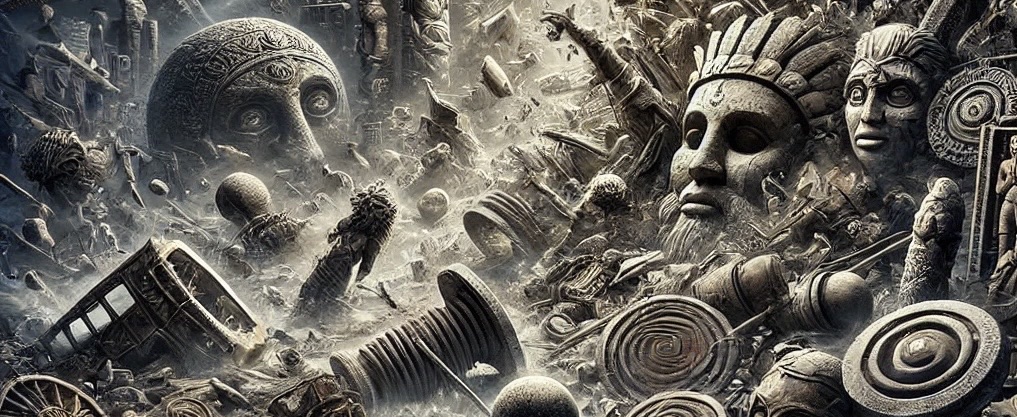
Philosophically and ethically, tribal gods collapse under scrutiny. A god who serves only one group cannot claim to be truly divine. Tribal gods depend on their tribes for identity, making them limited and conditional.⁹ Souleymane Bachir Diagne critiques this isolationism, pointing out its logical inconsistencies.¹⁰
Hanno Sauer adds that tribal constructs lack universal coherence, reinforcing the idea that such gods fail to provide consistent moral frameworks.¹¹
Ethically, tribal gods fail to uphold justice and impartiality. John Stuart Mill’s utilitarianism argues that moral systems must seek the greatest good for all, yet tribal gods benefit only their chosen group.¹² Similarly, W.D. Ross’s deontological ethics, with its emphasis on prima facie duties, calls for moral obligations that serve humanity universally, not selectively.¹³ Tribal gods also prioritise virtues like loyalty at the expense of compassion, contradicting Alasdair MacIntyre’s vision of virtue ethics as fostering unity.¹⁴
Conclusion: The Bridge That Holds
If God is merely a tribal deity, His bridge will collapse under the weight of division. Such a bridge is narrow, fragile, and insufficient to bear the burden of humanity’s brokenness. But if God is universal, His bridge will hold. It will unite every nation, tribe, and tongue under one truth.
Jesus is that bridge. His cross spans the greatest chasm—between God and humanity, and between each other. Unlike tribal gods that demand exclusivity, Jesus invites all to walk across His bridge, regardless of background or identity.
This is not a weak or fragile structure; it is the unshakable foundation of grace and truth. So, the question remains: Will you step off the broken bridges of tribalism and step onto the bridge that holds—the bridge that leads to life, reconciliation, and hope in Christ?
Practical Application

What does it mean to step onto this bridge? First, it means rejecting the broken bridges of tribalism. Christians must resist the temptation to remake God in the image of their tribe—whether political, cultural, or denominational.
Second, it means living out the universal gospel. Jesus calls us to cross boundaries, to love those outside our “tribes,” and to reflect His grace to all people. As Jonathan Haidt observes, overcoming tribal divisions requires humility and a shared vision of humanity.¹⁵
Prayer
Lord,
Help us to see You not as a God confined to one tribe but as the God of all creation. Open our hearts to embrace the universal message of Your love and grace. Teach us to reject the broken bridges of division and to live as ambassadors of reconciliation. May we reflect the unity and inclusivity of Jesus in all that we do, crossing boundaries to share Your hope and love with others.
In Jesus’ Holy name,
Amen.
References

1. Joshua Greene, Moral Tribes: Emotion, Reason, and the Gap Between Us and Them (New York: Penguin Books, 2013).
2. John W. de Gruchy, The Church Struggle in South Africa (Minneapolis: Fortress Press, 2005).
3. “A warlike culture? Religion and war in the Aztec world,” Journal of Anthropological Research 79 (2022).
4. Fred M. Donner, The Early Islamic Conquests (Princeton: Princeton University Press, 1981).
5. Carolyn Hamilton, Mfecane Aftermath: Reconstructive Debates in Southern African History (Johannesburg: Witwatersrand University Press, 1995).
6. Mary Beard, SPQR: A History of Ancient Rome (New York: Liveright Publishing, 2015).
7. Gregory of Nyssa, On the Soul and the Resurrection, trans. Catharine Roth (New York: St. Vladimir’s Seminary Press, 1993).
8. Michael McClymond, The Devil’s Redemption (Grand Rapids: Baker Academic, 2018).
9. Georges Florovsky, Bible, Church, Tradition: An Eastern Orthodox View (Belmont: Nordland Publishing, 1972).
10. Souleymane Bachir Diagne, “Philosophy Versus Tribalism,” UNESCO Courier (2019).
11. Hanno Sauer, The Invention of Good and Evil: A History of Morality (Princeton: Princeton University Press, 2023).
12. John Stuart Mill, Utilitarianism (London: Parker, Son, and Bourn, 1863).
13. W.D. Ross, The Right and the Good (Oxford: Oxford University Press, 1930).
14. Alasdair MacIntyre, After Virtue (Notre Dame: University of Notre Dame Press, 1981).
15. Jonathan Haidt, The Righteous Mind: Why Good People Are Divided by Politics and Religion (New York: Vintage Books, 2012).

 #Hayibo