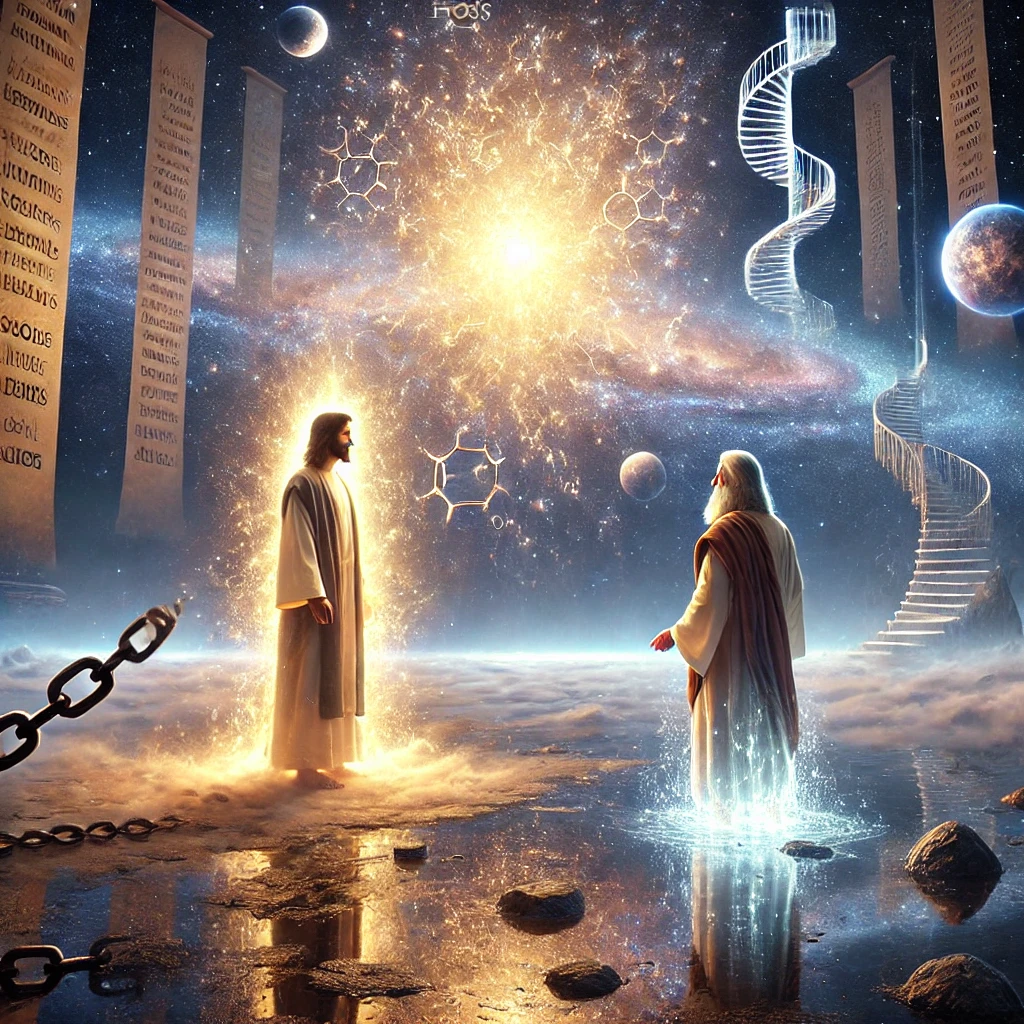
Nicodemus approached Jesus under cover of darkness—careful, cautious, mindful of what others might think. He began with a polished statement:
“We know You are a teacher come from God…”
As if Jesus required human validation. But Jesus did not entertain the small talk. He ignored the flattery.
Instead, He went straight to the heart of the matter—the very question Nicodemus did not even realise he was asking:
“Most assuredly, I say to you, unless one is born again, he cannot see the kingdom of God.”
What a leap.
Nicodemus wanted a theological discussion, but Jesus was saying, “Nicodemus, your issue isn’t knowledge—it’s that you are not even alive yet.”
This was not about religious reform.
This was not about self-improvement.
This was about total transformation.
Nicodemus was operating within the limits of human understanding, but Jesus was speaking from a reality beyond comprehension. And here is the challenge: Jesus expected him to surrender to it.
The Deepest Deep: The Limits of Human Knowledge
I traced human comprehension to its outermost edge, to the places where even the greatest minds hit a wall—and I found something staggering. There is always a point where knowledge runs out.
- Cosmology – We have mapped a universe 93 billion light-years across, yet we have no idea what lies beyond. Theoretical physicist Paul Davies observes, “The laws of physics themselves break down at the singularity of the Big Bang; beyond that, science has no jurisdiction.”¹ We are left only with God, the First Cause.
- Physics – Quantum mechanics reveals that particles can exist in multiple states at once, and entanglement suggests that information can travel faster than light. Yet Richard Feynman admitted, “I think I can safely say that nobody understands quantum mechanics.”² Reality itself is beyond our grasp.
- Neuroscience – We can scan the brain, measure thought processes, yet we cannot explain consciousness. Philosopher David Chalmers calls this “the hard problem of consciousness—why should physical processes in the brain give rise to subjective experience?³ Science can track neural activity, but it cannot define the soul.
- Mathematics & Logic – Gödel’s Incompleteness Theorem proves that truth exists beyond what human reasoning can prove. He demonstrated that “within any logical system, there will always be truths that cannot be proven using the system itself.”⁴ Even logic bows to a higher, unprovable reality.
- Biology – DNA functions as an intricate code—one that points to an intelligent Designer. Francis Crick, co-discoverer of DNA, admitted, “An honest man, armed with all the knowledge available to us now, could only state that some form of intelligence appears to have been involved in the origin of life.”⁵
Beyond all these frontiers, human knowledge collapses into mystery.
This is the invisible boundary where the finite must bow to the infinite.
This is the moment when science, reason, and self-sufficiency give way to faith.
This is the point where Nicodemus’ intellect was useless, and Jesus told him:
“You must be born again.”
But What Does It Mean to Be Born Again?
A religious phrase? A self-help ideology? No.
It is a transformation into something only God understands.
Jesus—fully human, yet transcendent—bent time, space, and matter after His resurrection. He passed through locked doors, ate food without needing it, vanished and reappeared at will, and ascended into a dimension beyond human reach.
And He said, “Follow Me.”
Follow Him where?
Into the depths of born-againness—to a new life not confined by human limitation, but defined by God’s supernatural reality.
But Here’s the Catch: To Become, I Must Let Go
- Let go of my own definitions of self
- Let go of the fear of public opinion
- Let go of what I think is possible
To step onto the waters, I must surrender the shore.
So Here’s My Real Question
What if I could loosen my grip on the comfort of my conditioning?
What if I stopped clinging to a world that dictates my perspectives, fears, and limits?
Would I bow to a society so violently hostile?
Would I allow the fear of shame and humiliation to hold me back?
Would I remain like Nicodemus, sneaking through the night, drawn to Jesus but too afraid to step into the light?
Or would I have the boldness to shout back at the world—at the voices, the conditioning, the doubt—
“Shoosh! My Father is making me! Hands off!”
If I have never truly known the depths of born-againness… then what am I afraid of?
Who told me to be afraid?
The unknown is not terrifying—the loss of control is.
But is that not precisely what Jesus calls me into?
To lose my life in order to find it?
So, do I remain Nicodemus at night, creeping in the shadows, seeking answers but unwilling to surrender?
Or do I step forward, lift my hands, and declare—
“Shoosh, world! My Father is making me. Keep your grubby hands off!”
Yes, I want to be who Jesus says I am.
Yes, I need Him to help me let go.
Yes, I am curious enough to step onto the waters.
Is this terrifying? Yes.
But the real question remains—who taught me that it should be?
Prayer: The Depths of Born-Againness
Jesus, take me to the deepest deep—where human understanding fails and only You remain.
Take me beyond my limits, beyond my conditioning, beyond my fears.
Strip away every false identity, every voice that told me I must conform, bow, fear.
Break me free from the chains of what I think I know, so I can become who You say I am.
If stepping into born-againness means walking where no human feet have walked before,
If it means standing at the edge of the unknown,
If it means surrendering everything I thought was safe—
Then, Lord, let me step onto the waters.
Let me crave the depths of transformation more than I crave control.
Let me desire the adventure of becoming more than I fear the pain of unbecoming.
Let me trust that You are making me, and the world has no say in it.
I do not want to be Nicodemus at night, hiding my hunger for You behind caution.
I want to be Peter stepping out, terrified but trusting.
I want to be unmade, remade, reborn into Your reality.
Jesus, take me beyond.
To the depths where only You can take me.
Amen.
References
- Paul Davies, The Mind of God: Science and the Search for Ultimate Meaning (New York: Simon & Schuster, 1992).
- Richard Feynman, QED: The Strange Theory of Light and Matter (Princeton: Princeton University Press, 1985).
- David Chalmers, The Conscious Mind: In Search of a Fundamental Theory (Oxford: Oxford University Press, 1995).
- Kurt Gödel, On Formally Undecidable Propositions of Principia Mathematica and Related Systems (Leipzig: Springer, 1931).
- Francis Crick, Life Itself: Its Origin and Nature (New York: Simon & Schuster, 1981).

 #Hayibo