Chemical Gods and Leaky Vats: Why Materialism Can’t Explain the Soul
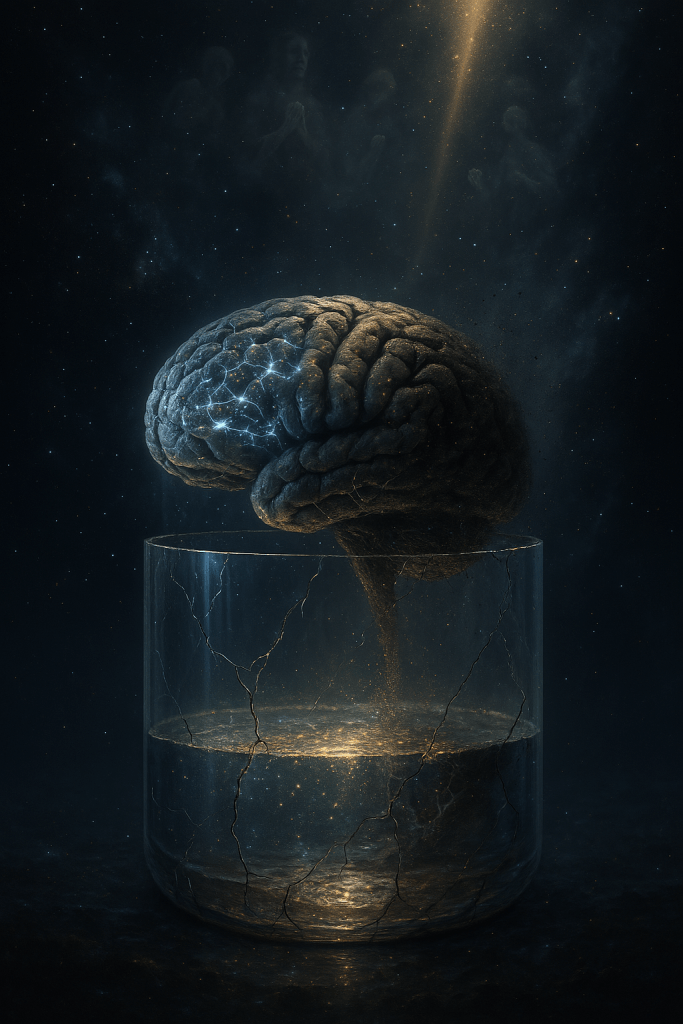
AI Generated Picture
If all we are is matter, why does our matter mourn?
Modern materialism claims that everything we are, our thoughts, morality, imagination, and longing, is simply the by-product of chemical processes, biological adaptations, and evolutionary randomness. The soul, it insists, is an illusion. Consciousness, no more than a trick of the brain. Even our deepest moral instincts, say some, are useful illusions for survival.
But what happens when we take these ideas seriously, philosophically, theologically, and existentially? What happens when we follow their logic to its final destination?
This reflection does just that. And it begins with a question that refuses to let go:
If the brain is god, why does it build a body that dies?
In the popular materialist metaphor, we are “brains in vats”, consciousness-generating organs floating in a closed loop of chemical reactions. Francis Crick famously wrote, “You, your joys and your sorrows, your memories and your ambitions… are in fact no more than the behaviour of a vast assembly of nerve cells and their associated molecules.”¹
But if the brain is such a brilliant chemical computer, why does it design a fragile, mortal housing? Why simulate death at all? Why generate bodies that break, hearts that ache, and minds that unravel?
If energy cannot be destroyed, and chemicals behave predictably, then surely a truly intelligent chemical system would perpetuate itself indefinitely. Instead, it creates mortality, a self-sabotaging feature. This suggests that even the so-called godlike brain must bow to something it did not invent. The vat leaks. The “god” dies.
If matter is the master, why aren’t all brains the same?
Materialist determinism argues that we are governed by the same laws of physics and chemistry. If so, and if all brains are made of the same matter, responding to similar environments, why do humans differ so profoundly?
Why does one person become a poet and another a predator? Why do humans love, dream, sacrifice, or self-destruct in such wildly different ways?
This variance cannot be attributed to mere chemical differentiation unless we assert that morality, intelligence, imagination, and self-worth are random chemical by-products. But then the very idea of intelligence, of reasoning about morality, becomes meaningless. If your convictions are simply what your chemicals do under pressure, then so are mine. And so is Dawkins’. And nothing is trustworthy.
Who taught genes to be selfish?
Richard Dawkins described humans as “survival machines, robot vehicles blindly programmed by selfish genes.”² But the moment we call a gene selfish, we smuggle in agency, choice, will, intention. Molecules do not intend. Sodium and chloride do not hesitate before bonding. They react, mechanically.
So what does it mean to say a gene is selfish?
Either Dawkins is speaking metaphorically, dangerously so, or he is making a moral claim about an amoral substance. In both cases, the metaphor collapses. A gene can no more choose selfishness than a rock can choose patience.
Can intuitions be trusted in a dying world?
Steven Pinker proposes that morality is “a set of intuitions that evolved culturally to help species survive and reproduce.”³ But if that is true, shouldn’t the evidence show us a thriving, morally stabilised humanity?
Instead, we see:
Declining birth rates in developed societies.⁴ Escalating suicide, depression, and anxiety.⁵ Increasing violence, environmental collapse, and global unrest.
If morality is an adaptive mechanism for survival, then it appears to be failing. And if entropy is the inevitable end of the universe, then even survival is temporary, a tent on melting ice.
So should we entrust our deepest moral instincts to a system built to fail?
Why would a brain destroy itself?
And here the materialist myth reaches its most absurd implication.
Why would a brain create conditions, like amnesia, depression, schizophrenia, or dementia, that cause it to forget, fragment, or kill itself?
If the brain is a self-optimising organ, forged by natural selection to preserve and enhance life, then why does it repeatedly sabotage itself?
Why would its own circuitry collapse into non-function?
Why would it:
Invent hallucinations it cannot distinguish from reality? Choose suicide against its survival instinct? Bury trauma so deeply that it splits the self?
These aren’t mechanical errors. They’re ruptures of identity.
And identity is not a molecule.
The brain behaves as if it is not in control of itself.
Materialism offers no coherent explanation for this. Evolution should not produce a system so fragile that it destroys its own design. Materialists cite mutations, stressors, or epigenetics, but these merely explain the mechanism of decay, not its meaning. The deeper question remains:
If a chemical system so easily turns against itself, can it truly be called intelligent?
Or are we seeing the breakdown of something more than biology?
The theological account makes more sense.
The Bible does not pretend the world is as it should be. It tells us we are fallen, fractured images of God in a broken creation. The brain does not malfunction simply because it evolved poorly. It suffers because we are not what we were meant to be.
Paul wrote, “The whole creation has been groaning as in the pains of childbirth…” (Romans 8:22).
Sin, trauma, and spiritual disorder are not metaphors for bad chemistry. They are deeper wounds, cosmic, personal, moral. They distort the body, yes, but also the soul.
How can an illusion detect itself?
Daniel Dennett calls consciousness a “user-illusion,” an emergent trick of the brain.⁶ But illusions require observers. If consciousness is an illusion, who is being tricked?
This is a philosophical suicide:
If consciousness is not real, then my belief in it isn’t real. If that belief is false, then so is my reasoning. And if reasoning is false, then so is Dennett’s argument.
You cannot use consciousness to argue that consciousness is an illusion. It’s like trying to speak silence into existence.
Where to from here?
Once materialism is dismantled, naturalism debunked, and determinism exposed, what remains?
We reach the limit of questions. Not because logic failed, but because it succeeded. It brought us to the edge where the next step isn’t an argument, it’s a decision.
“Choose this day whom you will serve.”⁷
If we are not brains in vats, but souls made in the image of God, then our thoughts are not hallucinations, our morality is not an evolutionary trick, and our longing for eternity is not foolish. It is memory. It is faith calling home.
And if not, if all is truly random, then so is your doubt.
Conclusion:
Matter does not imagine. Molecules do not mourn.
But we do.
And that alone may be the clearest evidence that we are more than matter. Perhaps the very ache to make sense of the world is the Spirit whispering: “You are not from the vat. You are from Me.”
The mathematical improbability of a conscious, self-aware brain randomly forming and sustaining itself in a vat-like environment, without divine design or guidance, is conservatively estimated at less than 1 in 10⁵⁰,⁰⁰⁰.⁹
Practical Application
Pic. Credits: Rethinking the Future
Live like a soul, not a system.
If your morality, your love, your longing for justice and transcendence aren’t illusions, then they’re invitations.
This blog isn’t just a critique of materialism. It’s a call to:
Treat people as sacred, not as chemical arrangements. Resist reducing your pain to biochemistry alone, bring it to God as lament, not malfunction. Pay attention to the moments when you wonder why you’re here, they’re not glitches. They’re glimpses. Refuse nihilism. Even when it feels rational. Especially when it feels rational.
Because if you are more than matter, then every decision is sacred. And the ache in your chest is not neurological noise, it’s the whisper of eternity.
Prayer
Pic. Credits: The Presbyterian Outlook
Father God, Jesus, Holy Spirit,
In a world that calls the soul a myth, and the mind an illusion, teach us again what it means to be made in Your image.
Let our questions lead us to You, not away.
Let our wounds reveal a deeper hunger for wholeness. And let every moment of wonder, sorrow, beauty, or despair remind us that we are not from the vat, we are from You.
Amen.
References
Pic. Credits: Forbes
1. Francis Crick, The Astonishing Hypothesis: The Scientific Search for the Soul (New York: Scribner, 1994), 3.
2. Richard Dawkins, The Selfish Gene, 30th anniversary ed. (Oxford: Oxford University Press, 2006), 3–4.
3. Steven Pinker, The Better Angels of Our Nature: Why Violence Has Declined (New York: Viking, 2011), 621.
4. Wolfgang Lutz, William P. Butz, and Samir KC, eds., World Population and Human Capital in the Twenty-First Century (Oxford: Oxford University Press, 2014), 212.
6. Daniel C. Dennett, Consciousness Explained (Boston: Little, Brown, 1991), 365–366.
7. Joshua 24:15 (NRSV).
8. Romans 8:22 (NRSV).
9. Adapted from probability calculations used in discussions of biological complexity and neurological emergence. See Stephen C. Meyer, Signature in the Cell: DNA and the Evidence for Intelligent Design (New York: HarperOne, 2009), 212–213; and William A. Dembski, The Design Inference: Eliminating Chance through Small Probabilities (Cambridge: Cambridge University Press, 1998), 62–75.
Lessons learned in God's Holy Word
Love Jesus
BTh
Biblical Counsellor
Author: ‘Bedroom Called Rainbow'
☎️: (+27) 817719162,
📧: arionstylist1@gmail.com
View all posts by Arion J Bezuidenhout





 #Hayibo