

Is this even possible?
Archaeologists have uncovered the perceived oldest known partial facial fossil of a human ancestor in western Europe, dating between 1.1 and 1.4 million years old.
The fossil, consisting of a left cheekbone and upper jaw, “Pink” was discovered in 2022 in the Sima del Elefante cave in Spain’s Atapuerca Mountains. This significant find suggests that supposed early human ancestors inhabited western Europe much earlier than previously believed. While it is argued that humans share approximately 98.8% of their DNA with chimpanzees, they also share around 96% with gorillas, 90% with cats, and even 85% with mice.¹ Such genetic overlap does not automatically imply evolutionary descent; rather, it may reflect a shared functional architecture, or what some scholars call a common design framework.² Similarity in genetic material does not equate to a direct ancestral relationship, any more than two books sharing 90% of the same vocabulary must be revisions of one another.
But behind the headlines and academic excitement, a quiet question demands to be asked, “On what basis is this date, 1.4 million years, considered reliable?” and “Could that “evidence” look very different without the assumptions baked into the model?”
This is not an anti-scientific question. It is a scientifically necessary one.
What Are We Actually Measuring?
The physical fossil is real. So is the layer of sediment in which it was found. So are the isotopic ratios of minerals surrounding it.
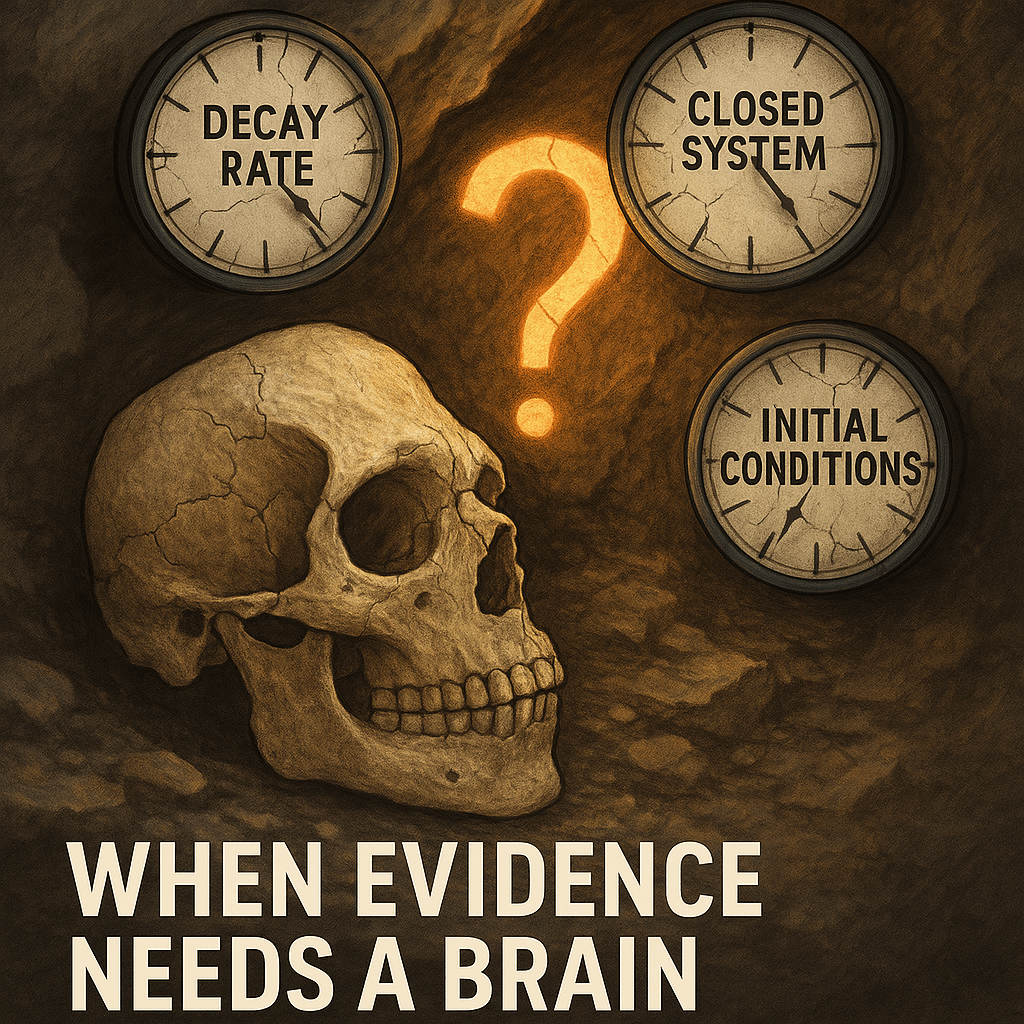
But here’s the issue: what we are measuring is not time, it is present data. The interpretation of age (1.4 million years) is not the data itself; it is the result of a model built on a cascade of assumptions:
* That the rate of radioactive decay has remained constant since the rock was formed,
* That no external contamination added or removed material from the system,
* That the rock’s environment (temperature, radiation, chemistry) has been stable over immense periods,
* That the fossil’s position in the sediment corresponds linearly to a timeline of earth history.
Yet Earth, by all recorded measures, is not stable. Ice ages, meteor impacts, volcanic cataclysms, floods, tectonic upheavals, and magnetic reversals make it a deeply unstable system. And in unstable systems, assumptions of uniformity become acts of interpretive faith.³
The Religion Beneath the Microscope
Modern science claims to be “evidence-based.” But the uncomfortable truth is that evidence doesn’t interpret itself.
A fossil doesn’t say, “I am 1.4 million years old.”
A rock doesn’t whisper, “My potassium began decaying at year zero.”
Those statements are conclusions, reached by interpreting present observations through a framework—a worldview—that accepts certain things as true a priori.⁴
In fact, science itself depends on a host of unprovable assumptions:
* That the laws of physics are constant,⁵
* That human cognition is trustworthy,⁶
* That logic and mathematics can accurately describe the universe,⁷
* That observations in the present can tell us reliable truths about an unrepeatable past.⁸
These are philosophical foundations, not empirical discoveries. And this means that modern science is not free from faith, it is framed by it.⁹
What Happens If We Remove the Assumptions?
If we removed the assumptions, if we stripped away the belief in constancy, closed systems, and uniform rates, what would we truly have?
We would have:
* A fossil in a layer.
* A ratio of isotopes in a rock.
* A geographic location and mineral composition.
But we could not date it with any certainty. We could not say when the creature lived or how long it lay buried. We could only describe what we see today.
This is not anti-science. It is epistemological honesty.
The dating methods used, whether Potassium-Argon, Argon-Argon, or Electron Spin Resonance, require assumed starting points, stable decay environments, and a consistent rate of change. Any breach in those assumptions, through gas escape, thermal events, chemical leaching, or environmental radiation fluctuations, throws the entire timescale into question.¹⁰
A Return to Forensic Theology
When evidence is no longer allowed to be interpreted solely through naturalistic models, it must be reinterpreted through a wider lens.
What if, instead of being 1.4 million years old, “Pink” was buried during a rapid, catastrophic event, like the kind described in Genesis?
What if sedimentary layering reflects not slow, calm processes, but turbulent burial, erosion, and re-deposition during periods of judgment?¹¹
What if radiometric “ages” are stretched by presuming closed systems in a very open, chaotic world?¹²
In that case, we are no longer doing “secular science.” We are doing forensic theology: interpreting data in light of divine revelation, not philosophical naturalism. And that may be precisely what truth requires.
Final Thought
Science cannot operate without assumptions because evidence never exists in a vacuum. It exists in a world full of bias, philosophy, interpretation, and belief.
The question, then, is not “Should we trust science?”
The question is: “Which framework of assumptions best explains what we observe?”
And if the answer points back to a Designer, a catastrophic history, and a moral order, then perhaps science doesn’t lead us away from God…
…it just needs the courage to follow the evidence to its rightful Author.
if we chose different assumptions, we’d find ourselves not in a museum of deep time…
…but at the base of an ark.
References

1. National Human Genome Research Institute, “Comparative Genomics Fact Sheet,” updated April 2020, https://www.genome.gov/about-genomics/fact-sheets/Comparative-Genomics-Fact-Sheet.
2. Todd Charles Wood, “The Design of Life: Understanding the Evidence for Design,” Journal of Creation Theology and Science 1 (2018): 22–33.
3. P. J. Aston, “Is Radioactive Decay Really Exponential?” arXiv (2012), https://arxiv.org/abs/1204.5953.
4. Timothy McGrew, “Evidence, Epistemology, and Modern Science,” Philosophy Compass 3, no. 5 (2008): 1090–1108.
5. Hugh Ross, The Creator and the Cosmos: How the Latest Scientific Discoveries of the Century Reveal God (Colorado Springs: NavPress, 2018), chap. 3.
6. Alvin Plantinga, Where the Conflict Really Lies: Science, Religion, and Naturalism (Oxford: Oxford University Press, 2011).
7. Vern Poythress, Redeeming Science: A God-Centered Approach (Wheaton, IL: Crossway, 2006).
8. Charles Lyell, Principles of Geology, 1st ed. (London: John Murray, 1830).
9. Andrew Snelling, “Radioisotope Dating: The ‘Assumptions’ and the Challenges,” Answers Research Journal 2 (2009): 77–90.
10. Roger Wiens, Radiometric Dating: A Christian Perspective (Los Alamos National Laboratory, 2002), https://www.asa3.org/ASA/resources/Wiens.html.
11. Steven A. Austin, Grand Canyon: Monument to Catastrophe (Santee, CA: Institute for Creation Research, 1994).
12. Henry M. Morris, The Genesis Record (Grand Rapids, MI: Baker, 1976), 111–125.

 #Hayibo