

Matthew 27:62–66 | Post-Traumatic Growth and the Fourth Day of Pain

Personal Reflection
I used to be a go-go-go kind of guy. I still am, but for different reasons. Previously, I was running so fast from myself that I ran into anything that kept me from dealing with my stuff. I was hurting so much that I thought time would heal, so I didn’t need to face my pain. Every time I paused for a brief second, I was overcome by rage and despair about my life. I often screamed, “Why me?”
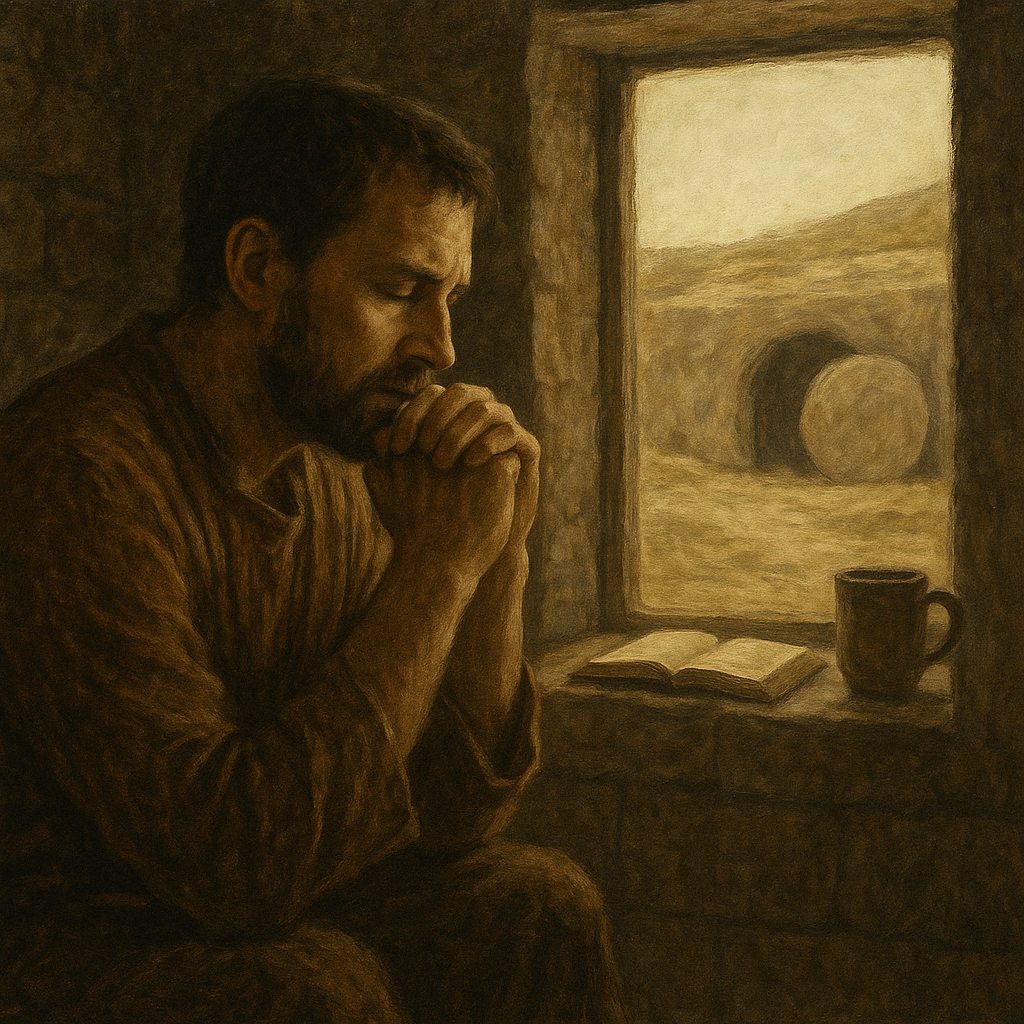
These days, I’ve learned to cherish the silence so that I can just process what is going on around me. I don’t run into distractions; rather, I run from them at all costs. I’m supposedly an ambivert, someone who enjoys deep connection with people, but who thrives most in spaces of rumination. My favourite time of day is my morning coffee with cream, my Bible, and the Holy Spirit opening up God’s Word. Without this deeply reflective time, I simply fall apart. The world gets to me.
But it took years to get to the place where I love to be in silent contemplation. I remember the first time I tried spending time by myself. I was about twenty-five. I had enrolled in a Jungian philosophy self-help programme. We had to do an alone exercise, sit in a dark room, no phones, no music, no doodling, no distractions. Just ourselves and our thoughts. I lasted five seconds.
I couldn’t believe how much I hated myself and my own company.
I’ve spent years in therapy, and in God’s presence, to learn the power of rumination. In the in-between space between avoidance and peace, there was a period of about two years where I felt like an empty sack of potatoes. I was hollow, dull, unalive. Not dead, but not alive either. Zombie’ish. I became deeply analytical, trying to make sense between my desires and the reality they produced. I was angry with God. I wanted answers, but things just seemed slow.
Looking back, I see that God was teaching me to lean on Him. To let go. To let Him unfold my healing. I was learning to trust.
Theological and Psychological Insight
Holy Saturday and the Fourth Stage of Post-Traumatic Growth
Matthew’s Gospel records that on the Sabbath after Jesus’ crucifixion, the tomb was sealed and guarded by soldiers (Matt 27:62–66). But the disciples are nowhere in sight. No crowds. No miracles. Just silence.
Holy Saturday is the liminal space of grief, when the trauma has struck, but the healing has not yet arrived. In psychological terms, this is the fourth stage of post-traumatic growth: ruminative silence. According to Richard Tedeschi and Lawrence Calhoun, this phase emerges after the initial shock and guilt, when survivors begin to internally process the traumatic event and its meaning.¹ It often begins as intrusive rumination (flashbacks, unwanted thoughts), but over time becomes more deliberate and reflective.² Growth, they argue, often requires this painful internal dialogue.
Trauma theologian Shelly Rambo explains that this is precisely what Holy Saturday teaches. She writes, “Holy Saturday is the abyss of darkness… one cannot imagine a way forward.”³ For Rambo, the space between crucifixion and resurrection validates trauma’s lingering impact. It is a day of divine silence, a descent into hell, not because God is absent, but because suffering has not yet given way to hope.
This ruminative space is deeply uncomfortable. The silence is not peace, but numbness. It is what Nicholas Wolterstorff, after the death of his son, described as “a wound that has not healed and will not heal.”⁴ Yet this silence is also sacred. Psychologists and theologians alike affirm that in these numb, quiet seasons, something deeper is taking place. Meaning is being rebuilt. Belief systems are being reconstructed. Slowly, the heart begins to learn what cannot be forced.
Conclusion
The Silent Sabbath and the Gift of Not-Knowing
We don’t like Holy Saturday. We want either the sorrow of Friday or the celebration of Sunday. But in trauma recovery, and in life, there is often a middle day. One of confusion. Stillness. Withdrawal. It may look like we’ve given up. But internally, the mind and spirit are labouring to make sense of the wreckage.
In this silence, growth is seeded. Holy Saturday teaches us to stay. Even when there’s no miracle yet. Even when all we can do is think, feel, and ask “Why?”

Practical Application
What can we do when the world goes quiet and we feel nothing but spiritual numbness?
- Make space for the silence. Not every void is a vacuum. Some are wombs.
- Name your pain honestly. Even Jesus’ followers needed time to grieve.
- Turn inward without shame.Rumination is not weakness, it is part of the process.
- Trust the God who rests. If Jesus could be still in a tomb and still fulfil the Father’s will, then your stillness is not in vain.

Prayer
Father God,
Jesus, our Suffering Saviour,
Holy Spirit, Breath in the silence,
Help me sit in this space.
Help me not to rush to resurrection before the lesson of the tomb is learned.
You are here even when I feel nothing.
Even in my numbness, you are working.
Teach me to ruminate, not in fear, but in faith.
In Your Holy Name King Jesus,
Amen.
References
- Richard G. Tedeschi and Lawrence G. Calhoun, Posttraumatic Growth: Conceptual Foundations and Empirical Evidence, Psychological Inquiry 15, no. 1 (2004): 1–18.
- Ibid., 6.
- Shelly Rambo, Spirit and Trauma: A Theology of Remaining (Louisville: Westminster John Knox Press, 2010), 71.
- Nicholas Wolterstorff, Lament for a Son(Grand Rapids: Eerdmans, 1987), 70.

 #Hayibo