
It is one of history’s most haunting reversals: a crowd offered the choice between a violent insurrectionist and a man who healed the sick and preached peace, and they chose Barabbas.
Why?
This question, echoing from Jerusalem’s stone-paved praetorium to modern pulpits and films like The Passion of the Christ, forces us to confront the fragile complexity of human psychology, religious power, and societal fear. The trial of Jesus is not merely a matter of ancient history. It is a mirror. And in it, we see ourselves.

The Crowd: Fear and Fervour
First-century Judea was a cauldron of unrest. Roman occupation was cruel, taxation severe, and executions public.¹ Amid this chaos, many longed for a messiah, one who would overthrow Rome and restore the kingdom of Israel.² Jesus, however, offered no rebellion. He did not rouse crowds to arms, but to repentance. Not vengeance, but forgiveness. He was, as one scholar observed, “the Messiah no one expected.”³ Barabbas, by contrast, had “raged against the occupying force” and resembled the kind of …
The religious authorities viewed Jesus not as Saviour but as threat—to their theology, their influence, and their nation’s fragile survival under Roman scrutiny. The Gospel of John reveals their concern: “If we let him go on, the Romans will come and take away both our place and our nation.”⁴ Their solution was preemptive scapegoating. Jesus must die for the good of the many.⁵
But perhaps the most overlooked fact is that the crowd at Pilate’s palace was likely not random. Scholars suggest they may have been a “rent-a-crowd”, a group deliberately assembled or stirred up by the authorities.⁶ Matthew notes that Pilate “knew it was out of envy” that Jesus had been handed over.⁷ Yet he caved. And so did they.
The Psychology of Complicity
What happened that day is not just theology. It is also psychology. Social scientists have long studied mob behaviour, and the crowd’s cry, “Not this man, but Barabbas!” reflects textbook symptoms.⁸
Deindividuation: In large groups, people lose their moral compass and sense of self. Diffusion of Responsibility: No one feels personally accountable. Emotional Contagion: Agitation spreads, intensifying as it goes. Social Conformity: Asch’s experiments showed 75% of people will conform to wrongness if the majority does.⁹ Authority Influence: As the Gospels state plainly, “The chief priests stirred up the crowd.”¹⁰
Dr Gayook Wong summarises it this way: “Behaviours usually seen as unacceptable become acceptable when others in the group are seen carrying them out.”⁸
Add to this the mechanism of scapegoating. As anthropologist René Girard explains, societies under pressure often unify by projecting fear or guilt onto a sacrificial victim.¹¹ In choosing Barabbas, a symbol of rebellion, they cast Jesus out as a threat to religious purity and national survival. It was a perverse moment of unity: “We the people” against a peacemaker.
The Individual: Silent in the Crowd
But crowds are made up of individuals. And the tragedy is that many in that mob had likely heard Jesus teach, seen him heal, or even shouted “Hosanna!” days earlier.
Fear is one answer. Self-preservation often drowns out compassion. Standing with Jesus meant standing against powerful voices. So many entered a fight-or-flight mode, fleeing him to survive.
Others likely experienced cognitive dissonance: how could the one they once hailed now wear a crown of thorns? To resolve the discomfort, it was easier to believe he deserved it than to admit their betrayal.¹²
There was obedience to authority, the high priest’s voice louder than conscience. Stanley Milgram proved that ordinary people will inflict harm if someone in power tells them to.¹³ Albert Bandura called this moral disengagement: handing off responsibility to an authority figure in order to suppress guilt.¹⁴
Identity protection also loomed large. Jesus threatened not only institutions, but internalised identities. To follow him would mean questioning everything. So they clung to Barabbas; more familiar, more fierce. More manageable.
Even Pilate, the Roman governor, folded under pressure. His own reputation and political standing were on the line. He faced what one analysis calls a “double cognitive bias of conformity and dissonance.”¹⁵ Though he knew Jesus was innocent, the cost of defending him was too great.
Then came trauma. The people of Judea had experienced generations of imperial violence. Collective trauma often leads either to bursts of resistance or numbed resignation. When Pilate presented Jesus, beaten, crowned with thorns, mocked, some may have pitied him. But others likely saw only weakness. According to Bandura, once a victim is dehumanised, harming them becomes easier.¹⁴
Theological Weight: Barabbas as Us
Yet from the Christian perspective, this darkness carries a light.
Barabbas becomes every sinner, released because Christ took his place. The innocent condemned so the guilty might walk free. A symbol of substitutionary atonement.
Some church fathers drew a parallel to Yom Kippur: one goat released, the other slain (Leviticus 16).¹⁶ Jesus and Barabbas became those two goats. One bore sin. One walked away.
Christian theology holds that in humanity’s worst moment, God’s redemptive plan prevailed.
Ethical Echoes: We Still Choose Barabbas
In a modern reflection, one writer observed:
“They chose Barabbas because he demanded nothing from them—no self-examination, no repentance, no acts of mercy or forgiveness. We choose Barabbas every time we refuse to accept something as fundamentally factual as human equality… Truth demands certain things from us.”¹⁷
We still choose Barabbas.
Every time we vilify the peacemaker, scoff at the prophet, or silence the inconvenient voice of truth, we reenact that choice. Every time we yield to hate over healing, tribe over truth, comfort over conviction—we echo the cry: “Give us Barabbas.”
Poetry
We Chose Barabbas
By Arion JB
The merciless sun beat down.
Romans too.
And priests in torn, opulent robes with tongues like nine-tailed whips of religiosity’s precision
Stirred the sacred into frenzy.
A crashing crescendo warring against heaven itself,
From fear, not faith.
We scapegoated: fast, fearful, fervent,
Buying dissonance with silver pieces,
Traded the diamond of absolute truth for the plastic of relativist peace.
Decency for the liturgy of fear.
We sweat against each other’s stinking moral decay,
Breathed vulgar conformity like a conclave’s smoke,
Chanted with them, the populist mantra:
“Give us Barabbas.”
“Give us insurrection,” we collectively thought.
Learned idealism of deliverance on trial;
Insurrection versus Eternity.
Perceived good against Righteous Good.
Messiah weighed against philosophised appeasement,
Self versus Selfless.
We gratifyingly and pompously chose Self.
Swollen.
Bruised.
Blood-soaked.
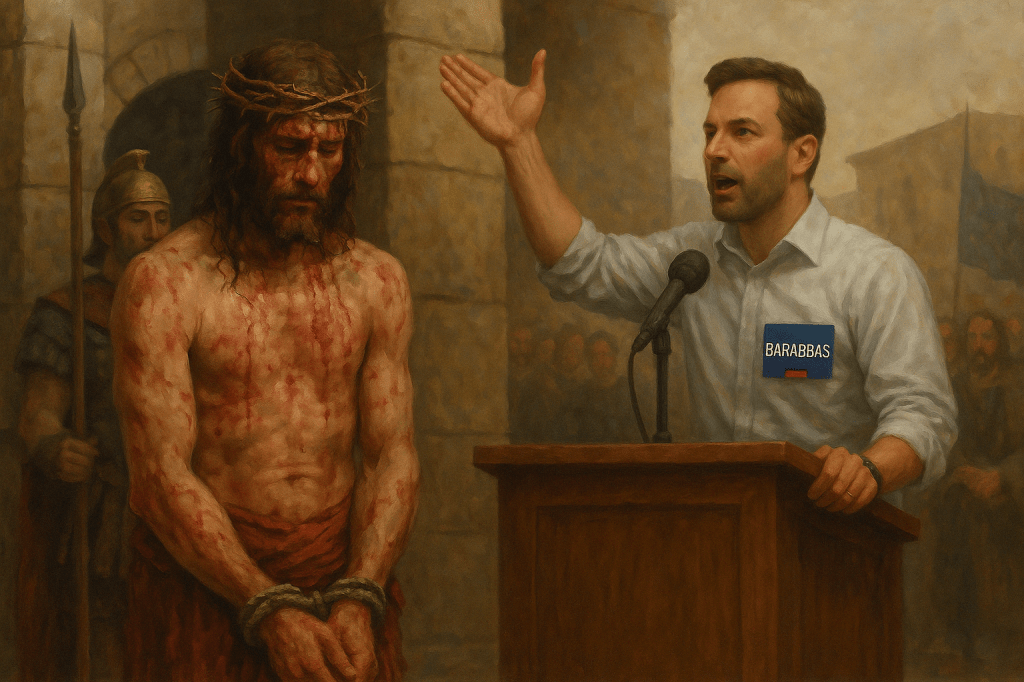
Pools of red He stood above dripping down hand-carved stairs of powers and principles
Trembling in physical weakness
Bold as Creation
Defiant against sin manifested through blind crowds
Flesh hung like fading scrolls half-washed in blood; our own.
Our own frailty
He looked like a slaughtered animal.
And we, barbaric beasts of the crowd,
Preferred the whole to the holy.
He was beaten.
Broken
Torn apart
Clinging onto God’s Promise
Crowned with hungry thorns carried by piercing slogans.
He was tortured.
Tortured.
Torture to witness.
We wouldn’t choose to be,
So we willfully despised Him.
My illusory hope of freedom came
Packaged like me,
With putrid, stale, familiar violence in its breath,
And hateful vengeance in its eyes.
Barabbas wore my tattered dreams better than Jesus did.
My politics yearned for actualisation.
We had made ourselves as of the “gods.”
Forged fire-baked idols in the image of lived fear.
Put imagined man before the Word made flesh.
Put “Americanised dream” before just confrontation.
Put tribe mentality before prevailing truth.
God won’t be mocked, neither will I.
And so I quieted the lonely voice in my wilderness that knew me.
I clapped to the rhythm of pulsing rage: “Crucify.”
Rather Him than me.
I have a family,
Goals,
Deadlines,
Applause to achieve,
Recognition to which I aspire.
A job.
A calendar of conquest,
A ladder to climb.
Am I one rung past grace?
If I resist, I’d sure be next.
A puppet of public scorn?
Beneath Rome’s harsh, deliberate whip?
My taxes bought that torture cane.
Excommunicated by “royal,” judgemental priests
Who hypocritically shouted, “Crucify!”
Shamed by those of my identity:
My sex,
My leaning,
My profession,
My crew,
These distressed mirrors I once trusted
Now cracked gavelled confession.
So I graciously blended;
I camouflaged into the convulsing crowds,
Into scattering dust sprayed up by dissonant heels,
Into neurological forgetting,
A self-inflicted amnesia.
My mercy ends at my doorstep.
At my convenience.
At my privilege.
At my word.
At my whim.
Does it?
I abandoned righteousness for immediate relief.
Pointedly, blamed the Lamb,
Because someone had to bleed.
If leaders said it was He, then who am I to refuse?
I follow,
So they lead.
There was welcoming silence in His intentional stare.
No guiltless plea. No rage.
Only knowing.
And that silently crucified me.
I saw what He always knew He saw:
My own soul,
Tortured by culture’s shape-shifted identity,
Herd-think,
Politick,
Performance,
False gods dressed as modernity’s prophets,
Hollow comfort dressed as empty courage.
And yet…
I still chose Barabbas.
We chose insurrection’s Barabbas.
We still do…
Barabbas in our dreams.
Barabbas in our agenda.
Barabbas through avoidance.
Rather the wounds we know than His gaping Wound too great to bear.
So we hide another day,
Chasing another “Once I get, then…” Instagram dream.
Ignoring what is broken,
Because we know healing means we must change.
And the slain, bloody Lamb hanging like meat on Calvary’s cross quietly whispers with eternal consequence:
“Forgive them, Father,
For they know not what they do.”
And that, again, crucifies us, daily,
As the sun hid behind the mourning moon of traded glory,
Majestic for mediocre.
Still we choose Barabbas.
Will we ever learn?
Conclusion
But grace still speaks.
As Jesus prayed, “Father, forgive them, for they know not what they do.” Even in our blindness, mercy remains.
And now we must choose again.

Practical Application: Learning to Unchoose Barabbas
The Barabbas decision wasn’t just a moment in history, it’s a mirror. And if we’re honest, it’s a mirror that still reflects us. Every time we prioritise power over purity, comfort over conviction, or ideology over intimacy with Christ, we vote again. And we often choose Barabbas.
But what if we stopped?
What if instead of defaulting to the familiar, the loud, or the strong, we paused at the foot of the bloodied Lamb and listened to His silence?
What if we let His bruised body rebuke our obsession with winning, performing, and avoiding pain?
To unchoose Barabbas in your life means:
Choosing the narrow way when the broad road is more applauded. Choosing truth when narrative manipulation feels safer. Choosing repentance when self-preservation seduces. Choosing the Lamb when power would prefer a lion.
This isn’t a once-off act. It’s a daily reordering.
It means learning to see Christ in the tortured, not the triumphant. In the wounded Word, not the crowd’s logic. In the pierced hand, not the raised fist.
So ask yourself today:
Where in your life are you still choosing Barabbas?
And what would it look like to finally let Him go, and choose Jesus instead?

Prayer
Lord Jesus,
You stood silent when You could have spoken. You absorbed rejection when You could have retaliated. You wore a crown of thorns while Barabbas walked free. And that crowd… was me.
I confess that I have chosen safety over surrender, Popularity over obedience, And self-preservation over Your sacrifice. I confess that Barabbas still lives in my fears, my justifications, and my applause.
But today, I choose You.
Let my heart be pierced like Yours was. Let my need for You outweigh my desire to belong. Let the silence of Your love outshout the noise of my ambition. And let the Lamb who was slain be the King of my soul.
Forgive me, Lord, for I did not know what I was doing.
But now I do. And still You choose me. So now, I choose You.
In Your Holy Name King Jesus,
Amen.

References
1. Wright, N. T. The Day the Revolution Began. London: SPCK, 2016.
2. Keener, Craig S. The IVP Bible Background Commentary: New Testament. Downers Grove, IL: IVP Academic, 2014.
3. Eklund, Rebekah. “From ‘Hosanna’ to ‘Crucify!’: The Fickle Crowds in the Four Gospels.” Bulletin for Biblical Research 26.1 (2016): 21–42.
4. John 11:48 (ESV).
5. Ryan, Maurice. “Who Was Barabbas? Confronting an Obstacle for Christian–Jewish Relations.” Journal of Religious Education 71.1 (2023): 63–76.
6. Ehrman, Bart D. Jesus Before the Gospels. New York: HarperOne, 2016.
7. Matthew 27:18 (ESV).
8. Wong, Gayook. “Mob Mentality and the Psychology of Crowds.” Psychology Today, Jan 24, 2021.
9. Asch, Solomon E. “Opinions and Social Pressure.” Scientific American 193.5 (1955): 31–35.
10. Mark 15:11 (ESV).
11. Girard, René. The Scapegoat. Baltimore: Johns Hopkins University Press, 1986.
12. Festinger, Leon. A Theory of Cognitive Dissonance. Stanford, CA: Stanford University Press, 1957.
13. Milgram, Stanley. Obedience to Authority: An Experimental View. New York: Harper & Row, 1974.
14. Bandura, Albert. “Selective Moral Disengagement in the Exercise of Moral Agency.” Journal of Moral Education 31.2 (2002): 101–119.
15. McKnight, Scot. “The Trial of Jesus and the Psychology of Pilate.” Jesus Creed Blog, Patheos, 2020.
16. Leviticus 16:7–10 (ESV).
17. Waggoner, Myron. “Even Today, We’re Still Choosing Barabbas.” Times-Mail, April 4, 2021. https://www.tmnews.com/story/news/2021/04/04/commentary-even-today-were-still-choosing-barabbas/44030405/

 #Hayibo