

The Days I Swallowed Splinters
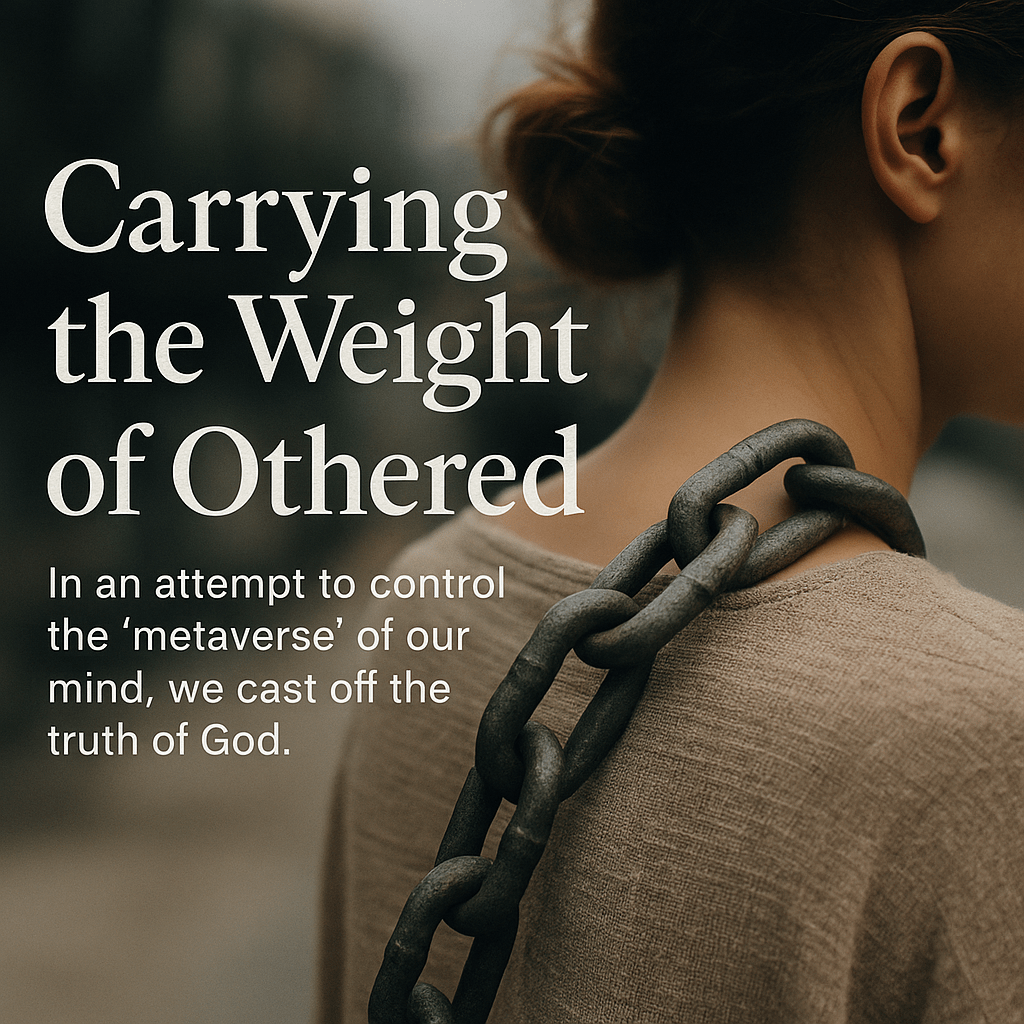
My entire life, I have been othered.
As a kid, I wasn’t the “boy” my father wanted. I couldn’t be the man my mother needed to protect her. At school, I was the fringe; bullied endlessly. In LGBTQ circles, I was good enough to party with, but never held closely for friendship. In rehab, I was the oddball gay boy. In some Christian spaces, a testimony. To other religions (including secular humanism), an enemy.
At work, I face daily sabotage. Some colleagues don’t speak to me at all. Some clients speak down, as if hairstylists are nothing more than brain-dead xenobots. Online, I’m called inspiring, or triggering.
But seldom am I called upon. Checked in on. Asked if I need anything.
Simply put: I live othered.
And yet… as my morning coffee with indulgent cream hits the right notes, the Holy Spirit gleams with joy. Again, Yahweh, my Lord, my God, my Soul’s Lover, has set me up magnificently.
“Living as Othered,” the Spirit whispers. I wipe the dust from my eyes. I know the next portion in John 8 will set a fuse in the rotting trenches of improvised belief calling itself faith.
And Jesus…
Jesus does not disappoint.

Scriptural Core (John 8:41b-43): The Sound of Being Misheard
Jesus says:
“If God were your Father, you would love Me, for I proceeded forth and came from God… Why do you not understand My speech? Because you are not able to listen to My word.” (John 8:42–43, ESV)
These leaders believed they knew God. Yet the Word standing in front of them, the Logos made flesh, was illegible to their hearts. They couldn’t hear Him. They couldn’t love Him. Prejudice muted perception.
As George Morrison observes:
“The impossibility was spiritual. Prejudices, jealousies, and antagonisms made the real Christ inaudible to them though His every syllable fell upon the ear.”¹
When bias hardens our inner ear, divine love becomes unintelligible.
Myth, Manipulation, and the Manufactured Mind
We do not live in a metaverse. We build one, from inherited pain, parental projections, religious expectations, digital echoes, and cultural scripting. It is not a virtual space of code, but a cognitive architecture of illusion. A personal empire of self-deception. And like all empires, it demands loyalty to lies.
We have deafened ourselves with myth.
A 2016 study by Microsoft and Science Publications identifies the mechanisms of such distortion. It reads:
“In modern times, information has a powerful (exploitative) nature, being used in the framework of opportunistic behaviour… designed to inspire (or deceive) people to encourage and guide their actions… Despite their concealment, knowledge of components of manipulative practices… helps to understand the situation and to block, at least partially, the impact of manipulation. The knowledge of manipulating information helps relieve the flair of wonderfulness, restoring the person to the fold of rational and real perception of the world.”²
Restoring the person to the fold of rational and real perception of the world.
This sounds almost eschatological.
This is precisely why the revelation of God in Scripture matters, and why identity cannot be abstracted from it. As Eighteen Takes on God notes, “It matters immensely whether God is the name of an abstract Ground of Being (Take 8), or the personal God who speaks, acts, and calls (Take 1).”³
The Bible does not offer us a proposition to contemplate. It offers us a Person to encounter. God names Himself not as an idea but as presence, Ehyeh asher ehyeh, “I AM who I AM.” He does not conform to our epistemic frameworks. He explodes them. The name is not static ontology, but covenantal movement. It is not simply that He exists. It is how He exists, rescuing, liberating, entering history, and redeeming it. As Stevenson reflects, “If God is impersonal, then worship becomes absurd. Only a personal God, one who speaks and listens, can relate to us, command us, love us.”⁴
In a world of curated illusions and mythologised identities, the God who says I AM breaks the spell of our cognitive dissonance.
The Healing God: Reconstructing the Self through Divine Encounter
To know God rightly is not merely to understand His nature, it is to be re-formed by it. Divine revelation throughout Scripture consistently reveals a God who heals by naming, restores by calling, and transforms by covenant. This is not a cold transaction of salvation, but a relational drama of reconstitution: identity remade through intimacy with the I AM.
Christopher J.H. Wright identifies this pattern in the Exodus narrative. Israel’s identity is not built on ethnicity or moral triumph, but on God’s saving actions: “The people of Israel are who they are because of what God has done for them , not because of what they have done or achieved for themselves.”⁶ This counters every empire of self-made identity. In God’s economy, our identity is not earned but received. It is a gift of grace, shaped by faithfulness, not fame.
Similarly, James K.A. Smith reminds us that liturgical habits and embodied practices shape our desires and, ultimately, our vision of who we are. “You are what you love,” he insists, “because you live toward what you want.”⁷ This is crucial. In a fractured culture obsessed with self-expression, God offers something better: restoration by reordering our loves. We are healed when our deepest desire becomes Him.
Leslie Stevenson adds a philosophical layer in Eighteen Takes on God, distinguishing between abstract deities of metaphysical speculation and the biblical God who reveals Himself in action. Take 11 of his work highlights how the biblical God “enters history, makes promises, acts in judgment and mercy, and calls us into relationship.”⁸ This kind of God does not stand at the edge of human pain with metaphysical aloofness; He stoops, speaks, and saves. He restores not through concept but through covenant.
This transformation is not merely moral but ontological, it reaches to the roots of who we are. John W. Cooper explores this in his discussion of psycho-physical unity, showing that the human being is not split into soul versus body, but is one whole creature meant for communion with God. “The hope of salvation is not the escape of the soul, but the resurrection of the whole person,” he writes.⁹ In other words, God does not patch us up spiritually while ignoring our history, culture, or trauma. He restores all of us.
Finally, consider Jesus’ encounter with the bleeding woman in Mark 5. She does not simply get healed. She is named: “Daughter, your faith has made you well.” Her body, dignity, and identity are all restored in one touch. This is what the living God does, He names the unnamed and invites them into wholeness. As Mercy Amba Oduyoye says, “Women experience God as empowering them with a spirituality of resistance to dehumanization.”¹⁰ God’s healing is not only personal; it is social, cultural, and subversive.
In a world that ‘others’ us, exploits us, or discards us, the God who says “I AM” responds: You are mine.
Conclusion
We do not see God rightly because we do not hear Him truly. And we do not hear Him truly because our ears have been tuned by trauma, culture, false doctrine, and desire. Like the religious leaders in John 8:43, we “are not able to listen to [His] word,” not because God is silent, but because our epistemology is engineered to resist His speech.
We have built metaverses of meaning, not in digital code, but in the tangled architecture of our neural memory, forged by lived experience. And like mirrors that reflect back only what we’ve already imagined, we project onto God an image made from pain, not truth.
Yet even in this distortion, Jesus comes speaking plainly: “I proceeded forth and came from God… He sent Me.” (John 8:42). He is not a myth, nor a metaphor, but the speech of God incarnate.
As Leslie Stevenson points out, it is only in Take 10 that we begin to glimpse a God who is not merely a force, or essence, but “a person who speaks, listens, relates,” one who is deeply concerned with our plight.¹¹ This God is not a projection of wishful thinking or a utilitarian moral force, but the personal I AM who meets us with both justice and mercy.
The Microsoft research into informational opportunism offers a striking contemporary warning: manipulated narratives, whether through media or memory, “penetrate… the consciousness of many people… designed to inspire (or deceive)… to encourage and guide their actions.”¹² Without vigilant discernment, we begin to act, think, and feel “in a certain specified way,” dictated by the myths we’ve absorbed.
To encounter the real God, then, is not just theological, it is disruptive. It shatters illusions and restores reality. Or as the researchers concluded: “The knowledge of manipulating information helps relieve the flair of wonderfulness, restoring the person to the fold of rational and real perception of the world.”¹³ Jesus relieves our illusions with truth, and that truth sets us free.
Practical Section: Living Known in a Manipulated World
Practice slow theology: Spend time meditating on the names and actions of God in Scripture (e.g. Exodus 3:14; Exodus 34:6–7; John 1:1–18).
Ask: What does this reveal about who God says He is?
Audit your projections: Where do your views of God come from? Cultural inheritance, trauma, church experience? Name the sources. Then hold them against the witness of Jesus.
Reclaim holy language: Speak the truth about God aloud. In a world of curated soundbites and identity slogans, declaring “The Lord is merciful and gracious, slow to anger and abounding in steadfast love” is countercultural resistance.
Live relationally: Remember, to be “known” by God is not just to be observed but embraced. Let this shape how you relate to others who’ve also been “othered,” they too carry the image of God.
Fast from false selves: Take a break from environments (digital or otherwise) that tempt you to curate yourself. Be seen by God as you are, not as the algorithm prefers.

Prayer
YHWH, I AM, Uncreated One,
I have named You wrongly.
I have looked at mirrors and seen monsters and thought they were You.
I have called You distant because I could not hear through the noise.
Yet You are not silent.
You have spoken in thunder, in breath, in Word made flesh.
Tear down the idols I’ve built with wounded hands.
Undo the false gods I’ve formed in pain.
Let me hear You again, not in the echo chamber of ego, but in the still small truth that remakes.
I am tired of being “othered.”
Come be Other with me.
Come be Present.
Come be Lord.
And let me, in being known, make You known.
In Your Holy Name Lord Jesus,
Amen.

References
1) George H. Morrison, The Gospel of St. John (New York: Revell, 1912), 146.
2) Irina G. Shendrik, “Modern Information and Opportunistic Behaviour,” American Journal of Applied Sciences 13, no. 9 (2016): 996–1005, https://thescipub.com/pdf/ajassp.2016.996.1005.pdf.
3) Leslie Stevenson, Eighteen Takes on God (Cambridge: Cambridge University Press, 2010), 2, 37.
5) Ibid., 47–49.
6) Christopher J.H. Wright, The Mission of God: Unlocking the Bible’s Grand Narrative (Downers Grove: IVP Academic, 2006), 269.
7) James K.A. Smith, Desiring the Kingdom: Worship, Worldview, and Cultural Formation (Grand Rapids: Baker Academic, 2009), 26.
8) Leslie Stevenson, Eighteen Takes on God (Oxford: Oxford University Press, 2010), 127.
9) John W. Cooper, Body, Soul, and Life Everlasting (Grand Rapids: Eerdmans, 2000), 153.
10) Mercy Amba Oduyoye, “The African Experience of God Through the Eyes of an Akan Woman,” The Way 37, no. 2 (1997): 202.
11) Leslie Stevenson, Eighteen Takes on God (Oxford: Oxford University Press, 2019), 156.
12) Irina G. Shendrik, “Opportunism in the Information Society,” American Journal of Applied Sciences 13, no. 9 (2016): 996, https://thescipub.com/pdf/ajassp.2016.996.1005.pdf.
13) Ibid., 1005.

 #Hayibo