
Introduction
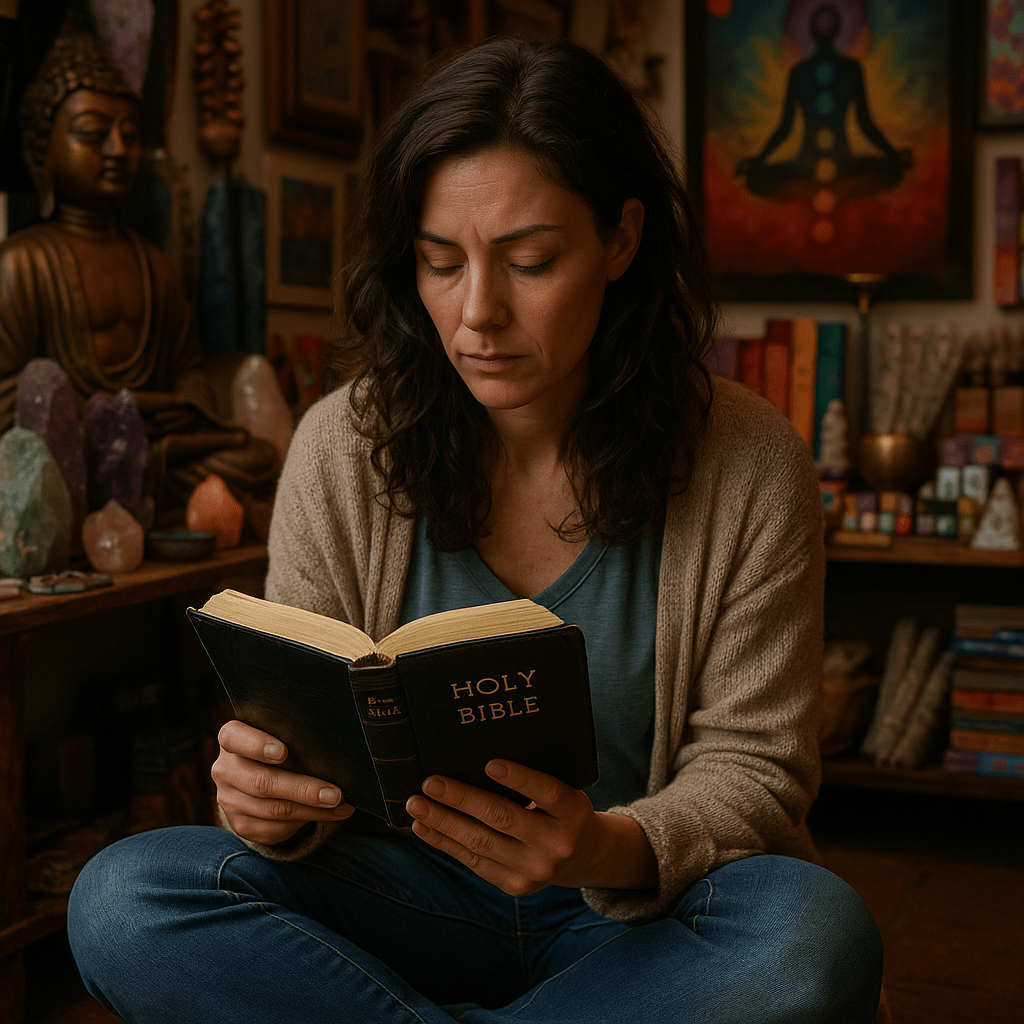
Reading Jesus’ words in John 10:8 surfaces a cascade of memories. “All who ever came before Me are thieves and robbers,” He declares, and I know, viscerally, what that means. I have spent thousands pursuing answers across countless forms of therapy, spiritual ideologies, and wellness trends. Most of it was fascinating. Some of it was well-packaged. Nearly all of it was empty.
What angers me most is not just the vacuity of those systems, but their theft, the time stolen, the hope manipulated, the psychological cost inflicted on those of us who were already vulnerable and searching. There is nothing benign about false spirituality. Behind the aesthetics of healing lies a brutal industry of deceit. And self-deifying idolatry.
And the cost? Let’s not even begin to tally it. Books, crystals, sage sticks, chakra tools, chant recordings, hemp cushions, coloured salt, CDs, podcasts, online courses, in-person retreats, donations to gurus, entrance fees to events, a liturgy of expenses chasing a gospel that does not save. All that money, all that energy, when every answer I needed was quietly waiting in the pages of the Holy Bible.
I tried to Jungianise myself into some mystical archetype. I analysed myself into paralysis. I emptied myself of everything except exhaustion. The self-help industry is not a neutral space. It is often a sanctified version of self-violence, cloaked in empowerment.
Then Jesus came…
Like the unfaithful woman in Hosea, I needed God to pursue me beyond my betrayals, and to heal me beyond the lies I had consumed. And He did. Relentlessly. Lovingly. Authentically. Jesus became the love of my life, and abundantly so. When He says He has come to give life, and life more abundantly, I no longer wonder what that means. I live in it.
I grieve for those still trapped in the marketplace of meaning, walking aisles of spiritual merchandise, never knowing that Truth has a name. He is the Door. He is the Shepherd. He is the Way.
Fortunately, many are seeing what I learned too. To quote: “
According to Barna’s latest data, 66 percent of all U.S. adults say they have made a personal commitment to Jesus that is still important in their life today. That marks a 12-percentage-point increase since 2021, when commitment levels reached their lowest in more than three decades of Barna tracking.
This shift is not only statistically significant—it may be the clearest indication of meaningful spiritual renewal in the United States.” – https://www.barna.com/research/belief-in-jesus-rises/

“All who ever came before Me are thieves and robbers… I am the door. If anyone enters by Me, he will be saved, and will go in and out and find pasture. The thief does not come except to steal, and to kill, and to destroy. I have come that they may have life, and that they may have it more abundantly.” — John 10:7–10
The Scandal of the Door
There are few statements more disruptive in the entire New Testament than Jesus’ words in John 10:8. To modern ears, they sound exclusivist, even offensive: “All who ever came before Me are thieves and robbers.” Yet, within the Johannine logic of incarnation, this is not a blanket condemnation of prophets or sages, it is a divine pronouncement against any system or leader claiming spiritual access apart from Christ.
Jesus does not describe Himself as a gatekeeper among many, but as the door, the only point of legitimate entry into life with God. This door is not metaphorical sentiment. It is the very person of Jesus, laid down like a shepherd across the sheepfold’s entrance, both boundary and welcome.
The Door and the Thieves
Jesus’ analogy draws from pastoral practice: the shepherd lying across the threshold to protect his sheep. In doing so, He asserts that all other claimants to divine mediation, however revered, ancient, or systematised, are ultimately false. “The thief does not come except to steal, and to kill, and to destroy” (v.10).
Raymond Brown affirms that “Jesus Himself is the eschatological door into God’s pasture… salvation is only through the person of the Logos.”¹ Similarly, Carson notes, “The ‘thieves’ were those who laid claim to spiritual authority without submitting to the revealed will of God.”²
The Johannine text does not allow for mild pluralism. There are only two categories: those who enter through Christ, and those who diminish, distract, or destroy.
Life-Diminishing Systems
False religions do not merely lack saving power, they diminish life. They offer moral frameworks without ontological renewal, ritual order without intimacy, and transcendence without reconciliation. They may foster social unity, but often by burdening the conscience or embedding injustice.
Vishal Mangalwadi, writing from post-colonial India, observes:
“Other religions can bind communities together, but they do so through fear, hierarchy, or fatalism, not freedom.”³
Alvin Plantinga argues that these systems, even when rational, suffer from the noetic effects of sin, they distort what they cannot fully perceive:
“What Christianity offers is not simply another story, but the truth which enables all stories to be interpreted rightly.”⁴
Their gods demand offerings but never give themselves. Their ethics demand perfection but offer no pardon. They take from humanity its deepest need: life in communion with the living God.
Grace, Not Law
Christianity’s claim is not that it is morally superior but that it is graciously sufficient. While other religions offer structure, Christianity offers a Saviour. Harold Netland summarises:
“Only in Christ is there both the diagnosis of sin and the deliverance from it.”⁵
Where other systems burden, Christ lifts. Where others require, Christ provides. In Him, law and love are reconciled, not by compromise but by substitution.
Union, Not Escape
Jesus does not promise escape from the world, but life within it, restored and reoriented. The abundant life He speaks of is not prosperity or perfection, but the overflow of divine vitality in the soul.
Hans Urs von Balthasar puts it beautifully:
“Life in Christ is not merely extended survival but transformed existence: shared communion with the Triune God.”⁶
This is abundance not by accumulation, but by proximity to the Shepherd.
The Pluralist Illusion
In the name of tolerance, modern pluralism proposes that all religions are equally valid paths to God. Yet this claim collapses under its own contradictions. As Netland notes:
“To affirm all religions equally is to reject them all in substance. For they disagree profoundly at the centre.”⁷
Moreover, pluralism imposes its own orthodoxy: no exclusive truth claims permitted. In this way, it subtly mirrors the systems it critiques, replacing dogma with relativism, but retaining the coercion.
Global Testimony
The singularity of Christ is not a Western imposition; it is a global confession. In African contexts, false religious systems have often reinforced fear and spiritual bondage. The gospel, by contrast, brings liberation.
“False systems in African traditional religions often breed fear, secrecy, and submission to illegitimate powers. The gospel liberates.”⁸
In feminist and womanist theology, the gospel also subverts structures of spiritual patriarchy. The relational ontology of the Trinity provides mutuality, not domination.
“The relational ontology of the Trinity stands over against patriarchal religious structures , offering mutuality, not hierarchy.”⁹
What Is Abundant Life?
Boice reminds us that the word perissos (abundant) does not mean extended ease, but divine surplus:
“Abundant life is not long life. It is full life—braver, freer, more God-shaped.”¹⁰
Jesus does not promise every hunger will disappear. He promises that in Him, we will never hunger alone.
Conclusion: The Door Remains Open
Jesus does not destroy false religion with force, but with Himself. He comes not as a warrior to shut doors, but as a Shepherd to become the door. He is at once the boundary and the welcome, the rebuke and the rescue.
He speaks not only against error, but for life.
And that door, today, remains open.

Practical Application
Examine Your Entry Point Ask yourself: Am I entering life through Christ Himself, or through the performance of religion? Jesus is not one spiritual option among many. He is the door, and there is no pasture apart from Him.
Discern the Voice of the Shepherd Learn to recognise truth not merely by tradition or title, but by fidelity to Jesus’ character, gospel, and Word. Not every religious voice leads to life. Some subtly steal, even while appearing sacred.
Speak Truth with Patience In a world saturated with relativism, do not shrink back from Christ’s exclusive claims, but proclaim them with humility, clarity, and compassion. The door is narrow, but it is open.
Celebrate the Global Gospel Honour the ways Christ liberates people from fear, legalism, and hierarchy across cultures. The gospel is not Western, it is universal, and its fruit can be seen where Christ truly reigns.
Pursue Abundant Life Daily Abundant life is not about achieving or accumulating. It is about abiding. Walk with Jesus, listen for His voice, and let your life become full by being rooted in Him.
The Danger Of Stockholm Syndrome Christianity: Ps Adi Olivier, Rivers Church Sandton- https://podcasts.apple.com/za/podcast/rivers-church-sandton/id1474938524?i=1000712266034, “As believers, it’s easy to fall into a ‘Stockholm Syndrome’ mindset where we start aligning more with the world than with God. In this message, Ps Adi unpacks the causes of this mindset in our lives and encourages us with powerful truths on how we can overcome it in our personal lives and our church.”

Prayer
Lord Jesus,
You are the door, not just a passage, but the presence. You alone bring us out of fear and into pasture.
We confess how often we have trusted in systems, traditions, and voices that could not give life.
Forgive us for following thieves, and for being ones, when we misrepresent You. Teach us to live abundantly, not in the noise of performance, but in the quiet nearness of Your voice.
Help us welcome others not with suspicion, but with the same open grace You have shown us. Make our lives a testimony that the door still stands open, and that You are good.
In Your Holy Name Messiah King Jesus,
Amen.

References
1. Raymond E. Brown, The Gospel According to John (New York: Anchor Bible, 1970), 385.
2. D.A. Carson, The Gospel According to John (Leicester: IVP, 1991), 386.
3. Vishal Mangalwadi, The Book That Made Your World (Nashville: Thomas Nelson, 2011), 210.
4. Alvin Plantinga, Warranted Christian Belief (Oxford: Oxford University Press, 2000), 499.
5. Harold A. Netland, Are All Religions True? (Grand Rapids: Zondervan, 2021), 123.
6. Hans Urs von Balthasar, Theo-Drama, Vol. II (San Francisco: Ignatius Press, 1990), 144.
7. Netland, Are All Religions True?, 157.
8. G. Ogbonnaya, Practical Theology in Africa (Cambridge Scholars, 2015), 64.
9. Feminist and Womanist Essays in Reformed Theology (Louisville: Westminster John Knox, 2006), 122.
10. J.M. Boice, quoted in Enduring Word Study Guide on John 10.

 #Hayibo