

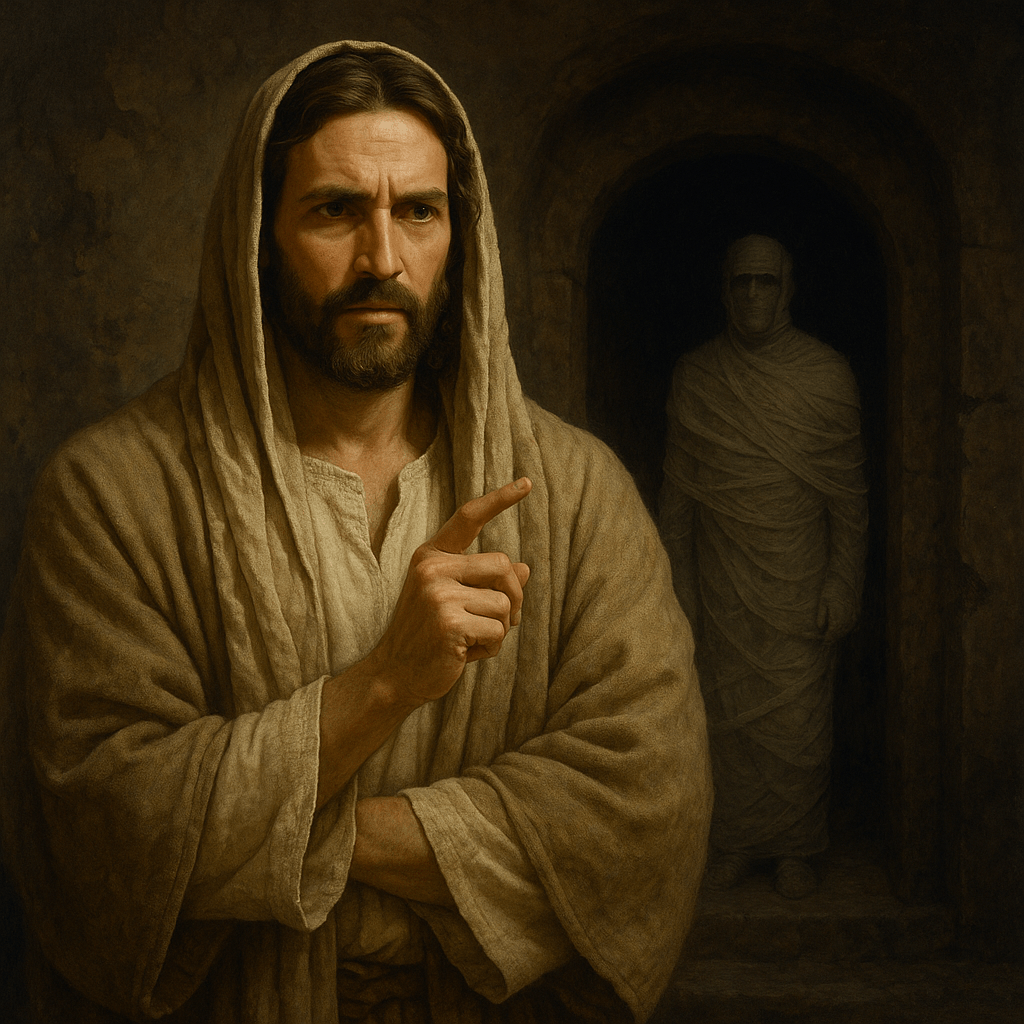
That line, John 11:15, from Jesus, hits like a maize meal sack to the head:
“I am glad for your sakes that I was not there, that you may believe.” (John 11:15)
This is not casual speech, it is divine strategy. Jesus reveals that if He had intervened immediately to prevent Lazarus’s death, the disciples’ belief (pistis, πίστις) would not have been deepened but diminished. In Johannine thought, belief is not a surface-level agreement with facts but a relational, transformative trust in the One sent from the Father (John 20:31).¹

Greek Word Study
The verb pisteuō (πιστεύω) here carries the sense of entrusting one’s whole self, not merely assenting intellectually.² This kind of belief often emerges only through confrontation with death, both literal and metaphorical.
The phrase “I am glad” translates the Greek chairō (χαίρω), which means to rejoice or exult. Jesus is not rejoicing in suffering itself, but in the redemptive faith that will emerge on the other side of it.
Johannine Theology: Life Out of Death
In John’s Gospel, life and death are not merely biological states but theological realities. Death becomes the arena where the glory of God is revealed (John 11:4). This aligns with earlier Johannine themes:
In John 9, the man born blind’s condition was “that the works of God might be displayed in him.” In John 12:24, the grain of wheat must die to produce much fruit.
In each case, Jesus delays or allows a condition to persist so that belief is not merely in miracles as spectacles, but in Him as the Resurrection and the Life (John 11:25–26). This is faith birthed not in avoidance of suffering but in resurrection through it.
Augustine: Faith Born in Mourning
Augustine, reflecting on Lazarus, wrote:
“Though he were dead in the flesh, yet shall he live in the spirit; and whosoever lives and believes in me shall never die.”³
For Augustine, this moment was a divine lesson, forming the disciples in patience and trust. Faith, in his view, is often sharpened not when God’s presence feels obvious, but when His seeming absence compels longing. The miracle then becomes a double gift: the restoration of life and the strengthening of belief.
Modern-Day Relevance
We live in an age allergic to waiting.
The cultural expectation is instant delivery, instant healing, instant resolution. Yet Jesus’ delay with Lazarus tells us that holy delays are often the incubators of durable faith.⁴
In the context of identity, this has piercing implications: sometimes God allows the “death” of false identities, ambitions, or relationships, not because He has abandoned us, but because only resurrection can reveal who we truly are in Him. Quick fixes often lead to shallow belief, while enduring through God’s timing forges unshakeable trust.
Conclusion
Jesus’ absence was not neglect; it was love with a longer horizon.
His joy was not in Lazarus’s death, but in the disciples’ coming belief, a belief rooted in resurrection reality, not in the comfort of uninterrupted life.
The same is true for us: every delay, every loss, is an opportunity to encounter Christ as the Resurrection and the Life.

Practical Application
Identify one area where you feel God has “delayed.” Ask: What kind of faith could be forged here that immediate relief could never produce?
Shift from asking “Why is God late?” to “What is God forming?”
Remember: Resurrection faith is not about controlling God’s timing but trusting His nature.

Prayer
Lord Jesus,
You are never late, though my heart often fears You are. Teach me to trust that Your timing is love, even when I do not understand it.
Let my faith be forged in the waiting, my hope anchored in Your promise, and my identity found in the One who calls the dead to life.
In Your Holy Name King Jesus,
Amen.

Footnotes:
- Walter Bauer, Frederick W. Danker, William F. Arndt, and F. Wilbur Gingrich, A Greek-English Lexicon of the New Testament and Other Early Christian Literature, 3rd ed. (Chicago: University of Chicago Press, 2000).
- Craig S. Keener, The Gospel of John: A Commentary, vol. 2 (Peabody, MA: Hendrickson, 2003).
- Augustine, Tractates on the Gospel of John, 49, in Nicene and Post-Nicene Fathers, First Series, vol. 7, ed. Philip Schaff (Buffalo, NY: Christian Literature Publishing Co., 1888).
- Andreas J. Köstenberger, John, Baker Exegetical Commentary on the New Testament (Grand Rapids, MI: Baker Academic, 2004).

 #Hayibo