

John 12:42–43 — Affirmation Addiction: They Loved the Praise of Men
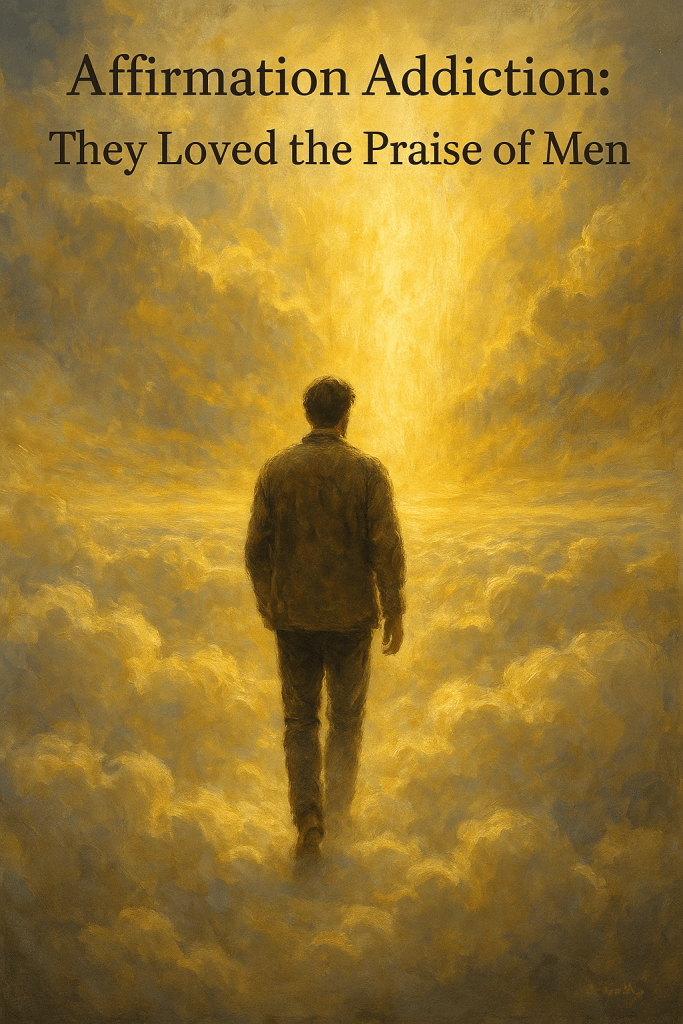
“Nevertheless, even among the rulers many believed in Him, but because of the Pharisees they did not confess Him, lest they should be put out of the synagogue; for they loved the praise of men more than the praise of God.”
— John 12:42–43 (ESV)

The Mirror of Scripture
John 12:42–43 arrests me.
I stare at the positional label, almost avoiding the verse itself. Perhaps because it cuts too close. Perhaps because I see yesterday-self within its reflection.
“They loved the praise of men more than the praise of God.”
Approval addiction and codependency scream off the page. Yet as I read, the Holy Spirit widens the lens beyond a Christian subculture critique. He asks: Why does anyone hold onto what they portray themselves to be?
Is it because it affords their bias a place to belong?
Here the text exposes an ailment older than modern psychology: the human compulsion to seek significance through applause. The Pharisees’ craving was not aesthetic; it was ontological. Their need for praise became a counterfeit glory system. The Greek word for praise (doxan) is the same root used for glory. John is therefore making a devastating claim: they exchanged the glory of God for the glory of self-reflection.
The Psychology of Needing Praise
Clinical psychology now names what Scripture discerned millennia ago.
Dr. J. D. Kelly describes approval addiction as a distortion of self-worth rooted in conditional acceptance:
“Approval addicts generally suffer from a lack of self-esteem. We often forfeit responsibility for our lives, defining our worth principally by what others think of us… raised by a critical parent or caretaker who extended conditional love and who validated or rewarded us based on particular behaviours.”¹
This addiction is not vanity, it is a survival strategy forged in emotional scarcity. Conditional love becomes the earliest catechism of the child; approval becomes the currency of safety.
Knapek and Kuritárné Szabó (2014) trace the phenomenon further, linking codependency to dysfunctions in empathy, attachment, and family systems:
“The individual variability of the predisposition to care, failure of prefrontal cortex to inhibit empathic responses, a multitude of aversive experiences in a dysfunctional family… and parentification… could play a role in the development of codependency.”²
The reward circuits of the brain learn that acceptance equals relief and rejection equals pain. The result? A lifetime of emotional bargaining, doing, performing, accommodating, just to stay loved.
The Epistemic Trap: When Praise Becomes a Prison
My own research into identity dysphoria confirms what these psychologists describe biologically: when affirmation becomes oxygen, truth suffocates. We begin choosing information, relationships, and even beliefs that reinforce the self we want others to see.
This is epistemic captivity, a prison of perception. As I once wrote:
“The information put into us as children creates in us perspectives, needs to be validated, and biases that make certain things more appealing than others. This appeal is either harnessed through rebellion against childhood influence, or it affirms childhood exposure. Either way, this does not equate to truth; rather it is the perception of truth based on internalised bias that seeks outward affirmation to feel real, relevant, and validated.”
In that sense, affirmation addiction is not just emotional; it’s hermeneutical. It shapes what we are willing to see as true. Those who “loved the praise of men” could not confess Christ, not because they lacked belief, but because belief threatened belonging. The brain’s reward system and the soul’s need for community colluded to silence truth.
The wisdom literature foresaw this:
“The fear of man brings a snare, but whoever trusts in the LORD is safe.”
— Proverbs 29:25 (ESV)
When identity depends on audience approval, every crowd becomes a courtroom. We curate, filter, and perform, forgetting that the only gaze that heals is divine, not social.
Theological Resolution: From Performance to Conferral
At its root, affirmation addiction is a disordered doxology. We were made to reflect glory, not to generate it. When the source of that glory shifts from God to human affirmation, the soul begins to orbit its own image.
Jesus reverses that gravitational field.
He does not perform for approval; He lives from conferral: “This is My beloved Son, with whom I am well pleased.” (Matt. 3:17). Every act of His ministry flows from that prior naming.
For us, redemption begins when we cease performing holiness and receive identity as gift. Conferral frees us from codependence, because it roots worth in relationship, not reputation. Galatians 1:10 becomes the litmus test of integrity:
“For am I now seeking the approval of man, or of God? Or am I trying to please man? If I were still trying to please man, I would not be a servant of Christ.”

Practical Application: The Reorientation of Belonging
Take a moment to examine the conversations that dominate your thoughts.
Whose opinion can ruin your peace?
Whose validation feels like oxygen?
Approval addiction is cured not by abstaining from affirmation, but by relocating its source. We were never meant to live unpraised; we were meant to live rightly praised, by the God who names us beloved.
The path of healing often involves silence, confession, and re-patterning. Replace the inner dialogue of comparison with thanksgiving. Replace “How am I seen?” with “Who sees me?” Replace scrolling for validation with Scripture for renewal.
Let the stillness teach you this: you are not what others see, nor what you fear; you are who God calls you.
“But you are a chosen race, a royal priesthood, a holy nation, a people for His own possession, that you may proclaim the excellencies of Him who called you out of darkness into His marvellous light.”
— 1 Peter 2:9 (ESV)

Prayer
Lord Jesus,
You who never sought the crowd’s approval yet gave Yourself for the crowd’s redemption, teach me to rest in Your gaze.
Strip away my need to perform, to impress, to please. Name me again from Your Word, not from my wounds.
Let Your “Well done” echo louder than the applause of men. May I live conferral, not construction; truth, not theatre; and love You more than I fear losing them.
In Your Holy, Stunnung, and Invincible Name Messiah King Jesus,
Amen.

References
1) J. D. Kelly, “Your Best Life: Overcoming Approval Addiction,” Clinical Orthopaedics and Related Research 478, no. 8 (2020): 1733–1734, https://pmc.ncbi.nlm.nih.gov/articles/PMC7371090/.
2) E. Knapek and I. Kuritárné Szabó, “A kodependencia fogalma, tünetei és a kialakulásában szerepet játszó tényezők [The concept, the symptoms and the etiological factors of codependency],” Psychiatria Hungarica 29, no. 1 (2014): 56–64, https://pubmed.ncbi.nlm.nih.gov/24670293/.

 #Hayibo