There is a truth so unmovable that our opinions judge us.
(John 12:44–50)

“And if anyone hears My words and does not believe, I do not judge him; for I did not come to judge the world but to save the world. He who rejects Me, and does not receive My words, has that which judges him— the word that I have spoken will judge him in the last day.” — John 12:47–48
The Mirror That Speaks Back
A bit of humour:
I used to think self-reflection was a virtue, until I realised I was only admiring the lighting.
I keep staring at those words in John 12:47-48.
They sting. They strip me of excuses.
Jesus doesn’t judge us, we judge ourselves.
But how?
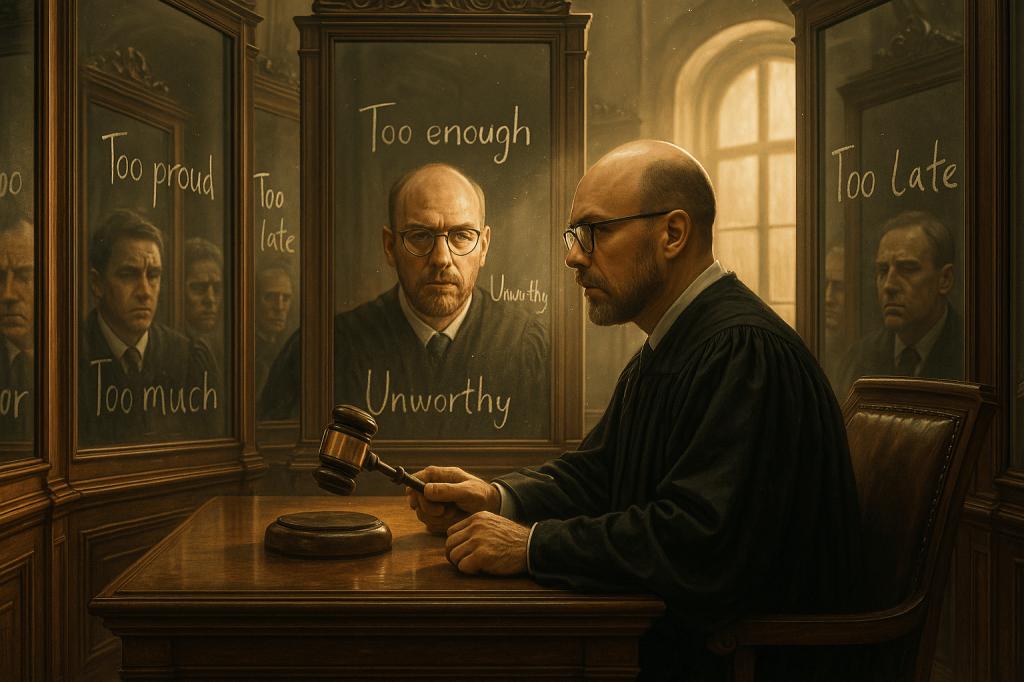
When I read these verses, I feel like I’m sitting under a mirror that speaks.
The truth doesn’t accuse, it simply is.
We are the ones who twist, deflect, and fracture under its weight.
Jesus’s words reveal something startling: judgment is not an act of divine vengeance, but the collision between reality and illusion. The Word He has spoken is reality. When we resist it, we invent smaller versions of truth that orbit our comfort zones, and in doing so, we create our own prisons.
Truth as the Wall We Beat Ourselves Against
Jesus’s statement is profoundly epistemic:
“The word that I have spoken will judge him.”
Truth is not malleable to our preferences; it stands like a wall we beat ourselves against until we either surrender to it or break upon it.
This is not cruelty, it is mercy refusing to lie.
We do not fall under judgment because Jesus condemns us, but because the truth He reveals refuses to conform to our self-deceptions.
The Logos, the divine Word, is both rescue and reckoning.
When light enters darkness, it does not apologise for existing. It simply reveals what is real.
The Johannine Paradox: The Word That Saves and Judges
John’s Gospel holds two seemingly opposing statements together:
“I did not come to judge the world but to save the world” (12:47), yet also, “For judgment I came into this world” (9:39).
This is no contradiction. The same light that saves exposes what resists salvation.
Judgment is the shadow cast by rejected grace.
The Greek term krínō (κρίνω) carries a forensic sense, to decide, to discern, to separate. Jesus’s words are not accusatory, but diagnostic. They distinguish between light and darkness, belief and unbelief.
When He says, “the word that I have spoken will judge him in the last day,” He is revealing that truth itself is the criterion of reality. To receive His word is to live in alignment with divine reality; to reject it is to misalign one’s being with the very structure of existence.
Ridderbos: The Authority That Offends
Herman Ridderbos, reflecting on this passage, captures it precisely:
“What offended ‘the Jews’ … was the absolute authority with which He proclaimed to them the Word of God as the only way to life. … When in reaction to their unbelief Jesus steps back in favor of His words and deeds, He does not thereby cancel Himself out to make the way of faith easier for them. He confronts them, rather, all the more forcefully with the truth of His words and of His whole mission as that of the light of the world.”¹
Jesus subordinates His person to His message, not to diminish His divinity but to disarm the accusation of ego. His authority is not self-serving, it is salvific.
Thus, the rejection of His word is not mere intellectual disagreement; it is the soul’s rebellion against the reality of God.
Ridderbos shows that the offense of Jesus lies not in His claim to divinity but in His demand for surrender. His Word unmasks self-rule as delusion.
Vitz: The Religion of Self
Paul C. Vitz calls this modern self-rule “selfism.” He writes that secular humanism “functions as a religion,” offering “a frame of orientation and an object of devotion.”²
Humanity has replaced worship with self-expression, and confession with self-affirmation. The cult of self-esteem, what you and I might call approval addiction, promises freedom but delivers bondage.
This is the very pathology John exposes in verse 43: “they loved the praise of men more than the praise of God.”
When we seek validation from others, we enthrone their opinions as our theology.
We forfeit transcendence for applause.
We reject the Word that saves, preferring the echo of our own construction.
Vitz helps us see that the “religion of self” is not simply pride, it is idolatry disguised as authenticity.
Ratzinger: When Truth Loses Its Voice
Joseph Ratzinger, speaking to the ethical crisis of our age, warned that the collapse of moral certainties is not solved by science or philosophy alone. He writes:
“A renewed ethical consciousness does not come about as the product of academic debates. … It is the responsibility of philosophy to shed a critical light on premature conclusions and apparent certainties about what man is, whence he comes, and what the goal of his existence is.”³
Ratzinger’s words echo Jesus’s claim: “I have not spoken on My own authority; but the Father who sent Me gave Me a command… and that command is eternal life.”
When truth is detached from divine origin, it loses both its moral gravity and its saving power. The result is what Ratzinger calls “the collapse of moral certainties,” a world adrift in opinions but devoid of truth’s anchor.
Jesus’s Word remains the one criterion that science, philosophy, and emotion cannot overrule: reality as spoken by God Himself.
The Verdict of Unbelief
So, why do we judge ourselves?
Because when we hear truth, we meet a mirror that cannot flatter us.
Jesus’s words expose not just our deeds, but the motives behind them, the secret negotiations we make to avoid transformation.
Ridderbos shows that unbelief resists divine authority.
Vitz exposes that we replace God’s praise with man’s applause.
Ratzinger warns that when truth is untethered from transcendence, it becomes mute.
Together they reveal that our rejection of truth is not an intellectual problem, it is an affectional one.
We love the wrong things.
And so, our judgment is simply the result of our loves being misaligned with reality.

Practical Reflection: Hearing the Word That Heals
Ask yourself:
Where have I softened the Word of God to stay accepted by others? Whose praise have I made necessary for peace? Where have I confused approval with love?
Practice:
Read John 12:44–50 aloud each morning this week. Each time you sense resistance to a truth, ask, “What am I protecting?” Write one area where obedience feels costly, and surrender it in prayer.

Prayer
Lord Jesus,
You came not to judge, but to save. Yet Your Word exposes what I hide and reveals what I fear. Help me to love Your truth more than human praise.
Let Your Word judge my illusions now, so that Your mercy may heal me before the last day.
Speak again, Logos of God, and make me whole.
In Your Majestically Holy Name King Jesus,
Amen.

Footnotes
1) Herman Ridderbos, The Gospel of John: A Theological Commentary (Grand Rapids: Eerdmans, 1997), 449–450.
2) Paul C. Vitz, Psychology as Religion: The Cult of Self-Worship, 2nd ed. (Grand Rapids: Eerdmans, 1994), 32.
3) Joseph Cardinal Ratzinger, Western Culture Today and Tomorrow: Addressing the Fundamental Issues, trans. Michael J. Miller (San Francisco: Ignatius Press, 2004), 51–52.

 #Hayibo