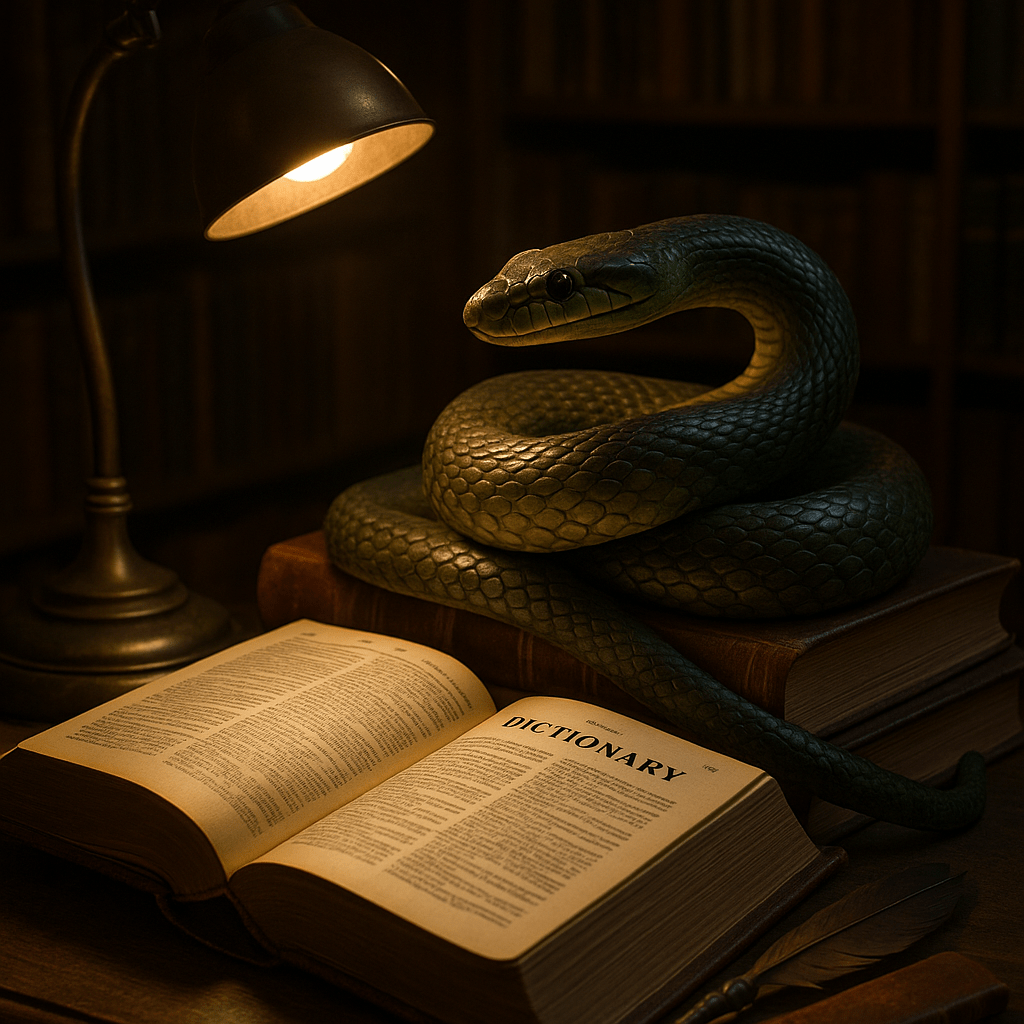
Naturalists say words evolved, but curiously, only the human ones know what they empirically mean.
It’s a strange confession, one that reveals how even unbelief must borrow belief’s grammar to speak. For the moment a man claims meaning, he invokes the immaterial. As G. K. Chesterton once said:
“When people stop believing in God, they don’t believe in nothing, they believe in anything.”¹
Atheism has always been an interesting project, not because of what it destroys, but because of what it must steal to survive. Its vocabulary betrays it. For even as the secular mind proclaims autonomy from divine origin, its speech remains parasitic upon the very metaphysical order it denies. It is a lexicon of borrowed light; radiant words without a sun.
The atheist, the materialist, the determinist, the naturalist, all may discard transcendence in theory, but their tongues never do. Their words remain haunted by the syntax of the soul.

1. Blessed
To say one is blessed implies an invisible benefactor. The term presupposes benevolence, intention, and purpose, a giving One, not a random sequence. Yet in naturalistic thought, there is no benefactor, only chemical coincidence. The universe cannot bless. It does not notice, cannot will, cannot smile. The atheist who says, “I’m blessed,” borrows theological capital without interest or repayment.
A secular blessing is a contradiction in terms, an emotional theft from a metaphysical economy that presupposes moral agency. A molecule cannot confer favour; yet every “thankful” tweet without God’s address whispers toward the heavens it denies.
2. Determinism
Ironically, determinism too reeks of divinity. The word itself requires an agent that determines. “To determine” is a verb of volition, it assumes consciousness. Yet the mechanistic cosmos of atheism offers no such thing. Causality, stripped of mind, is not determination; it is blind sequence.
The deterministic atheist thus commits linguistic fraud: importing purpose-language to describe purposeless process. The moment the word determinism is uttered, it already invokes the ghost of a Determiner.²
3. Choice
Choice is the sacred child of free will, and free will the mark of imago Dei. Without soul, “choice” is mere synaptic illusion; the deterministic brain firing in patterns preordained by matter.³
If naturalism were true, no one could choose atheism; one could only be compelled by biology to declare it. Yet, paradoxically, the atheist appeals to “choice” as proof of liberation. It is linguistic irony of the highest order, proclaiming freedom while chained to chemistry.
4. Governance
Governance implies moral hierarchy, justice, and order. These are categories alien to a godless cosmos. If the universe is indifferent, then all authority is illusion, the strong ruling the weak by force of neuron or narrative.
And yet every human society instinctively invokes governance as a moral necessity, not merely a pragmatic arrangement. The atheist legislator, like Pilate, washes his hands while still demanding order, invoking transcendence while pretending to drown it.
5. Normal
To say something is “normal” presupposes a norm, an ideal standard by which other states deviate. But who, in a godless universe, establishes the norm? Evolutionary advantage cannot serve as moral compass; cancer too is adaptive at the cellular level.
Normalcy requires teleology, the concept of what a thing ought to be.⁴ Remove the “ought,” and “normal” collapses into aesthetic preference. Yet every secular debate about “normal” sexuality, “normal” behaviour, “normal” politics, secretly imports divine law under new branding.
6. Rationality
Steven Pinker argues that rationality is the means by which humans use knowledge to achieve goals.⁵ But goals themselves are value-laden, to aim implies an “ought.” Rationality requires consciousness, and consciousness demands a non-material substrate capable of meaning. To reason is not merely to compute. It is to weigh truth, a metaphysical category that matter cannot conceive.
Thus, when the atheist praises rationality, he invokes a transcendent faculty his worldview cannot produce. The mind evaluating its own thought for validity already proves it is not mechanical. For machinery cannot doubt itself.
7. Education
Education means to draw out, from the Latin educare. It presupposes there is something within the human that can be awakened. But in a purely material world, there is nothing to draw out, only information to imprint.
True education belongs to souls, not circuits. It calls the eternal within the temporal to attention. Without transcendence, the teacher becomes a technician, the classroom a laboratory, and wisdom collapses into data.
8. Existence
To “exist” comes from ex-sistere, to stand forth, to emerge into being. Yet being cannot emerge from non-being. Matter, by definition, cannot explain its own is-ness. It simply is.
Every atheistic explanation of existence thus stumbles on the metaphysical threshold: to explain why there is something rather than nothing is to acknowledge causation beyond the closed system. Aquinas called this the actus essendi, the act of being conferred by the Necessary Being.⁶
To say “I exist” is to speak theology, whether one admits it or not.
9. Like
“Like” seems harmless, even trivial, but it carries a profound metaphysical implication: affection. Liking presupposes subjectivity, a consciousness capable of preference. Yet, if human emotion is nothing more than evolutionary chemistry, “like” loses meaning. Neurons do not like; they fire. Molecules do not cherish; they collide.
Every time the secular heart says “I like this,” it confesses the irreducibility of soul.
10. I
Perhaps the most theologically loaded word in human language. The self, the I, cannot be defined by physics. No equation captures personhood. To utter “I” is to invoke metaphysical existence, the awareness of awareness.
As Augustine wrote, “If I am deceived, I am.”⁷ Even error proves essence. Materialism cannot explain this “I,” this irreducible first-person vantage point that makes rationality possible. Naturalism thus borrows personhood as a linguistic loan from theism, unable to repay the debt.
11. Them
“Them” implies moral otherness. It assumes that others exist, that consciousness is plural, not merely simulation. But if the universe is a cosmic accident, there are no “others,” only organisms programmed to self-preserve.
Empathy, then, is impossible under pure materialism. To feel for another presupposes shared essence, that we are not merely cohabiting matter but kindred spirits. “Them” is a theological word disguised as grammar.
12. Self-Expression
The secular world prizes “self-expression,” the liberty to externalise inner identity. Yet this assumes two impossible things: first, that there is a self to express; second, that expression is meaningful beyond survival instinct.
In a godless cosmos, expression cannot mean; it can only occur. The atheist poet therefore lives as a metaphysical contradiction; using divine faculties to declare divine absence. The tragedy of secular art is not that it lacks beauty, but that it refuses to acknowledge the Source of beauty it mirrors.
13. Humour
Humour is one of humanity’s strangest proofs of transcendence. Laughter requires incongruity, irony, and self-awareness, all of which depend on perspective, not programming. Even our laughter at death betrays a hope that death is not final.
To laugh is to momentarily transcend the absurd. It is theology in disguise.
14. Beyond
The word “beyond” is fatal to atheism. It presupposes there is something more. The very human instinct to imagine transcendence testifies to its reality. As Lewis wrote, “If I find in myself a desire which no experience in this world can satisfy, the most probable explanation is that I was made for another world.”⁸
Every “beyond” is an echo of home.
15. Important
Importance implies hierarchy of value. To call something “important” is to measure it against an ultimate standard of significance. Yet without God, all measures dissolve. The death of one or the survival of billions is equally meaningless in an indifferent universe.
And yet, no one truly believes this. Even the atheist cries “this matters!” Thus, confessing with passion what their philosophy forbids.
16. Value
The second-last theft. Value presupposes a valuer. It requires a transcendent referent to ground moral worth.⁹ Under materialism, human life is but animated carbon. Yet every law, every humanitarian plea, every moral outrage betrays a sacred instinct: the imago Dei still whispering through the ruins.
Without God, we cannot speak of value, only of preference. And preference is not morality; it is taste dressed as truth.
17. Think
Why Naturalists Can’t Legitimately Use It
To think is to engage in intentionality, to aim the mind toward truth.But chemicals don’t “aim”; they react. Synapses don’t intend, they fire.
If every human thought is just a deterministic cascade of molecules, then “thinking” isn’t an act, it’s an event, no more deliberate than carbonation in a soda bottle.
Under naturalism, you don’t “think,” your neurons fizz that way. You don’t “change your mind,” your chemistry rearranges.
But the moment a naturalist argues, “I think naturalism is true,” he’s already betrayed his creed, because the I that thinks has just declared itself sovereign over chemistry.
To “think” requires freedom, the ability to weigh, to reason, to discern.And freedom is the ghost in the machine that materialism cannot exorcise.
As C.S. Lewis warned,
“If thought is the undesigned by-product of matter, we have no reason to suppose that any of our thoughts are true.”¹⁰
In short, to claim one thinks under naturalism is to perform an act of faith, faith in a freedom your own system forbids.
The Final Word: Logos
The atheist borrows words from the God he denies, because he cannot escape speaking in a universe spoken into being. The Logos is not merely the first word of creation; it is the structure of intelligibility itself. Every sentence is a confession.
To speak at all is to bear witness to the Word that was “in the beginning.” To reason is to echo Reason Himself. To love, to laugh, to choose, to value, these are not evolutionary accidents; they are signatures of divine authorship written into human syntax.
The tragedy of atheism is not silence; it is speech without source, words unmoored from the Voice that made them possible. But grace remains. For the same Word who spoke the cosmos into existence still whispers to the doubter, the sceptic, the poet, and the philosopher alike:
“In the beginning was the Word, and the Word was with God, and the Word was God.” — John 1:1


Footnotes
¹ Chesterton, Heretics (1905).
² Aquinas, Summa Theologica, I.2.3.
³ Reid, Essays on the Active Powers of the Human Mind, Essay IV.
⁴ Aristotle, Metaphysics, 1013b.
⁵ Steven Pinker, Rationality (2021).
⁶ Thomas Aquinas, De Ente et Essentia.
⁷ Augustine, City of God, XI.26.
⁸ C. S. Lewis, Mere Christianity, Book III.
⁹ Paul Vitz, Faith of the Fatherless (2013).
¹⁰ C. S. Lewis, Miracles: A Preliminary Study (New York: HarperOne, 2001).

 #Hayibo
Great content and good research. The greatest term atheists borrow is morality which they get from Judeo-Christian values. Without God there is no absolute morality or whats right.
Absolutely spot on. Thank you.