


The Day Forgiveness Manifested
After the war, Corrie ten Boom stood in a small church in Munich, telling of God’s forgiveness.
Then she saw him, the former SS guard from Ravensbrück, the man who had once forced her and her sister to strip naked before him.
He smiled, not recognising her, and when the talk ended, he approached.
“Fräulein,” he said, “how grateful I am for your message. To think that, as you say, He has washed my sins away!”
Then he extended his hand.
Corrie froze.
All the years of suffering and humiliation collided into that one trembling moment.
Forgiveness was easy to preach, impossible to perform.
And then she prayed silently: “Jesus, I cannot forgive him. Give me Your forgiveness.”
In that instant, warmth flooded her arm, then her heart. She took his hand.
“I forgive you, brother,” she said, “with all my heart.”
Later she wrote, “When He tells us to love our enemies, He gives, along with the command, the love itself.”
It was there, in a broken church in post-war Germany, that Christ manifested Himself, not to the world that demands power, but to the soul that surrenders.

The Crisis of a Radical Generation
A headline reads, “Gen Z’s are increasingly turning to radical ideologies.”
It is not entirely wrong.
Across continents, researchers warn of growing youth susceptibility to extremism.
The Institute for Strategic Dialogue calls it the:
“the extremist landscape has fragmented into an ideologically diverse array of groups, movements, subcultures and hateful belief systems all simultaneously playing off one another. Facilitating this fragmentation is the increasingly central role of digital communications in extremist strategies, with movements using a broad range of mainstream and fringe digital platforms to organize, communicate, and plan in a decentralized fashion.”¹
A 2025 Newsweek survey found that Gen Z respondents were several times more likely than Baby Boomers to justify political violence.²
And yet, this isn’t the story of a violent generation, it’s the story of a searching one.
1. The Identity Vacuum
Clyde A. Missier’s study Fundamentalism and the Search for Meaning in Digital Media among Gen Y and Gen Z (2022) describes a paradox: hyperconnectivity without coherence. Radical movements thrive where meaning collapses; ideology becomes identity. Missier writes:
“rather than recommending more online counterpropaganda dampening violent extremism targeting communities, this article builds on the view that an integrated approach on digital citizenship, off-line interfaith communication, and religious face-to-face encounters with ‘the other’ to share sacred and secular values in the pedagogical environment will help understand the social reality of ‘the other’ and can offer effective insights to prevent home-grown extremism, social insularity and reduce in-group biases at an early age.”³
2. The Social Disconnection
Tumiran & Bahri (2025) observe that isolation often precedes conviction: young radicals find belonging before belief.⁴
Zych & Nasaescu (2022) confirm that ideological “inheritance” can run through families like trauma, not tradition.⁵
Radicalism begins, in truth, as homesickness, for community, for truth, for belonging.
3. The Algorithmic Echo
Stockhammer (2025) and Ware (2023) show how digital ecosystems weaponise outrage: algorithms reward fury, not reflection.⁶
Extremism becomes aesthetic; ideas traded like fashion.
Belief is no longer the pursuit of truth, but performance for applause.
4. The Spiritual Collapse
Sarnoto & Rahmawati (2024) state of radical ideologies “The analysis reveals the influential role of peer networks in amplifying vulnerability to radicalization, while also highlighting the nuanced dynamics of family influences and individual vulnerabilities. Psychological factors, such as identity crises and trauma, are identified as critical determinants of susceptibility to extremist narratives. Moreover, the proliferation of online radicalization emerges as a significant driver of radicalization processes.”⁷ This ontological void once filled by spirituality is now filled by pseudo-spiritualised radicalism.
When transcendence dies, ideology becomes its ghost, complete with prophets, liturgies, and apocalypse.
History proves that this cycle repeats: dislocation → disillusionment → ideology → collapse → rebirth.
Every century rehearses the same drama with new hashtags.
Each generation forgets transcendence and must rediscover it, or repeat history.
Every ideology that promises total belonging eventually breeds new loneliness.
Every generation that forgets heaven will seek it elsewhere.
The Manifestation That Chooses Love
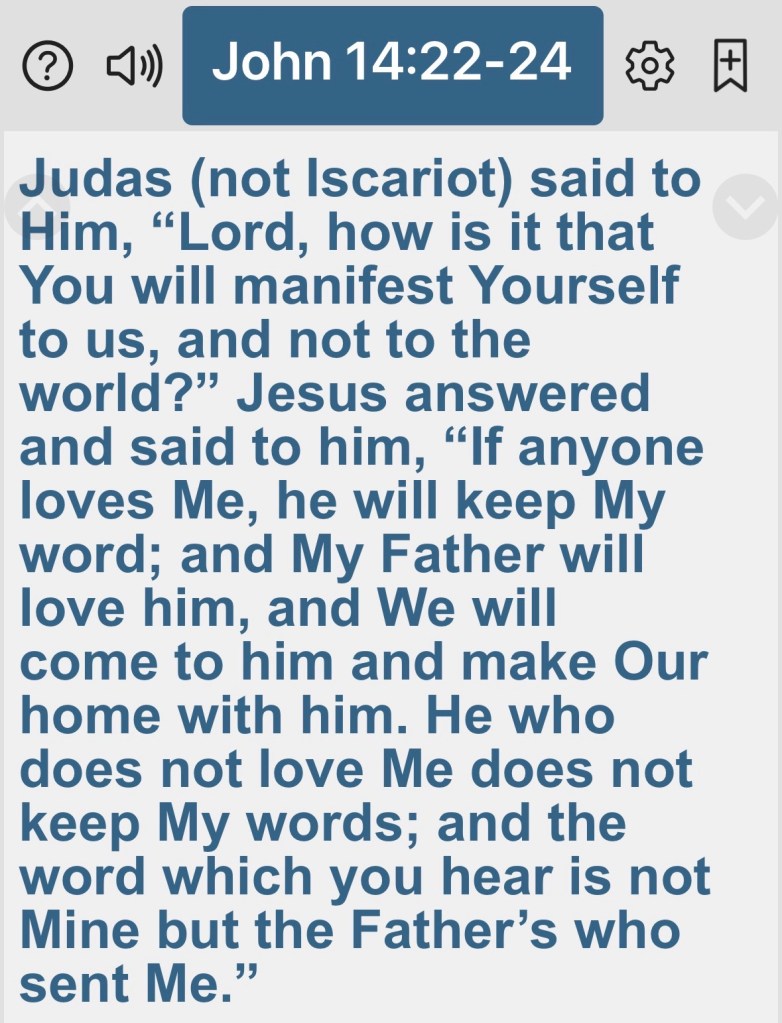
In John 14, Judas (not Iscariot) asks,
“Lord, how is it that You will manifest Yourself to us, and not to the world?” (v. 22)
Jesus answers:
“If anyone loves Me, he will keep My word, and My Father will love him, and We will come to him and make Our home with him.” (v. 23)
Judas wanted visibility; Jesus offered intimacy.
The world seeks manifestation through power; Christ reveals Himself through presence.
Radical ideologies promise revelation through conflict; Jesus manifests through communion.
The Four Counter-Realities
1. Identity Vacuum → Imago Dei Where ideology becomes identity, Scripture restores personhood. Jesus says, “We will come to him and make Our home with him” (John 14 : 23). The believer’s worth is no longer self-constructed but divinely inhabited; the Imago Dei reawakened.
2. Social Isolation → Body of Christ When radicalism fractures community into tribes, the gospel heals through communion. In Acts 2 : 42–47, the early believers “devoted themselves to fellowship;” not uniformity, but grace. The Body of Christ becomes the home that ideology only imitates.
3. Moral Confusion → Kingdom Ethics Ideological purity tests divide and devour; Christ’s Kingdom calls for mercy over might. In Matthew 5–7, the Beatitudes turn moral hierarchy into humility: blessed are the meek, the peacemakers, the merciful. True morality is born from relationship, not performance.
4. Loss of Transcendence → Indwelling Spirit Political religion seeks power; divine revelation gives presence. Jesus promises, “The Helper, the Holy Spirit, will teach you all things and bring to your remembrance all that I said to you” (John 14 : 26). What ideology mimics through fervour, the Spirit fulfils through habitation.
As Augustine wrote:
“God calls us, that we be not men. But then will it be for the better that we be not men, if first we recognise the fact that we are men, that is, to the end that we may rise to that height from humility; lest, when we think that we are something when we are nothing, we not only do not receive what we are not, but even lose what we are.”⁸
Divine manifestation is not spectacle but recognition; the heart attuned to presence.
Corrie ten Boom’s moment of forgiveness was such a manifestation: love doing what ideology could never do.
When she forgave, heaven entered history.
Seeing What the World Cannot See
Each generation stands between two visions of the radical.
One raises its fist; the other opens its hands.
If ideology is the world’s counterfeit for revelation, then revelation is heaven’s correction of ideology.
Christ does not radicalise, He re-roots.
He does not demand purity by violence but invites holiness through communion.
“‘Epistemologies have ethical implications,’ writes Professor Schwehn.
How do we help our students to understand that the Christian vision of life and the world is always both character-forming and culture-forming, that it is always concerned for both the personal and the political, both the individual and the institutional?”⁹
The manifestation of Christ is not merely what we see but how we are shaped by seeing.
For Gen Z, and for all of us, the real question is not whether we will be radical, but what kind of radical we will be: one that conquers, or one that forgives.

Practical Application: A Manifested Faith
Step out of the algorithm for one hour a day.
Read John 14 slowly, aloud.
Ask not, “What must I perform?” but “Where might Christ wish to manifest Himself today?”
Create one act of reconciliation, online or in person, where division has taken root.
Grace spreads quietly, but it changes everything it touches.

Prayer
Father God, Jesus, Holy Spirit,
Manifest Yourself again to a generation drowning in noise.
Let love replace outrage, belonging replace tribalism, and Your peace replace the performances of power.
Come to us and make Your home with us until the world sees, not our anger, but Your reflection.
In Your Holy Name Lord Jesus,
Amen.
TRACK TO ENJOY:

References
1. Institute for Strategic Dialogue, Young Guns: Understanding a New Generation of Extremist Radicalization in the U.S (2024): 4, https://www.isdglobal.org/wp-content/uploads/2023/08/Young-guns_Understandings-a-new-generation-of-extremist-radicalization-in-the-United-States.pdf.
2. Newsweek, “Gen Z Is Much More Supportive of Political Violence,” September, 24, 2025, https://www.newsweek.com/gen-z-is-much-more-supportive-of-political-violence-10474600
3. Clyde A. Missier, “Fundamentalism and the Search for Meaning in Digital Media among Gen Y and Gen Z” (Vrije Universiteit Amsterdam, 2022), https://orcid.org/0000-0001-5146-839X.
4. M. A. Tumiran and S. Bahri, “Negative Implications of Radical Thinking in Generation Z,” Qudus Journal of Social Sciences and Humanities (2025): 49-50, https://www.qjssh.com/index.php/qjssh/article/download/599/378/2664.
5. I. Zych and E. Nasaescu, “Is Radicalization a Family Issue?” Campbell Systematic Reviews 18, no. 3 (2022): 3, https://pmc.ncbi.nlm.nih.gov/articles/PMC9300959/pdf/CL2-18-e1266.pdf.
6. N. Stockhammer, “From TikTok to Terrorism?” CTC Sentinel (2025): 16-28, https://ctc.westpoint.edu/wp-content/uploads/2025/07/CTC-SENTINEL-072025.pdf.; J. Ware, “The Third Generation of Online Radicalization,” European Anti-Radicalization Network (2023):17-19, https://extremism.gwu.edu/sites/g/files/zaxdzs5746/files/2023-06/third-generation-final.pdf.
7. Sarnoto, A. Z., Hayatina, L., & Rahmawati, S. T., Ideological Radicalization Among Adolescents: Multidimensional Analysis and Prevention Strategies. Jurnal Ilmu Pendidikan Dan Humaniora, 13(3), (2024): 141–143, https://journals.ristek.or.id/index.php/jiph/article/view/93.
8. Augustine, Tractates on the Gospel of John 77. 4, pp. 2, https://www.unifr.ch/tmf/fr/assets/public/files/courses/comonjohn/augustine-john-ch-01-tracts-01-07.pdf.
9. Steven Garber, The Fabric of Faithfulness (Downers Grove, IL: InterVarsity Press, 1996), 171.

 #Hayibo