

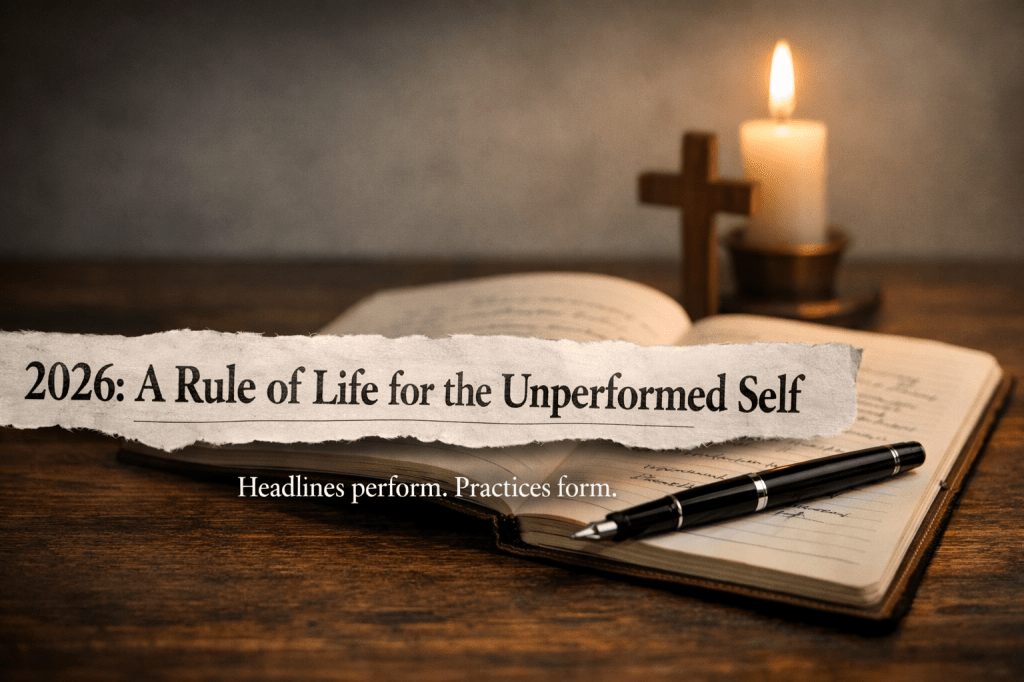
Introduction
We ended 2025 with a strange exhaustion: not only tired of bad news, but tired of ourselves, tired of managing impressions, curating narratives, defending our tribe, and trying to look coherent while quietly coming undone. If 2025 had a spiritual atmosphere, it was this: the mask became a survival strategy.
The irony is that masks often begin as protection and end as prisons. And the great danger of a headline-driven age is that we learn to live like headlines: sharp, fast, emotionally certain, yet thin, untested, and easily steered.

A Defence Minister Resigns Over a CV Lie, And Nobody Is Surprised
You would think the scandal is the point. It isn’t.
In late 2025, Romania’s defence minister resigned after admitting he had misrepresented his education in his résumé.¹ The immediate story is a personal failure. The deeper story is cultural: we have built systems where credential theatre is treated as normal. We are trained to “present” ourselves, professionally, socially, even morally, as if the self were a product and reputation were the proof of worth.
Sociologist Erving Goffman famously described ordinary life as a kind of social “presentation,” where people manage impressions in front-stage settings and reserve truth for back-stage spaces.² That insight is not cynical; it is diagnostic. It helps explain why public life increasingly feels like performance: not because everyone is wicked, but because the incentives reward polish over substance.
A Rule of Life for the unperformed self begins here: I refuse to let image become my identity.³
The ‘Honesty’ Scholar Is Fired for Research Misconduct: The Collapse of Credibility Theatre
Hypocrisy? Yes, but… the point is formation.
In May 2025, Harvard revoked tenure and dismissed a prominent researcher known for studying honesty and ethical behaviour, following findings of research misconduct.⁴ The shock value is obvious. But the deeper problem is larger than one person: modern institutions can become theatres of legitimacy, where the appearance of rigour becomes more important than the slow disciplines that sustain truth.
Philosopher Harry Frankfurt warned that modern public speech is not merely lying, but something worse, it is the indifference to whether what is said is communication aimed at effect, not reality.⁵ When “truth” becomes a tool for reputation, the self becomes trapped in maintaining a narrative. And narratives can be maintained long after reality has begun to revolt.
A Rule of Life begins with this honesty: I want truth more than I want to be seen as truthful.
Deepfakes Didn’t Just Trick Us, They Trained Us to Doubt Everything
The problem is technology, but also discipleship.
In 2025, reporting documented a sharp rise in fake political content, imposter ads, fake news pages, and deepfakes, capable of undermining both targeted leaders and the public’s trust in journalism itself.⁶ In another case, a UK MP reported an AI-generated deepfake video to police after it circulated online portraying him defecting to another party.⁷ Meanwhile, platforms began tightening policies: for example, Meta announced requirements for disclosure when political ads use AI-manipulated media ahead of Canada’s federal elections.⁸
The spiritual danger here is not merely deception; it is cynicism. When everything can be faked, people stop asking, “What is true?” and start asking, “What benefits my side?” That is how performative identity thrives: when truth is tiring, tribe becomes the shortcut.
This is why the unperformed self cannot survive on outrage and speed. It needs a disciplined way of knowing, slower than propaganda, stronger than vibe.
A Rule of Life begins with one decision: I will not outsource reality to the algorithm.
The Mask Isn’t Metaphor, It’s Literally in the Words
Word-nerdery? It’s actually diagnosis.
“Performance” did not originally mean acting. The older sense was closer to fulfilment, to carry into effect, to accomplish what is required.⁹ That is good and human: faithful execution, excellence, craft.
But our modern atmosphere bends “performance” toward persona-management: not doing the thing well, but looking like the kind of person who does. The word “pretend” comes from the sense of putting something forward as a front, as pretext.¹⁰ And “hypocrite” traces back to the world of acting, someone presenting a role.¹¹ Even “sincere” is best understood not as a cute “without wax” myth, but as pure, unmixed, unadulterated; a life without hidden filler.¹²
So the issue is not doing well. It is living as a mask.
A Rule of Life is not an attack on excellence. It is an attack on falsehood as habit.
Your ‘Truth’ Isn’t Truth Until It Survives Reality
If you only read headlines, you’ll think this is harsh. It’s actually mercy.
We live in an age that baptises the phrase “my truth.” Some people mean it innocently: “my experience.” But the phrase often smuggles in something more dangerous: immunity from correction.
A fact is not merely brute existence; it is existence that becomes intelligible, distinguishable, stable enough to talk about, and corrigible under evidence and reason.¹³ Reality is not only “out there”; it is also answerable, capable of correcting us without collapsing into mere subjectivity.
Charles S. Peirce insisted that inquiry is fallibilist: we learn by being corrected.¹⁴ That correction is not humiliation; it is the only path out of self-enclosure.
A Rule of Life for 2026 begins with a vow: I will become corrigible again.
Malcolm X Demanded Truth Beyond Tribe, But the Question Is: Who Can Hold It?
This is not merely politics. It’s actually worship.
Near the end of The Autobiography of Malcolm X, he writes: “I’m for truth, no matter who tells it. I’m for justice, no matter who it is for or against.”¹⁵ (He continues by grounding this stance in a shared humanity.)
That is moral clarity. It refuses tribal epistemology, the habit of accepting or rejecting claims based on who says them. And yet, history keeps showing us how difficult this is to sustain. Even the noblest human resolve can be swallowed by fear, rage, or the need to belong.
Alasdair MacIntyre argued that modern moral life fragments when it loses a shared telos, when virtues become slogans floating free of thick formation.¹⁶ The demand for truth beyond tribe is right, but it needs a ground deeper than human willpower.
This is where I confess something distinctly Christian: Christ fulfils what the quote reaches for. Jesus does not merely tell the truth; he is the Truth (John 14:6). And he does not merely applaud justice; he accomplishes it, naming sin without denial and offering mercy without pretending.¹⁷
Jesus Ends the Audition: Identity Is Received, Not Performed
Religious sentiment? It’s a new ontology of self.
The unperformed self is not achieved by refusing Instagram. It is received through reconciliation.
Christian theology insists that the deepest human problem is not ignorance but disordered love, wanting to be justified by performance, whether moral, social, ideological, or professional. Augustine knew the restless self that cannot settle because it cannot stop striving to secure itself.¹⁸
The gospel does something unbearable to the mask: it removes the need for it. Justification by grace means I no longer need to manufacture a self that deserves love.¹⁹ In Christ, the audition ends, not because standards disappear, but because identity is secured as gift.
This is why a Rule of Life matters: not as a ladder to earn worth, but as a trellis that protects the gift from being strangled by old habits.
A Rule of Life Is Not Legalism, It’s Anti-Performance Training
If you only read headlines, you’ll think this is a self-help social media advert. Instead, It’s spiritual resistance.
A Rule of Life is an intentionally chosen pattern of practices that trains desire toward God and neighbour. It is not a prison; it is a pathway. It is what you build when you stop trusting your impulses to carry you into holiness.
St Benedict’s Rule was never meant to create impressive people; it was meant to form stable ones, people grounded enough to be truthful.²⁰ And modern writers like Dallas Willard remind us that transformation is not achieved by “trying harder,” but by training, habits that reshape attention, affection, and action over time.²¹
A Rule of Life is how you live unperformed when everything around you rewards performance.

Seven Anchors for 2026: How to Live Unperformed
Another hack? These are practices, not hacks.
Here is a simple Rule of Life, small enough to do, strong enough to change you:
Daily silence (2–10 minutes). Let your nervous system meet God without commentary.
Scripture as mirror, not ammunition (one short passage). Read to be corrected, not to win.²²
Weekly confession (to God; and regularly to a trusted person). The unperformed self lives in the light.²³
Embodiment: sleep, food, movement as stewardship. The mask thrives in disembodiment; truth grows in groundedness.
Hidden service (one unseen act each week). Jesus explicitly trains secrecy as a cure for performative righteousness (Matthew 6).
Neighbour-love that crosses tribe-lines. Practice truth and justice without the dopamine of “us versus them.”
Sabbath (a protected day-part). Refuse productivity-as-worth. Receive being.²⁴
You don’t need to do these perfectly. You need to do them faithfully. The point is not an aesthetic life. The point is a true one.

Prayer: Make Me Real
Lord Jesus,
Truth in person, deliver me from the exhausting theatre of self. Where I have preferred appearance to integrity, correct me gently and firmly. Where I have confused my feelings with reality, make me corrigible again. Where I have used tribe to escape truth, teach me love without denial.
Give me a Rule of Life that protects what You have already given: a self received, not invented, whole, sincere, and unperformed.
In Jesus’ Holy name,
Amen.
TRACK TO ENJOY

Footnotes
1. Reuters, “Romanian defence minister resigns after admitting lying in education row,” Reuters, 28 November 2025.
2. Erving Goffman, The Presentation of Self in Everyday Life (Edinburgh: University of Edinburgh Social Sciences Research Centre, 1956).
3. Charles Taylor, A Secular Age (Cambridge, MA: Harvard University Press, 2007).
4. James Tapper, “Harvard professor fired following claims she falsified ethics research data,” The Guardian, 27 May 2025; see also Miles J. Herszenhorn, “Harvard Revokes Tenure From Francesca Gino,” The Harvard Crimson, 27 May 2025; “Harvard revokes tenure of ethics researcher accused of faking data,” Washington Post, 27 May 2025.
5. Harry G. Frankfurt, On Bullshit (Princeton, NJ: Princeton University Press, 2005).
6. Leyland Cecco, “Dramatic rise in fake political content on social media as Canada election looms,” The Guardian, 18 April 2025.
7. Peter Walker, “Tory MP reports ‘AI-generated deepfake’ video announcing his defection,” The Guardian, 18 October 2025.
8. Reuters, “Meta to seek disclosure on political ads that use AI ahead of Canada elections,” Reuters, 20 March 2025.
9. Douglas Harper, “perform,” Online Etymology Dictionary, accessed 29 December 2025.
10. “pretend,” Merriam-Webster Dictionary, accessed 29 December 2025.
11. Peter Sokolowski, “Discovering the Meaning and Origin of ‘Hypocrite’,” Merriam-Webster, accessed 29 December 2025.
12. Douglas Harper, “sincere,” Online Etymology Dictionary, accessed 29 December 2025.
13. Wilfrid Sellars, “Empiricism and the Philosophy of Mind,” in Science, Perception and Reality (London: Routledge & Kegan Paul, 1963).
14. Charles S. Peirce, “The Fixation of Belief,” Popular Science Monthly 12 (1877): 1–15.
15. Malcolm X and Alex Haley, The Autobiography of Malcolm X (New York: Grove Press, 1965). (Quotation also reproduced in a public-domain text scan.)
16. Alasdair MacIntyre, After Virtue: A Study in Moral Theory, 3rd ed. (Notre Dame, IN: University of Notre Dame Press, 2007).
17. Scripture references: John 14:6; Matthew 6; Romans 3:23–26. (Use your preferred translation consistently in final formatting.)
18. Augustine, Confessions, trans. Henry Chadwick (Oxford: Oxford University Press, 1991).
19. Martin Luther, “Preface to the Letter of St. Paul to the Romans” (1522), in Luther’s Works, ed. Jaroslav Pelikan and Helmut T. Lehmann (St. Louis: Concordia; Philadelphia: Fortress, 1955–86).
20. Benedict of Nursia, The Rule of St Benedict, trans. Timothy Fry (Collegeville, MN: Liturgical Press, 1981).
21. Dallas Willard, The Spirit of the Disciplines: Understanding How God Changes Lives (San Francisco: HarperOne, 1988).
22. James K. A. Smith, You Are What You Love: The Spiritual Power of Habit (Grand Rapids, MI: Brazos Press, 2016).
23. Dietrich Bonhoeffer, Life Together, trans. John W. Doberstein (New York: HarperOne, 1954).
24. Walter Brueggemann, Sabbath as Resistance: Saying No to the Culture of Now (Louisville, KY: Westminster John Knox Press, 2014).

 #Hayibo