


“Perfectionism is the voice of the oppressor… it will keep you cramped and insane your whole life” – Anne Lamott.

The Lie That Feels Like Love
We were promised fulfilment if we just worked harder, showed up stronger, smiled longer. Yet somehow, the more we performed, the less we belonged. Modernity has sold us a lie wrapped in affirmation; that excellence is proof of worth. We curate our days with the precision of algorithms, measure our impact by visibility, and call exhaustion “calling.” We are performing to stay human. But this isn’t ambition, it’s anxiety cloaked as productivity. The modern soul is no longer oppressed; it is overworked. It no longer cries out for liberation but for permission to stop pretending. Dani Rae Wascher articulates that:
“In recent years, the word “burnout” has become more prevalent within our society and vocabulary. People feel burned out from work, stress, and life. The World Health Organization (WHO) has characterised burnout as a syndrome resulting from chronic, unmanageable workplace stress. In 2019 the WHO also recognised burnout as an occupational phenomenon” – https://news.unm.edu/news/overwhelmed-at-work
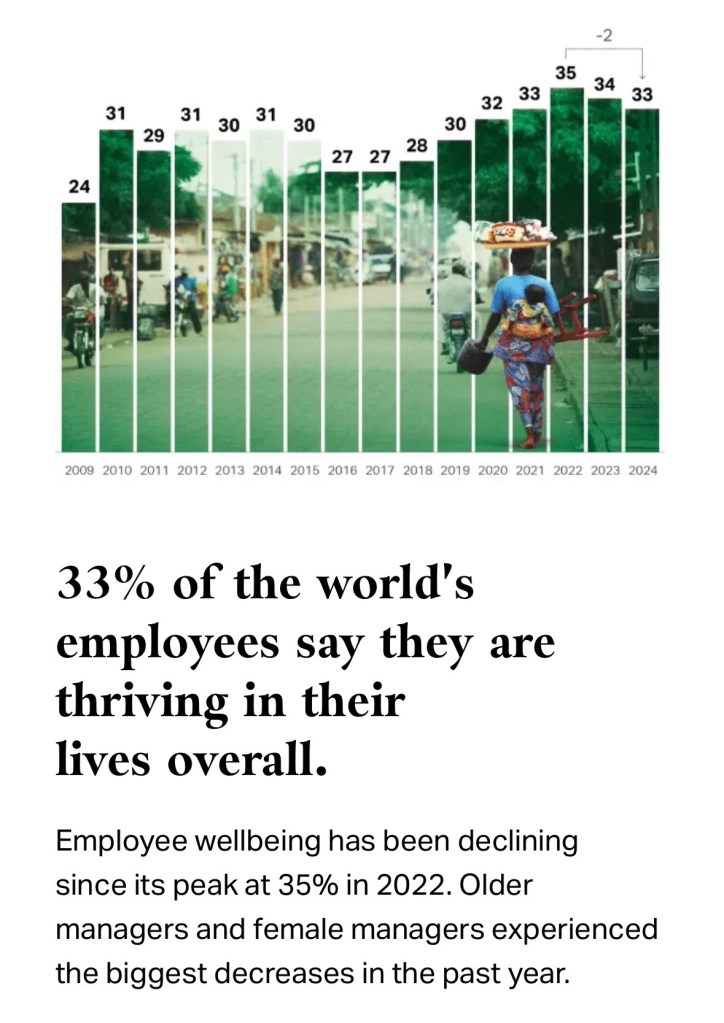
Performance has become the new piety, and success its liturgy.
Wascher, further writes that:
“The study also showed that when workers in the field experienced exhaustion, they seemed to self-isolate by not helping their coworkers. They indicated that they would be less likely to “try to help a coworker.” This research showcased that it was consistent with theory… This creates a domino effect in the workplace, leading to fewer employees receiving help and increasing the burden of feeling overwhelmed, exhausted and burned out. It fosters an environment where everyone is overwhelmed and working individually.”
The Cognitive Distortion of Modernity
Aaron T. Beck, in Cognitive Therapy and the Emotional Disorders, mapped what he called the cognitive triad, the self, the world, and the future, and how depression distorts them into hopeless loops: I am worthless, the world is hostile, the future is bleak. Beck writes:
“The relation between negative view of the future and suicidal wishes has been supported by a number of studies. The most crucial study attempted to determine what psychological factor contributed most strongly to the seriousness of a suicide attempt. We found that hopelessness was the best indicator of how serious the person was about terminating his life (Minkoff, Bergman, Beck, and Beck, 1973; Beck, Kovacs, and Weissman, 1975)… The patient’s sadness is an inevitable consequence of his sense of deprivation, pessimism, and self-criticism. Apathy results from giving up completely. His loss of spontaneity, his escapist and avoidance wishes, and his suicidal wishes similarly stem from the way he appraises his life. His hopelessness leads to loss of motivation…” – Cognitive Therapy.
But what Beck described in the clinic, modernity has perfected in culture. The logic of the market now applies to the mind. We live by a new, cruel gospel:
If I am productive, then I am worthy.
If I am seen, then I exist.
This isn’t mental illness; it’s mental architecture. Our self-talk has become society’s soundtrack. Beck wrote that distorted thinking breeds emotional disorder. We could, likewise, say that a distorted society breeds spiritual disorder. Our worth is constantly negotiated through visibility and valuation, leaving us cognitively starved for grace. Beck stated of phobias:
“The social phobias represent a caricature of the desirability our society places on being liked and admired and on the undesirability of being unpopular and despised. These social emphases may strait-jacket an individual into conformity with group norms” – Cognitive.
The world itself has become the abuser and the therapist; breaking us with expectations, then offering self-help as comfort. Eva Illouz concurs, arguing that:
“The therapeutic discourse has become a central cultural framework through which people understand their identity, emotions, and relationships, and by which institutions manage and regulate emotional life” – Illouz, Saving the Modern Soul.
The Death of Creativity & The Soul’s Quiet Suffocation
Brené Brown, The Gifts of Imperfection, writes that unused creativity doesn’t disappear; it suffocates. It lives within us until expressed, neglected to death, or suffocated by resentment and fear. Modernity has found a way to institutionalise that suffocation. We have professionalised our passions and monetised our imagination. “Content creation” has replaced creation. “Personal brand” has replaced identity.
Aaron Beck might call this schema reinforcement; when a false belief becomes self-perpetuating. If our worth depends on performance, then stillness feels like failure and creativity feels like indulgence. We are not creating meaning anymore; we are curating impressions. Erich Fromm once argued that modern life has replaced being with having. We no longer live artfully; we simply own artifacts. Meaning is now a brand value, not a birthright.
Unused creativity is the corpse of meaning.
The Self as Achievement: The Burnout of Becoming
Byung-Chul Han, in The Burnout Society, observed that the modern subject is both master and slave; the self exploits itself, convinced it is free. Therefore, freedom without grace becomes a whip we wield upon ourselves. We’ve replaced external oppression with internal expectation. Every achievement is immediately obsolete, every rest immediately guilt-ridden. Burnout is not a malfunction; it’s the logical outcome of a self that must perform to exist.
When you live as your own project, every moment becomes a KPI.
The paradox is cruel: the more we perform to be accepted, the further we drift from the one thing that can’t be performed, our need for true belonging. When our worth depends on our output, rest feels like guilt, and silence feels like failure.
The Theology of Being, When Doing Dies, God Begins
Genesis opens not with a command to perform, but with a rhythm of creation that ends in rest. Humanity’s first full day on earth began with Sabbath, not striving, but being.
Before humanity worked, it was already called “very good.”
The gospel of performance whispers, “Do, and you will become.” But the gospel of Christ proclaims, “You are, therefore create.” Dorothy Sayers wrote that work is meant to be “the expression of the maker’s joy in creation,” not the proof of their value. Jesus, the carpenter, washed feet rather than curate an image. His excellence was love expressed through humility, not self-protection through perfection.
We were not made to perform for God, but to create with Him. Grace dismantles the audition.
Hope as Cognitive Renewal
If Beck taught us that healing begins with challenging distorted thoughts, then theology teaches us that renewal begins with hope. Hope reorients the cognitive map of the soul. It transforms the distortion “If I fail, I am nothing” into the declaration “Even if I fall, I am loved.” Hope is not optimism, it’s defiance. It is the mind’s rebellion against despair, the heart’s argument with death. Beck saw hope as the foundation of recovery; Paul called it the anchor of the soul. Both knew that hopelessness is the root of human collapse.
Performance demands perfection. Hope just asks us to begin again.
Epilogue: Becoming Human Again
Brené Brown reminds us: “If we want to make meaning, we need to make art.” Meaning-making is not luxury; it’s survival. When we create, we reconnect with the image of the Creator. When we rest, we re-enter the rhythm of grace. Hope, then, is not naïveté, it’s spiritual sanity. It’s the only epistemology the devil cannot counterfeit. Because evil can mimic many things, religion, virtue, even light, but it will never understand resurrection.
Why?
Evil is birthed from createdness and imprisoned by it. Hope belongs to the eternal. The rest of us, well, we have a choice to make.
“The Cross ends performance because it begins resurrection.”

Practical Application: Becoming Human Again in a Performance World
The only way to unlearn performance is to practice presence. Not the curated kind, but the slow, awkward, honest presence that makes space for imperfection and awe. If modernity breaks us through performance, then healing must begin through participation, in life, in rest, in conversation.
So here are three small ways to begin:
1. Reclaim your rhythm. Take one task you do for approval and do it for joy instead. Let it be small, cooking, writing, cleaning, but let it be yours. Holiness often hides in the ordinary.
2. Interrupt your self-talk. When you catch yourself thinking, “I must earn this,” whisper back, “I already belong.” Cognitive renewal begins in spiritual resistance.
3. Create without currency. Make something that no one will see. Sing in the kitchen, write a letter you’ll never send, paint with your fingers. It’s not about output, it’s about oxygen.
Excellence isn’t the enemy; ego is.
The goal is not to abandon doing, but to let doing flow again from being, not from fear, but from love.
Hope is the discipline of living as if resurrection is already happening, even when the world demands a better performance.

Prayer
Father God,
Teach us again the difference between calling and performing. We have rehearsed our worth for too long; polishing our masks, fearing stillness, pretending peace.
Yet You never asked for our perfection, only our presence. So breathe into our tired rhythms. Remind us that Your glory does not depend on our grind, and that every undone thing can still be holy in Your hands.
Free us from the stage we built in Your name. Let hope, not hustle, be our offering. Let rest, not recognition, be our revolution. And when the curtain falls on all our pretending, may we finally remember that You loved us before we ever learned to perform.
In Jesus’ Mighty Name,
Amen.
TRACK TO ENJOY:

 #Hayibo