

Epilogue
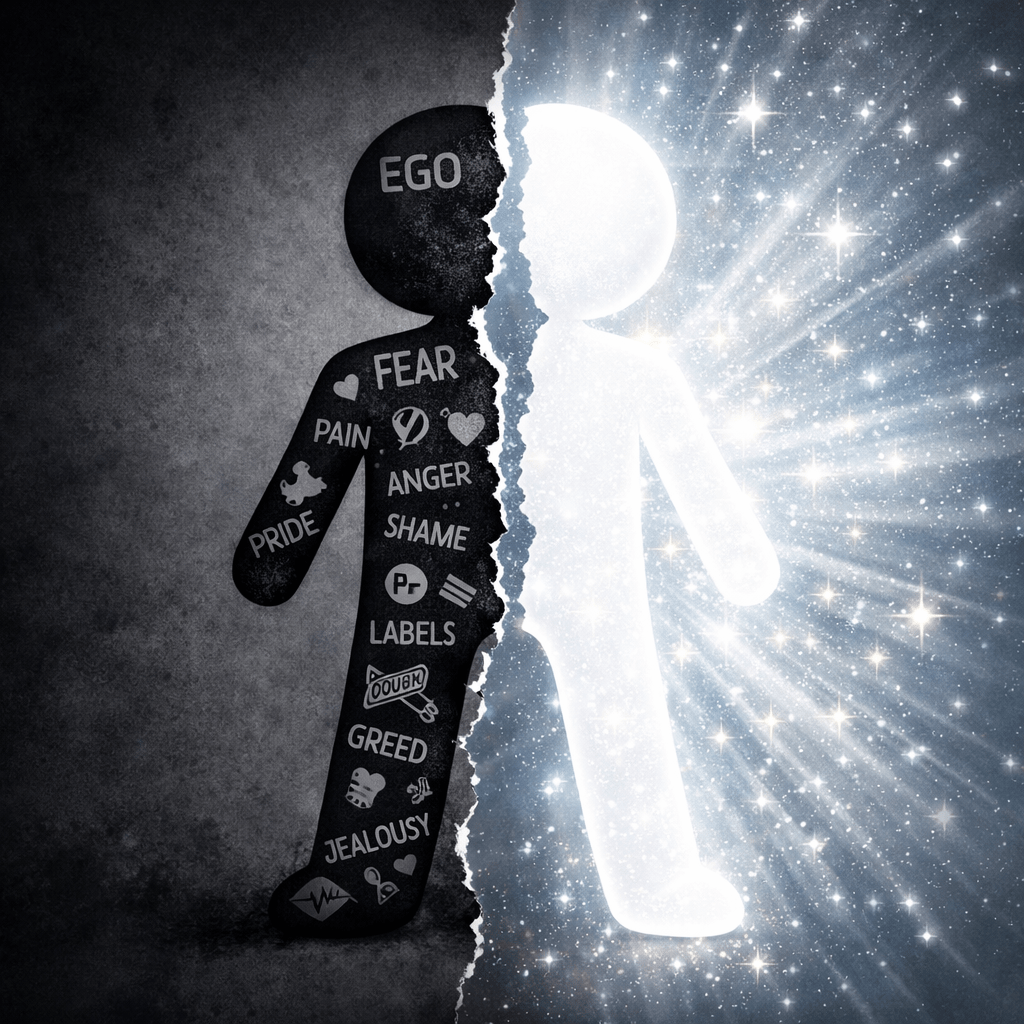
“We have the choice of two identities: the external mask which seems to be real…and the hidden, inner person who seems to us to be nothing, but who can give himself eternally to the truth in whom he subsists.” – Thomas Merton
Thomas Merton, a twentieth century Trappist monk, spiritual writer, and contemplative theologian, captures the tension we live with before we even realise it. He names the fracture between the external mask that appears substantial and the hidden person that feels insubstantial yet longs for truth.
Although Merton’s contemplative framework leans toward mysticism and at times seems to assume that the inner self is fundamentally intact beneath distortion, his insight still illuminates something profound. For the problem may not simply be that we hide our true selves, but that we have mistaken a constructed self for the real one altogether.
The divide he identifies is not healed by introspection alone. The Gospel presses further. It suggests that the mask must not merely be removed but crucified, and that what feels like “nothing” may in fact be the only self capable of being restored in truth. Merton helps us see the fracture. Christ reveals what must die and what, in Him, can live.
Foreword
A few years ago, I watched a child in a supermarket collapse in theatrical despair because her mother would not buy the cereal with the cartoon dragon on the box. She wept as though civilisation had ended. Five minutes later she was laughing in the car, entirely restored. The crisis had felt absolute. It was not. It was constructed in the moment, sustained by desire, and dissolved by reality.
We smile at children. We are less amused when adults do the same with identity.
The question is not whether we feel something deeply. The question is whether what we feel corresponds to what is real.
Introduction: The Self in the Immanent Frame
Modern Western thought has largely relocated the self into what Charles Taylor calls the immanent frame, a social imaginary in which meaning is generated from within the human horizon rather than received from beyond it.¹ In such a frame, identity is constructed through psychological integration, social affirmation, and narrative coherence. The self is understood as emergent, adaptive, and conditioned by prior influences, whether biological, cultural, or relational.
Cognitive science further complicates the matter by demonstrating that human perception is shaped by bias, predictive processing, and interpretive priors.² What we experience as authentic may in fact be conditioned expectation. The self becomes a negotiated centre of interpretation rather than an ontological given.
Some philosophical traditions go further. Derek Parfit famously argued that personal identity is not what matters, dissolving the substantial self into psychological continuity.³ Certain strands of Buddhist philosophy likewise treat the self as a convenient fiction, a bundle of aggregates without enduring essence.⁴ In both cases, the stable self evaporates under scrutiny.
The result is a cultural paradox. We speak endlessly of authenticity, yet we possess no agreed ontology of the self that could anchor it.
Section 1: Critique of No Self and Divine Self Narratives
The no self narrative claims liberation through dissolution. If the self is illusion, then suffering rooted in ego can be transcended by recognising its emptiness. There is a coherence to this vision. Yet it raises a severe difficulty. If there is no enduring self, who is liberated? Who persists? Who is morally accountable?
Conversely, a modern spiritual reaction has emerged which may be called the divine self narrative. Here the self is not dissolved but exalted. One discovers the divinity within. The authentic self becomes ultimate authority.⁵ This vision is attractive because it offers affirmation without surrender.
Both positions share an assumption. The self is either reducible to processes or self validating in its interiority. Neither position adequately accounts for the possibility that the self might be real yet derivative, valuable yet not self originating.
Christian theology has historically rejected both annihilation and self deification. Augustine insists that the human heart is restless until it rests in God, not because it is divine in itself, but because it is created for communion.⁶ The self is neither illusion nor sovereign. It is contingent.
Section 2: Luke 9:23 to 24 in Context
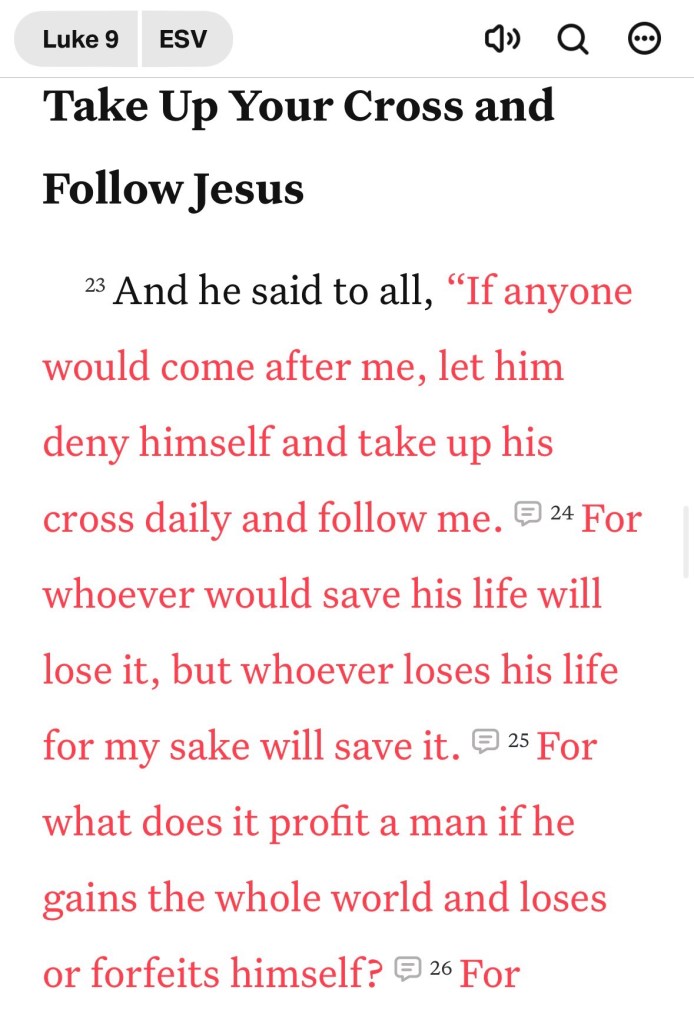
Into this philosophical tension steps Jesus of Nazareth. In Luke 9:23 to 24 he declares, “If anyone would come after me, let him deny himself and take up his cross daily and follow me. For whoever would save his life will lose it, but whoever loses his life for my sake will save it.”⁷
The Greek text is arresting. “Deny himself” translates ἀπαρνησάσθω ἑαυτόν, a reflexive denial, not of existence, but of allegiance.⁸ The command is not self destruction but self renunciation. It is covenantal language. To deny oneself is to refuse the claim of autonomous lordship.
“Take up his cross” would not have been metaphorical to its first hearers. Crucifixion was Rome’s public declaration of subjugation. To take up a cross was to walk toward execution.⁹ Jesus is not offering therapeutic improvement. He is announcing total reorientation.
The paradox intensifies in verse 24. “Whoever would save his life will lose it.” The word translated life is ψυχή, which can denote life, self, or soul.¹⁰ The one who clings to life as possession forfeits it. The one who yields it for Christ preserves it.
In the first century, this language was not abstract mysticism. It was political and existential. To follow Jesus was to risk exclusion, persecution, and death. The call was concrete.
Section 3: The Significance of “Forfeit Yourself”
Verse 25 sharpens the blade. “What does it profit a man if he gains the whole world and loses or forfeits himself?”¹¹ The Greek ἑαυτόν, himself, is unmistakable. There is a self to lose. There is a self to forfeit.
The verb ζημιωθῆναι carries legal and economic force. It denotes suffering loss, incurring damage, or being penalised.¹² Jesus frames the matter as catastrophic exchange. One may gain the world and yet incur the ultimate deficit.
This statement resists both reductionism and self deification. If the self were illusion, it could not be forfeited. If the self were sovereign, it could not be lost through misalignment with truth.
The terrifying implication is this. It is possible to construct a life that is socially affirmed, psychologically coherent, and materially successful, and yet to lose oneself.
External integration does not guarantee ontological preservation.
Section 4: Drawing the Threads Together
Secular accounts rightly observe that human identity is influenced, conditioned, and narratively shaped. Cognitive science humbles our confidence in introspection. Philosophy destabilises naïve notions of permanence. Yet none of these observations require the erasure of the self.
Luke 9 introduces a third way. The self is real. The self is precious. The self can be forfeited. But the self is not ultimate.
The deadly fake is this. To equate internal coherence with truth. To assume that because something feels integrated it is therefore authentic. To gain the world, including the applause of our age, and quietly lose the very centre of who we are.
Christian faith does not call for annihilation of self. It calls for surrender of false sovereignty so that the self may be secured in communion with Christ.
Conclusion
The child in the supermarket believed the dragon cereal was essential to her happiness. The crisis felt real. It was not ultimate.
We are more sophisticated. Our dragons are status, affirmation, ideological certainty, or spiritual autonomy. We clutch them fiercely.
Jesus asks a simpler and more devastating question. What is the worth of a world gained at the cost of yourself?
There is a self to lose.
There is a self to save.

Practical Application
Examine where you equate peace with truth. Internal calm is not always evidence of alignment with reality. Ask instead whether your life is ordered toward Christ, even when that ordering produces discomfort.
– Refuse both despairing self erasure and triumphant self deification.
– Practise daily denial in the sense Jesus commands.
– Relinquish the claim to autonomous authorship.
Take up your cross. Not dramatically. Daily.

Prayer
Father God,
Guard us from the deadly fake of mistaking coherence for truth. Reveal where we have gained approval, comfort, or control at the cost of ourselves. Give us courage to deny false sovereignty and to follow Your Son with integrity. Preserve our souls in Him, that we may not gain the world and lose ourselves.
In the magnificent Name of the Lord Jesus Christ,
Amen.
TRACK TO ENJOY:

Footnotes
1. Charles Taylor, A Secular Age (Cambridge, MA: Harvard University Press, 2007), 539 to 593.
2. Andy Clark, Surfing Uncertainty: Prediction, Action, and the Embodied Mind (Oxford: Oxford University Press, 2016), 1 to 25.
3. Derek Parfit, Reasons and Persons (Oxford: Oxford University Press, 1984), 210 to 214.
4. Jay L. Garfield, Engaging Buddhism: Why It Matters to Philosophy (Oxford: Oxford University Press, 2015), 45 to 62.
5. Alan Watts, The Book: On the Taboo Against Knowing Who You Are (New York: Vintage, 1989), 9 to 15.
6. Augustine, Confessions, trans. Henry Chadwick (Oxford: Oxford University Press, 1991), I.1.
7. Luke 9:23 to 24, English Standard Version.
8. Walter Bauer, Frederick Danker, William Arndt, and F. Wilbur Gingrich, A Greek English Lexicon of the New Testament and Other Early Christian Literature, 3rd ed. (Chicago: University of Chicago Press, 2000), 99.
9. Martin Hengel, Crucifixion (Philadelphia: Fortress Press, 1977), 22 to 32.
10. Bauer et al., Greek English Lexicon, 1098 to 1101.
11. Luke 9:25, English Standard Version.
12. Bauer et al., Greek English Lexicon, 427.

 #Hayibo