

Introduction
“By this my Father is glorified, that you bear much fruit and so prove to be my disciples.” John 15:8.
Fruit is one of the most overused metaphors in modern Christianity. We measure it in growth, influence, output, platforms, reach. Even when we speak spiritually, we often unconsciously import cultural definitions of success into divine language.
Yet Jesus roots fruit in something far deeper than productivity. He roots it in attachment.
Before we can understand fruit, we must understand the belief structure shaping how we define it.

What Is Global Belief?
Psychological research distinguishes between situational meaning and global meaning. Situational meaning refers to how we interpret specific events. Global meaning refers to the deeper system of fundamental beliefs through which we understand self, world, justice, control, and purpose.¹
Global beliefs are organising frameworks. They shape perception, identity, and behaviour. They are often implicit, socially reinforced, and rarely examined. They define what seems obvious, reasonable, and desirable.
When life proceeds smoothly, we hardly notice these frameworks. But when they are violated, destabilisation follows. Trauma researchers note that distress is often not caused by events alone, but by the disruption of global belief structures that previously gave coherence to experience.²
The process described by Park and Kennedy can be visualised as follows:
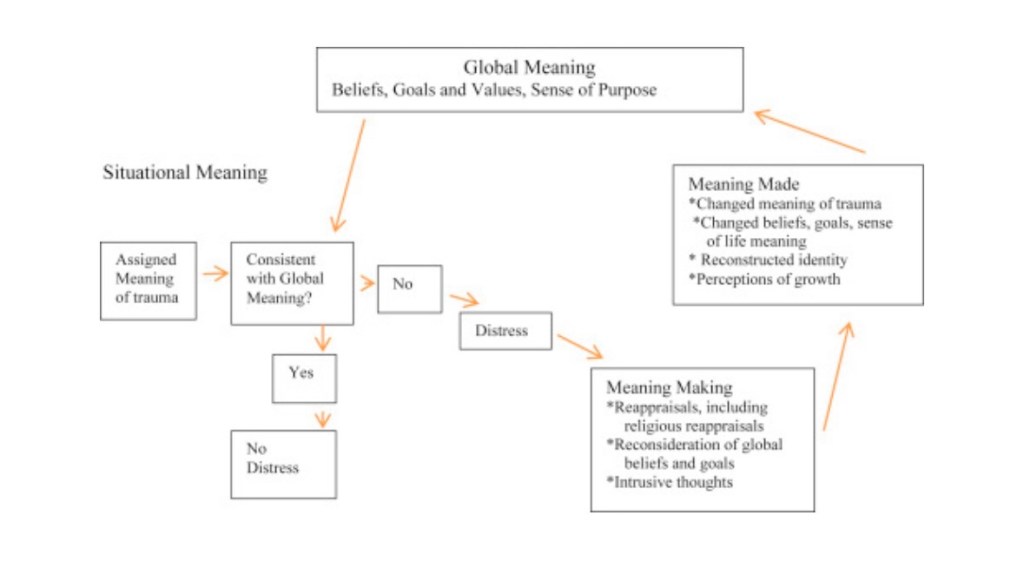
This model illustrates how global meaning functions as an organising framework. When an event or experience is inconsistent with one’s global belief system, distress follows. That distress initiates meaning-making, which may result in either assimilation or reconstruction of global belief. What is striking is that fruit-bearing in John 15 follows a similar pattern. Pruning violates inherited meaning structures. Abiding reconstructs them around a new source.
In other words, what we believe about reality determines what we recognise as fruit.
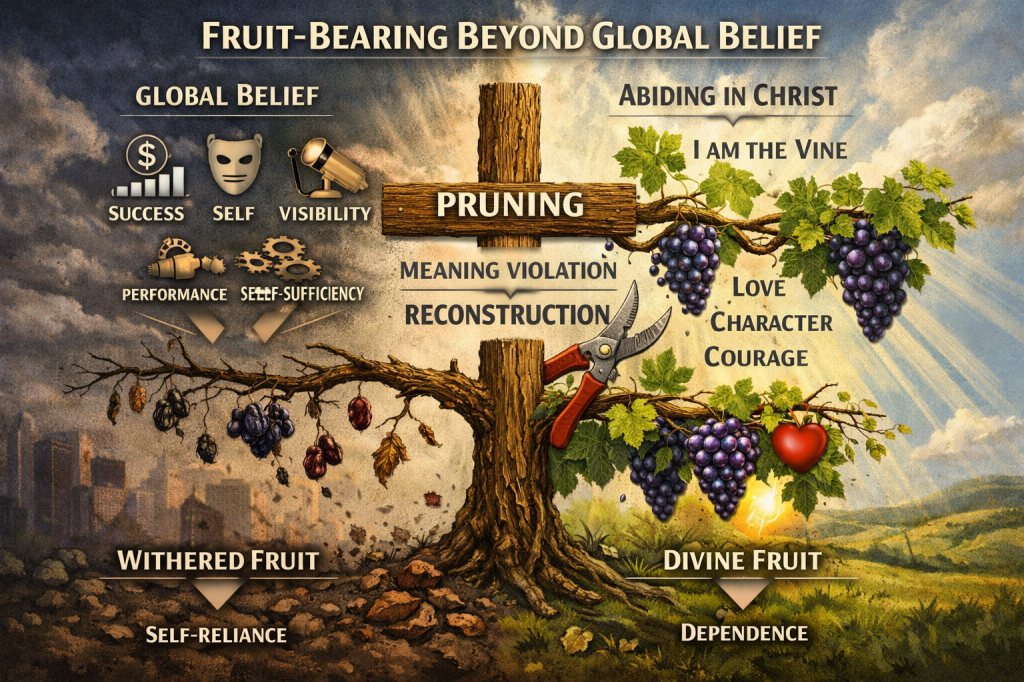
Our cultural global belief system assumes the self is self-originating, that meaning is self-generated, and that worth is demonstrated through visible success. Even spiritual language is easily absorbed into this frame. We speak of fruit, but we mean performance.
Jesus speaks of fruit, but He means participation.
Meaning Violation and Pruning
Park and Kennedy describe how global belief systems can be violated by disruptive events. When this happens, individuals attempt restoration either by assimilating the event into existing frameworks or by accommodating their global belief system itself.³
This distinction matters profoundly for John 15.
When Jesus says, “Apart from Me you can do nothing,” He does not offer advice for optimisation. He introduces a violation. He disrupts the self-originating model of fruitfulness. He challenges the belief that the branch produces life independently.
Pruning, therefore, is not merely behavioural correction. It is global belief reconstruction.
When God removes sources of identity we relied upon, we experience destabilisation. What we thought was fruit may be cut away. What we believed sustained us may be exposed as derivative. Pruning feels like loss because it violates the belief that fruit must be self-secured.
Yet pruning is not destruction. It is the removal of what cannot bear eternal weight.
What Is Fruit Through God’s Eyes?
In John 15, fruit glorifies the Father. It reveals resemblance.
Fruit is not influence. It is likeness.
It is character formed under pressure. Love sustained without applause. Courage exercised without consensus. Stability rooted not in comfort, but in attachment.
Global belief defines fruit externally. Divine reality defines fruit relationally.
A branch does not manufacture fruit. It remains connected. Life flows through it.
This reframes everything.
If fruit depends on abiding, then anxiety over visibility is misplaced. If fruit flows from union, then comparison loses its power. If fruit glorifies the Father, then self-promotion is irrelevant.
The question shifts from “How much have I produced?” to “To whom am I attached?”
Overcoming Global Belief
Overcoming global belief does not mean rejecting culture. It means recognising its assumptions.
We must notice where we equate fruit with visibility. Where we assume stability equals comfort. Where we measure obedience by affirmation.
Then we must allow those beliefs to be violated.
The Gospel does not simply console. It reorders. It dismantles self-originating frameworks and reconstructs identity around Christ as source.
This process often feels unstable. Unlearning rarely feels peaceful. Accommodation of a new global belief system requires surrender. But what is reconstructed is more durable than what was inherited.
The branch discovers that fruitfulness is not achieved by striving, but by remaining.
Conclusion
Fruit-bearing beyond global belief requires more than effort. It requires reconstruction.
The Father is glorified not by scale, but by resemblance. Not by noise, but by coherence rooted in Christ.
Global belief promises self-generated fruit. The vine offers something different: life that flows from beyond the self.
To abide is to consent to a new organising reality.
And from that reality, fruit comes.

Practical Application
This week, ask yourself:
What belief defines fruit for me?
If visibility were removed, would I still call this obedience?
Where is God pruning something I once relied upon for identity?
Read John 15 slowly. Notice what unsettles you. That discomfort may not be failure. It may be reconstruction.
Remain.

Prayer
Father,
Expose the global beliefs we have absorbed without noticing.
Show us where we have confused performance with fruit.
Prune what cannot endure.
Reconstruct our understanding of worth.
Root us in Christ as our only source.
May our lives glorify You through resemblance, not reputation.
Through abiding, not anxiety.
In Jesus’ name,
Amen.
TRACK TO ENJOY:

Footnotes
1. Crystal L. Park and Michael C. Kennedy, “Meaning Violation and Restoration Following Trauma,” in Reconstructing Meaning After Trauma (Elsevier, 2017), https://www.sciencedirect.com/topics/psychology/global-belief
2.Ibid.
3. Ibid.

 #Hayibo