

Why the Sermon on the Mount may be the most profound philosophy of the good life
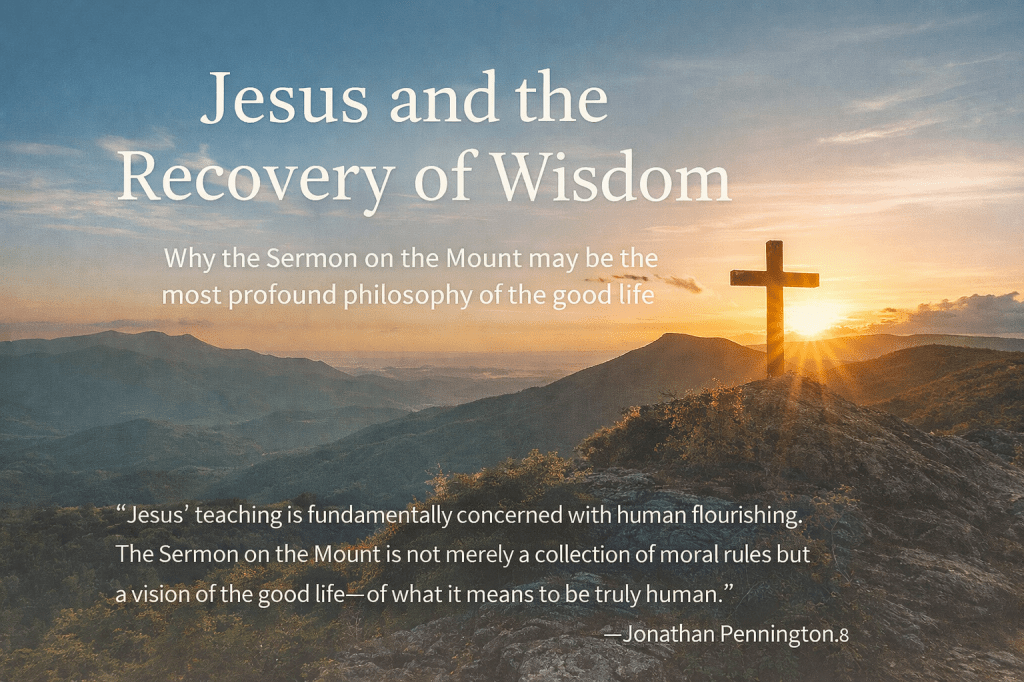

“Jesus’ teaching is fundamentally concerned with human flourishing. The Sermon on the Mount is not merely a collection of moral rules but a vision of the good life; of what it means to be truly human.”¹
Humanity has accumulated extraordinary knowledge. Never before have we possessed such technological capacity, scientific insight, and access to information. Yet for all this knowledge, the question that has haunted philosophers for centuries remains unresolved: what does it mean to live well?
The ancient Greeks wrestled deeply with this problem. Aristotle spoke of eudaimonia (human flourishing) as the ultimate aim of human life. Stoic philosophers sought tranquillity through disciplined reason and self-control. Modern ethical theories continue this search through elaborate systems of moral reasoning and debates about moral knowledge.²
Despite this immense intellectual effort, the question persists. Knowledge has multiplied, yet wisdom remains elusive.
It is precisely here that the biblical wisdom tradition speaks with surprising clarity:
“The fear of the LORD is the beginning of knowledge; fools despise wisdom and instruction.”³
To modern ears this claim may sound archaic. Yet when considered carefully, it offers a profound insight into the limitations of human understanding.
The Limits of Moral Knowledge
Contemporary philosophy frequently debates the nature of moral knowledge; whether moral truths exist and how human beings might know them. Some thinkers argue that moral beliefs are socially constructed, emerging from cultural narratives and historical circumstances. Others attempt to ground moral reasoning in rational principles or evolutionary psychology.⁴
Yet beneath these debates lies a deeper difficulty: human beings are not neutral observers of reality. Our judgments are shaped by experience, desire, and social influence. The very faculties we rely upon to interpret truth can themselves be distorted.
Scripture recognised this limitation long before modern epistemology.
The book of Ecclesiastes observes that the pursuit of knowledge alone does not produce wisdom:
“For in much wisdom is much grief, and he who increases knowledge increases sorrow.”⁵
The problem is not knowledge itself but the assumption that knowledge alone can guide human life.
The biblical tradition therefore begins wisdom with humility.
Wisdom in the Hebrew Tradition
Unlike many philosophical systems that begin with human reasoning, the Hebrew wisdom tradition begins with reverence.
“The fear of the LORD is the beginning of wisdom.”⁶
This phrase does not imply terror but recognition; the acknowledgement that reality is not self-constructed. Human beings do not stand at the centre of the moral universe; they inhabit a world created and sustained by God.
Wisdom therefore becomes less about intellectual achievement and more about alignment with reality.
The person who lives wisely is not merely informed but rightly oriented.
Jesus as a Philosopher of Wisdom
This perspective reaches its fullest expression in the teaching of Jesus, particularly in the Sermon on the Mount (Matthew 5–7).
At first glance the Sermon appears to be a collection of moral teachings. Yet many scholars now recognise that it functions as a form of wisdom discourse; a vision of what it means to live the good life.
Jonathan Pennington argues that Jesus should be understood as a profound moral philosopher whose teaching articulates a coherent account of human flourishing.¹ Rather than presenting isolated moral commands, Jesus offers a vision of life in which human character is transformed and aligned with the purposes of God.
The Beatitudes illustrate this vividly.
Where conventional wisdom associates happiness with power, security, and success, Jesus pronounces blessing upon the poor in spirit, the meek, and those who hunger for righteousness.
The values of the kingdom appear paradoxical precisely because they challenge our assumptions about what leads to fulfilment.
The Transformation of the Heart
One of the most striking features of the Sermon on the Mount is its emphasis on the inner life.
Anger is addressed as the root of violence. Lust is treated as the beginning of adultery. Love for enemies replaces the instinct for retaliation.
The focus repeatedly returns to the condition of the heart.
This reveals a profound insight about moral knowledge.
Human beings rarely fail because they lack information about what is right. More often they fail because their desires are disordered.
Knowledge alone cannot produce wisdom if the heart remains unchanged.
The wisdom Jesus offers therefore moves beyond intellectual understanding toward moral transformation.
As the letter of James later affirms:
“If any of you lacks wisdom, let him ask God, who gives generously to all without reproach.”⁸
Wisdom is not merely discovered through reasoning, it is received through relationship with God.
The Recovery of Wisdom
The modern world often assumes that the accumulation of information will eventually resolve humanity’s deepest problems. Yet the persistent crises of moral confusion, identity fragmentation, and cultural conflict suggest that knowledge alone is insufficient.
The biblical tradition proposes an alternative starting point.
Wisdom begins with humility, the recognition that human understanding is limited and that truth ultimately transcends us.
The “fear of the Lord” therefore represents a profound epistemic posture: the willingness to acknowledge that reality cannot be fully grasped from within the confines of the self.
In the teaching of Jesus, this wisdom finds its fullest expression.
The Sermon on the Mount is not merely religious instruction. It is a vision of life in which the human person becomes rightly ordered, mind, heart, and action aligned with the purposes of God.
A Closing Reflection
Perhaps the deepest irony of our age is that we live surrounded by knowledge yet starved of wisdom.
We know how to split the atom, map the genome, and transmit information across the planet in milliseconds.
Yet the ancient question remains.
What kind of person must we become in order to live well?
The wisdom tradition of Scripture answers that question not with a theory but with a posture:
humility before God,
openness to truth,
and a life transformed by wisdom.

Practical Application
If wisdom truly begins with humility before God, then several questions naturally arise:
Where am I seeking guidance for the interpretation of my life?
Do I pursue knowledge merely to accumulate information, or to cultivate wisdom?
Am I willing to recognise the limits of my own perspective?
Do I allow God’s wisdom to shape my desires, decisions, and relationships?
The pursuit of wisdom begins not with intellectual achievement but with a willingness to be formed.

Prayer
Lord,
You know the limits of our understanding.
You see the places where knowledge has not yet become wisdom.
Teach us humility before Your truth.
Give us hearts that seek wisdom more than information, and lives that reflect Your goodness.
May Your wisdom shape our thoughts, guide our decisions, and transform our character.
In Your Holy Name King Jesus,
Amen.
TRACK TO ENJOY

References
1. Jonathan T. Pennington, Jesus the Great Philosopher: Rediscovering the Wisdom Needed for the Good Life (Grand Rapids: Brazos Press, 2020).
2. Ethics: Contemporary Readings in Philosophy (Routledge).
3. Proverbs 1:7.
4. “Moral Knowledge,” SINMSA philosophical paper.
5.Ecclesiastes 1:18.
6. Psalm 111:10.
7.James 1:5.
8. Pennington, Jesus the Great Philosopher.

 #Hayibo