


“Abiding does not mean sitting idly by. It means resting in the work, resting in the moment, resting in the truth, resting in the confidence that God is your provision.” – Robin Bertram

Introduction
What does it mean to abide?
At face value, the word sounds simple. Soft. Almost poetic. But if we are honest, “abide” has become one of the most diluted and misunderstood words in modern Christianity. For some, it means showing up on a Sunday. For others, it means consuming Christian content. For others still, it becomes an over-spiritualised abstraction detached from real transformation.
Yet in John 15, Jesus does not present abiding as optional language. He presents it as the condition upon which everything else depends.
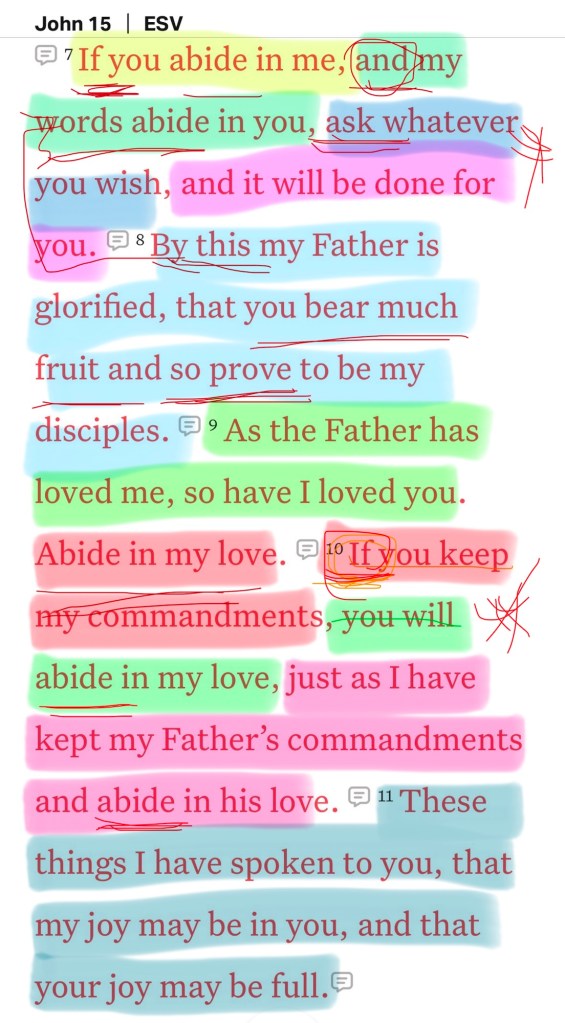
“If you abide in me, and my words abide in you… ask whatever you wish… it will be done… that my joy may be in you, and that your joy may be full.”
This is not suggestion.
This is structure.
And if we misunderstand abide, we misunderstand the entire passage.
Language Has Betrayed Us
One of the reasons for this confusion is something the philosopher Ludwig Wittgenstein observed with striking clarity:
“The meaning of a word is its use in the language.”¹
In other words, words do not carry fixed meaning. They are shaped by how they are used. This means something unsettling. If a culture uses the word “abide” loosely, superficially, or performatively, then the meaning itself begins to drift. We may be using the right word, while living the wrong reality.
This explains how someone can claim to “abide” while remaining unchanged. The problem is not always rebellion.
Sometimes, it is definition.
Abiding Is Not Information. It Is Participation.
If language exposes the problem, then epistemology clarifies the solution.
Philosopher Esther Lightcap Meek reframes knowing in a way that is profoundly aligned with Scripture:
“Knowing is covenantal… like a marriage… only then does reality unfold itself.”²
This insight dismantles a common modern assumption. We tend to think that knowing something means understanding it, analysing it, or storing information about it. But Meek argues that true knowing is relational, participatory, and covenantal.
You do not stand over reality as an observer. You enter into relationship with it.
Now read John 15 again.
“Abide in me… and my words abide in you.”
Jesus is not describing information transfer. He is describing mutual indwelling. Abiding is not: reading about Christ, agreeing with Christ, or admiring Christ. Abiding is remaining in Him allowing His words to reshape you participating in His life.
It is not intellectual proximity. It is relational union.
The Misguided Pursuit of Joy
But why does this matter so much?
Because we are all chasing something.
Happiness. Peace. Fulfilment. Joy. The problem is not that we desire these things. The problem is how we pursue them.
As Jonathan T. Pennington notes:
“The problem was not the desire for happiness but the means by which it is pursued.”³
This is where John 15 becomes confrontational. Jesus does not say:
“Pursue joy.”
He says:
“Abide.”
Joy is not the goal.
Joy is the outcome.
When we reverse this order, we create distorted lives; emotional chasing without transformation, spiritual language without substance, identity constructed without alignment. This is how we end up with people who speak of joy but live in fragmentation.
Abiding Is Entering a Different Reality
Theologian N. T. Wright helps us see the larger picture. Jesus did not come merely to give teachings. He came to inaugurate a new way of being human:
He was “celebrating with the new world… beginning to be born.”⁴
Abiding, then, is not passive spirituality. It is participation in that new world. It is stepping into a new order of reality, a new pattern of life, and a new alignment with truth.
This is why Jesus uses conditional language:
“If… abide…”
Because abiding is the entry point. And everything that follows is consequence: fruit, answered prayer, transformation, and joy.
So What Does Abiding Actually Look Like?
Let us remove the abstraction.
Before we define abiding practically, it is worth briefly asking what Jesus actually meant by the word. In Gospel of John 15, the Greek word translated “abide” is μένω (menō). It carries the sense of: to remain, to stay, to continue, and to dwell.
It is not a momentary action, but an ongoing state of relational persistence. This is not visiting. This is not occasional contact. This is remaining in place.
The Hebrew imagination behind this concept carries similar weight. Words such as יָשַׁב (yashav, to dwell, to sit, to remain) and דָּבַק (dabaq, to cling, to hold fast) convey not just proximity, but attachment and loyalty. The idea is not merely being near God, but being bound to Him in lived reality.
Taken together, the biblical concept of abiding is not abstract spirituality. It is relational permanence, sustained attachment, and lived continuity with God.
To abide, then, is to:
– Remain when you would rather withdraw,
– Submit when your instinct is to control,
– Obey when it costs you something,
– Return when you drift,
Let His words confront you, not just comfort you.
Abiding is not intensity. It is consistency. It is not emotional highs. It is relational faithfulness. It is choosing, again and again, to live within Christ’s reality rather than constructing your own.
Joyous Architecture
Now the structure becomes clear.
If you abide And His words abide in you, then your desires align, then your life bears fruit, and then your joy becomes full.
This is not mystical, it is architectural. Joy is not something you chase. It is something that emerges when your life is built correctly.
And perhaps the deepest misunderstanding is this: We still think knowing God is about information. But Scripture, and careful reflection on it, reveals something far richer. Meek articulates knowingness beautifully, stating:
“If truth is ultimately a person to be known, then it is reasonable to think that knowing truth should work like knowing a person. In fact, the way Scripture presents God and our knowing him is as a lover, a husband to his people, whom to know involves an interpersonal, unfolding, covenantal relationship. Knowing God is a relationship that deserves to be front and center in our lives for a number of obvious reasons. I suggest that this chapter shows that the covenant relationship should, additionally, be taken to be front and center in our understanding of knowing. The covenant mutuality of God and his people is paradigmatic for all human knowing. Knowing is like that: interpersonal, pledge-based, calling for respect and humility and patience.
If we understood this more fully, we would fulfill more appropriately the role that Scripture says is given to humans with respect to the world, a role aptly described as stewardship. If knowing is as I have described it here, then knowing just is the stewardship.”⁵

Practical Application
Audit your definition of abiding: Be honest. Is it behavioural? Informational? Occasional? Or relational and consistent?
Shift from consumption to participation: Reading Scripture is not the goal. Letting Scripture read you is.
Identify misaligned pursuits of joy: Where are you chasing outcomes instead of alignment?
Practice daily returning: Abiding is not perfection. It is returning, again and again, into Christ.
Let obedience become normal: Not dramatic. Not forced. Simply faithful.

Prayer
Lord Jesus,
We confess that we have often used Your words without entering their meaning. Teach us what it truly means to abide. Not in theory, but in reality.
Reshape our understanding where it has been distorted. Disrupt our comfort where it has replaced transformation.
Draw us into a deeper union with You. Where Your words do not sit beside us, but live within us.
Align our desires with Your truth. So that what we ask flows from who we are becoming in You.
And let Your joy, not the world’s imitation of it, be formed in us fully and faithfully.
In Your magnificent name: Messiah, King, Lord, God Jesus,
Amen.
TRACK TO ENJOY:

References
1. Ludwig Wittgenstein, Philosophical Investigations, trans. G. E. M. Anscombe (Oxford: Blackwell, 1953), §43.
2. Esther Lightcap Meek, Loving to Know: Covenant Epistemology (Eugene, OR: Cascade Books, 2011), 37-38.
3. Jonathan T. Pennington, Jesus the Great Philosopher (Grand Rapids, MI: Brazos Press, 2020), chap. “Humans, We Have a Problem.”
4. N. T. Wright, Simply Christian (New York: HarperOne, 2006), 11-12.
5. Esther Lightcap Meek, Longing to Know: The Philosophy of Knowledge for Ordinary People (Grand Rapids, MI: Brazos Press, 2003), 374.

 #Hayibo