
C.G. Jung: “Life is teleology par excellence; it is the intrinsic striving towards a goal, and the living organism is a system of directed aims which seek to fulfill themselves.”

Bound in what I thought was freedom,
served by a grace I did not see.

Introduction
I laugh at theorists who try to claim geographical locality as a precursor to belief affiliation. After my first violent and failed relationship, I fled as far from anything Christian as I could manage. Although I had briefly, and utterly inadequately, brushed against Christianity in my youth, God was filtered through my experiences of human nature.
At 30, I became a Christian. This came only after years of dabbling in everything from atheism to mysticism. As long as it was not Jesus, I gave it a shot. But with the walls of my life looking like a war zone, and my attempts at self-definition ending in suicidation, I turned to the Jesus thing.
Seven years later, God intervened again, saving me from myself. Up until that point, I had been trying to boss God around, telling Him what to do, when to do it, and in what order to serve me. I had not yet grasped that God, being omnipresent and Creator, knows far more than I do about how to bring me to where I ought to be. After all, His aim is not merely to satisfy my demands, but to save me from the dreadful wounds inflicted by a fallen world and bring me into the “new creation,” a reality so far beyond me that I have no ability to imagine it fully, let alone self-create it.
Today, after 22 years of being a Christian, and probably still not especially good at it, I am at least aware of this much: to get to an end without God, I would first have to know what that end actually is in order to plot the way toward it.
Right?
Thankfully, I know a guy.
Jesus declares Himself the “Author” (Heb. 12:2), the “Way” (John 14:6), “Alpha and Omega” (Rev. 22:13). and the One who holds the “rewards” (Rev. 22:12). That saves me a great deal of effort because I can rest in God’s teleology for me, rather In Isaiah 26:5–8, we find a remarkable statement about the teleology of God. Let’s take a look.
Section 1. Isaiah 26:5–8: A Discussion about Ends and Purposes
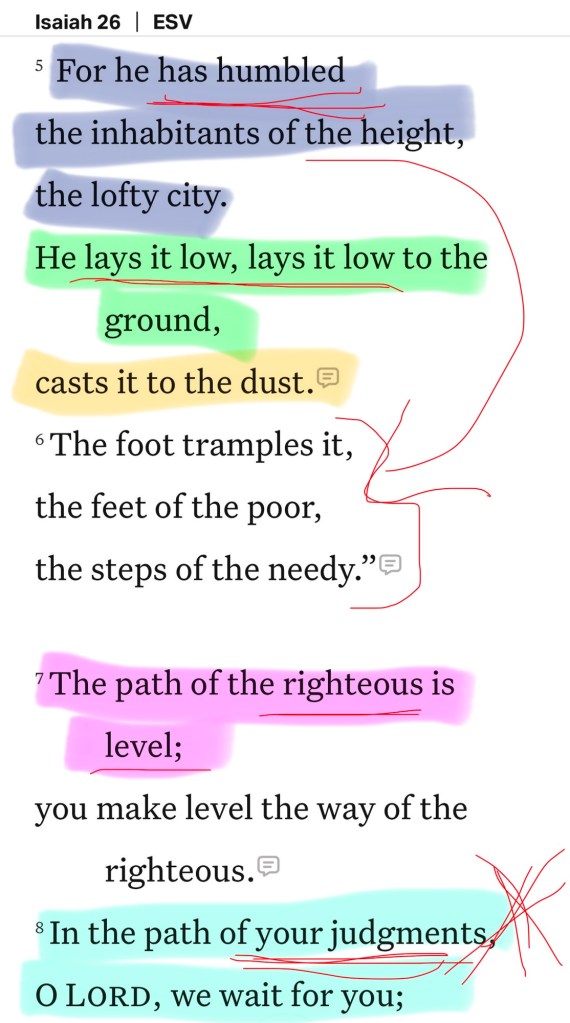
Isaiah 26:5–8 is not merely a poetic reflection on judgment. It is a statement about direction, about ends, and about what human life is ultimately ordered toward.
The passage opens with a collapse:
“He has humbled those who dwell on high, the lofty city. He lays it low… The foot tramples it, the feet of the poor, the steps of the needy.”¹
The “lofty city” is not simply a geographical or political entity. It represents an elevated way of life, a human project that has lifted itself up. It is height with intention. It is a vision of flourishing built apart from God.
And yet, it is brought down.
Why?
Because not all elevation is true ascent. Some forms of “height” are misdirected ends. They are teleologies that cannot sustain the weight placed upon them. What appears strong collapses, not because effort was absent, but because the aim was wrong.
In contrast, Isaiah immediately presents a different image:
“The path of the righteous is level; you make level the way of the righteous.”²
Here, the imagery shifts from height to path. From self-exaltation to direction. The righteous are not those who have constructed impressive structures, but those who are walking a way that has been made straight.
This is a teleological claim.
A path assumes an end. A level path assumes a rightly ordered end. The righteous life is not random movement, nor is it self-determined wandering. It is movement aligned with a reality that has already been structured by God. Thomas Aquinas in Summa Theologiae makes this explicit when he argues that “all things act for an end,” and that “the good is that which all desire.”³
Isaiah then deepens this orientation:
“In the path of your judgments, O LORD, we wait for you; your name and remembrance are the desire of our soul.”⁴
This is where teleology becomes unmistakable.
The end is not merely a destination. It is God Himself.
The righteous do not simply walk correctly. They desire correctly. Their longing is ordered. Their waiting is not passive resignation, but active alignment with God’s purposes, revealed through His judgments.
This stands in sharp contrast to the “lofty city.”
One seeks to construct its own end.
The other receives its end.
One rises quickly and collapses.
The other walks steadily and arrives.
Isaiah is not merely describing two groups of people. He is describing two fundamentally different teleologies. One is self-authored, unstable, and ultimately unsustainable. The other is received, aligned, and enduring.
And this raises the unavoidable question:
If there is a path that is made straight, and a height that is destined to fall, then the issue is not whether we are moving.
It is whether we are aiming correctly.
Section 2: What Is Teleology?
Teleology is the study of ends, purposes, and the toward-whatness of things.
At its simplest, teleology asks: what is something for?
This is not an abstract or optional question. It is built into how humans think. As Aristotle observed, “all men by nature desire to know.”⁵ But this desire is not satisfied with surface-level facts. Knowledge presses deeper. It seeks the “why,” the cause, the reason something is as it is.⁶ To ask why is already to ask about purpose. It is to assume that reality is not random, but structured, intelligible, and directed.
In this sense, teleology is not imposed onto the world. It is discovered within it.
Historically, this meant that human life itself was understood as ordered toward a given end. As Alasdair MacIntyre notes, earlier moral frameworks assumed “a view of human life as ordered to a given end.”⁷ To live well was to move toward that end, to progress toward a fulfilment that was not self-invented, but received. However, modernity has largely abandoned this framework. The result is what MacIntyre describes as a loss, where “the kind of telos in terms of which it once judged and acted is no longer thought to be credible.”⁸
In other words, we have not stopped living toward ends. We have simply lost agreement about what those ends are.
This loss is not neutral. It reshapes how we think, feel, and act. C. S. Lewis captures this with striking clarity when he argues that reality itself calls for fitting responses. Each thing is to be met with the kind of love appropriate to it, where “every object is accorded that kind and degree of love which is appropriate to it.”⁹ This is not mere sentiment. It is alignment. It is the recognition that truth involves “correspondence to reality.”¹⁰
Teleology, then, is not merely about where we are going. It is about whether we are rightly aligned with what is real.
To lose teleology is not to become free. It is to become disoriented.
Without a given end, desire becomes unstable.
Without a true good, love becomes misdirected.
Without correspondence to reality, truth becomes negotiable.
This is why teleology matters.
It is not a niche philosophical curiosity. It is the claim that life has a given direction, and that human flourishing depends on rightly ordered love and rightly perceived ends.
Aquinas’ Teleology Video Link (4:13 min.): https://youtu.be/uoPjFnqO7j4
Section 3: Historical Cases of Misappropriated Teleology Causing Social Havoc
When teleology is detached from created order, it does not disappear. It relocates.
Human beings cannot live without ends. We are always aiming at something. The question is not whether we have a telos, but where we locate it. When that location shifts away from reality as given, the consequences do not remain private. They scale outward into culture, institutions, and systems.
Two dominant patterns emerge.
The first is the inward turn, where the self becomes the source of purpose.
Modern identity increasingly defines itself from within. As Carl Trueman explains, the self is now understood in terms of “the purpose of my life,” grounded in “a prioritization of the individual’s inner psychology.”¹¹ What was once received from an external order is now generated internally. These shifts are not superficial. They reflect “deeper changes in how we think of the purpose of our lives.”¹²
At first glance, this appears liberating. The individual is freed from imposed structures and given the authority to define meaning. But this freedom comes at a cost.
If the self is the source of purpose, then it must also sustain that purpose. Identity becomes fragile because it is self-authored. Desire becomes authoritative because there is no higher reference point. Meaning becomes unstable because it is no longer anchored in anything beyond the individual.
In this framework, teleology collapses inward.
The second pattern moves in the opposite direction, but with equal consequence. If purpose cannot be reliably grounded in the self, it is often relocated into systems, institutions, and planners who attempt to engineer human ends from the outside.
C. S. Lewis saw this clearly. When formation is severed from objective value, societies produce what he famously called “Men without Chests.”¹³ That is, individuals whose capacity for rightly ordered love and moral response has been hollowed out. And yet, despite removing the very structure that enables virtue, we still demand it. As Lewis puts it, “We remove the organ and demand the function.”¹⁴
The result is predictable.
When inner formation fails, external control increases.
This leads to the technocratic impulse to reshape humanity itself. Scientific, social, and political systems begin to assume the authority to define what human beings should be. But this is not neutral power. As Lewis warns, “Each new power won by man is a power over man as well.”¹⁵ What appears as progress becomes domination, where “Man’s conquest of Nature… means the rule of a few hundreds of men over billions upon billions of men.”¹⁶
In other words, when teleology is lost, it does not produce autonomy. It produces either fragmentation or control.
Either the self becomes the unstable centre of meaning,
or power structures step in to impose meaning from the outside.
In both cases, the result is not human flourishing.
It is distortion.
Teleology cannot be removed without consequence. When it is severed from created order, purpose is either internalised or engineered. But neither option restores what was lost.
Human beings are not liberated by false ends.
They are deformed by them.
Section 4: Biblical Teleology vs. Secularist Teleology and Why It Matters
The difference between biblical and secular teleology is not subtle. It is foundational.
At stake is a single question: is purpose something we receive, or something we construct?
Biblical teleology begins with the conviction that purpose is given. The world is not self-explanatory. It is created, ordered, and directed by God. Meaning belongs to creation because it belongs to its Creator. This is why the resurrection is not merely a spiritual event, but an ontological one. As Oliver O’Donovan writes, “the resurrection of Christ from the dead” is “the reaffirmation of creation,” and in it “creation is restored and the kingdom of God dawns.”¹⁷
This is crucial.
Biblical teleology does not discard the world. It fulfils it.
The end of all things is not escape from creation, but the restoration of creation to its intended purpose. This means that teleology is not invented by human beings. It is embedded in reality itself. However, because human perception is darkened, that order is not always clearly seen. As O’Donovan cautions, “any certainty we may have about the order which God has made depends upon God’s own disclosure of himself and of his works.”¹⁸ What we know of purpose, we know because it has been revealed. The resurrection is not only a promise of the end. It is the unveiling of what creation was always for, a “divine reaffirmation of created order.”¹⁹
In this framework, purpose is received, not authored. Order is real, not constructed. Meaning is discovered, not projected.
Secularist teleology, by contrast, begins where revelation is denied.
If there is no given order, then purpose must be generated. Meaning is relocated from the structure of reality into the interior of the self. As MacIntyre observes, modernity has produced a self that has “lost its traditional boundaries,” including any shared understanding of life as “ordered to a given end.”²⁰ The result is not the removal of teleology, but its fragmentation. Each individual becomes responsible for defining what life is for.
This shift has consequences.
When purpose is self-authored, morality becomes unstable. There is no longer a shared good toward which life is directed. Instead, authenticity replaces obedience. To be true is no longer to align with reality, but to express oneself sincerely. Interior feeling begins to outrank created order.
But this model cannot sustain itself.
If meaning is projected, then it cannot correct us. If purpose comes from within, then it cannot judge whether we are rightly aligned or deeply mistaken. The self becomes both author and authority, yet lacks the stability to bear that weight.
This is why biblical epistemology is inseparable from biblical teleology. As Esther Lightcap Meek argues, “I simply cannot know him if I refuse to submit in reverence to him.”²¹ Knowing is not neutral. It is relational, covenantal, and shaped by posture. When that posture is rightly ordered, “good, responsible knowing brings blessing, shalom; irresponsible knowing brings curse.”²²
In other words, how we know is tied to what we are for.
Biblical teleology says the world is ordered by God and fulfilled in Him. Secularist teleology says meaning is projected by the self. One calls for alignment. The other permits invention.
One produces coherence.
The other produces eventual collapse.
The difference is not theoretical.
It is lived.
Section 5: Why Jesus Is the Telos We Need
If teleology is real, then the most pressing question is not whether life has an end, but whether we can know it.
More than that: whether the end can be reached.
This is where Christianity makes its most radical claim. Jesus is not merely a guide to the end. He is the end in person.
The New Testament does not present salvation as escape from the world, but as its fulfilment. As N. T. Wright explains, the future of creation is not abandonment or gradual improvement, but “the drastic and dramatic birth of new creation from the womb of the old.”²³ The world is not discarded. It is brought to completion. Heaven and earth are not opposing realms, but realities that “are made for each other.”²⁴ The direction of history, then, is not dissolution, but union. Not loss, but restoration. As Wright summarises, “what creation needs is neither abandonment nor evolution but rather redemption and renewal.”²⁵
This reframes teleology entirely.
The end is not something we construct. It is something God brings about. And that end is not abstract. It is personal.
Jesus does not simply teach truth. He identifies Himself with it. As Esther Lightcap Meek reflects, “one of the many astounding things that Jesus says is, ‘I am the truth.’”²⁶ If truth is a person, then knowing reality is not merely a matter of correct ideas, but of right relationship. Teleology becomes relational before it becomes conceptual. It is not first about reaching a destination, but about being rightly oriented toward the One who is the destination.
This also clarifies what it means to be human.
We are not self-originating beings trying to invent purpose. We are creatures made for communion. As Meek notes, knowing is not detached observation, but participation. It is “the very thing we were made to do.”²⁷ To know rightly is to be rightly aligned, not only intellectually, but relationally and morally.
This is why misdirected teleology feels like restlessness.
Augustine names this with disarming precision: “our hearts are restless until they rest in You.”²⁸ Restlessness is not merely emotional instability. It is ontological misalignment. It is the experience of aiming at ends that cannot hold us.
Jesus answers that restlessness, not by offering a better technique, but by offering Himself.
In Him, the end of creation is not abolished, but fulfilled. The good that all things desire is not an abstract ideal, but a living reality. The path, the truth, and the life converge in a single person.
This is why Jesus is not merely a moral instructor.
He is where truth, purpose, communion, and restoration meet.
To aim at Him is not to narrow life.
It is to finally align it.
Conclusion
Isaiah showed us something unsettling.
Not all heights are safe. Some are destined to fall.
The lofty city collapses, not because effort was lacking, but because its aim was wrong. It reached upward, but toward an end that could not sustain it. In contrast, the righteous walk a level path, not because life is easy, but because their direction is aligned with reality.
This is what teleology exposes.
Life is not random movement. It is movement toward an end.
Aristotle recognised that we are built to ask why. Aquinas clarified that all things act toward an end. MacIntyre showed us what happens when that end is lost. Lewis warned that when we sever ourselves from reality, we deform our capacity to live within it. O’Donovan demonstrated that creation itself is not abandoned, but restored. Meek reminded us that knowing requires surrender. And Scripture brings it all to its climax.
The end is not an idea.
The end is a person.
Modernity has not removed teleology. It has relocated it. We now aim inward, constructing purpose from feeling, or outward, handing purpose over to systems that attempt to engineer humanity. But neither can carry the weight of what we are.
False purpose does not merely fail privately. It fractures the self and distorts society.
The resurrection of Christ declares something different.
Creation is not discarded. It is fulfilled.
And that fulfilment is not found by inventing our own end, but by being rightly aligned with the One who is the end.
You are not lost because life has no meaning.
You are lost because you are aiming at an end that cannot hold your weight.
If God has already revealed what life is for, why do we keep insisting on aiming elsewhere?

Practical Application
Examine your habits. What do they reveal about what you believe life is for?
Identify your “lofty city.” Where are you trying to build a life apart from God’s order?
Surrender the outcomes you are trying to force. Learn to wait in God’s judgments, rather than inventing your own end.

Prayer
Father God, Lord Jesus, Holy Spirit,
Correct our aim.
Humble the false heights we build in ourselves, and expose the ends we pursue that cannot sustain us.
Teach us to wait in Your ways, not as passive observers, but as those being aligned to what is true.
Form in us a deeper desire for You, until our hearts learn to rest where they were always meant to rest.
Make Christ our end, our path, and our peace.
In the holy name of Jesus,
Amen.
TRACK TO ENJOY:

Footnotes
1. Isaiah 26:5–6 (ESV).
2. Isaiah 26:7 (ESV).
3. Thomas Aquinas, Summa Theologiae, I-II, q. 1, a. 2; I, q. 5, a. 1, trans. Fathers of the English Dominican Province (New York: Benziger Bros., 1947).
4. Isaiah 26:8 (ESV).
5. Aristotle, Metaphysics, trans. W. D. Ross (Oxford: Clarendon Press, 1924), I.1 (980a).
6. Ibid., I.1–2 (981a–982a).
7. Alasdair MacIntyre, After Virtue, 3rd ed. (Notre Dame, IN: University of Notre Dame Press, 2007), 33.
8. Ibid., 34.
9. C. S. Lewis, The Abolition of Man (New York: HarperOne, 2001), 10.
10. Ibid., 11.
11. Carl R. Trueman, The Rise and Triumph of the Modern Self (Wheaton, IL: Crossway, 2020), 22.
12. Ibid., 23.
13. Lewis, The Abolition of Man, 16.
14. Ibid.
15. Ibid., 36.
16. Ibid., 37.
17. Oliver O’Donovan, Resurrection and Moral Order: An Outline for Evangelical Ethics, 2nd ed. (Grand Rapids, MI: Eerdmans, 1994), 15.
18. Ibid., 19.
19. Ibid.
20. MacIntyre, After Virtue, 33–34.
21. Esther Lightcap Meek, Longing to Know: The Philosophy of Knowledge for Ordinary People (Grand Rapids, MI: Brazos Press, 2003), 373.
22. Ibid., 374–375.
23. N. T. Wright, Surprised by Hope: Rethinking Heaven, the Resurrection, and the Mission of the Church (New York: HarperOne, 2008), chap. 6.
24. Ibid.
25. Meek, 373.
26. Ibid., 374.
27. Augustine, Confessions, trans. Henry Chadwick (Oxford: Oxford University Press, 1991), I.1.

 #Hayibo