


Two men saw the same cross. One saw nothing. The other saw everything.
One of the toughest pills to swallow, as a Christian, for me personally, is recognising just how dishonourable I once was. Sometimes, still can be. Sadly. Conditioned humanness is really awful to overcome in our sanctification process. But so worth the unlearning. And relearning.
Perhaps that is unsurprising. When early formation is marked by dysfunction, suspicion becomes instinctive. You learn to expect harm, to question motives, and quietly to assume that you yourself are of little value. By God’s grace, my mother stood as a counterweight to that trajectory. Without her, I shudder to think how much further distortion might have taken root.
What I have come to realise, slowly and sometimes uncomfortably, is that honour is not a decorative virtue. It is foundational. Without it, even basic decency begins to erode.
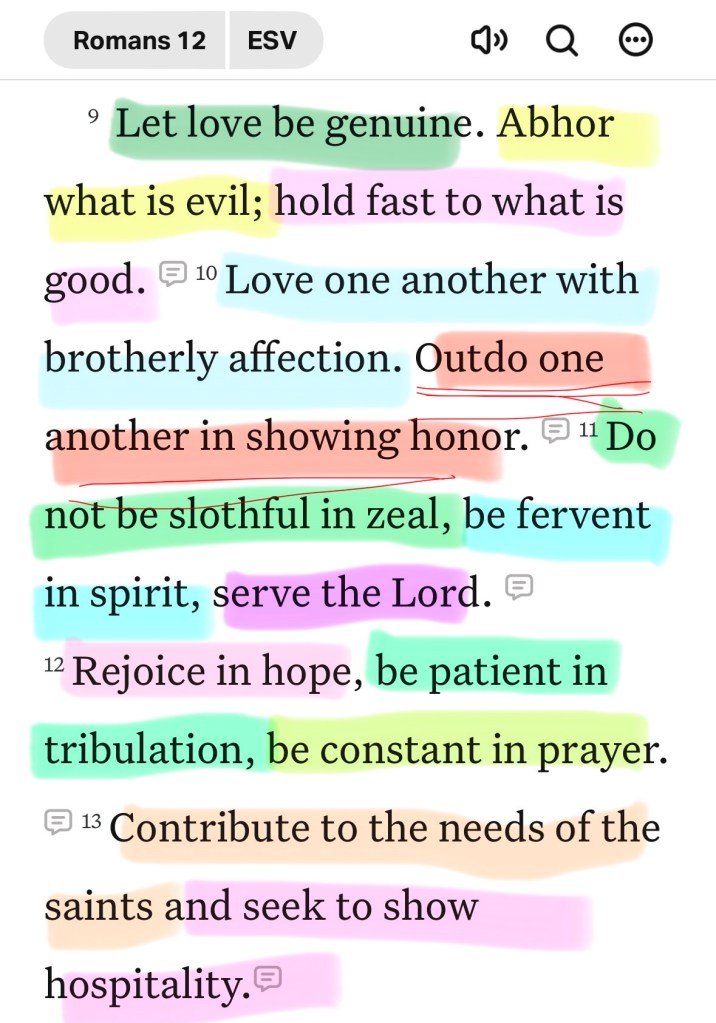
As we approach the remembrance of Christ’s crucifixion, the moment where divine honour and human dishonour collide most vividly, it is striking that my Bible reading landed in Romans 12:9–13. Within that passage sits a line that is deceptively simple:
“Outdo one another in showing honour.”
So why is honour so critical?
The modern instinct is to treat honour as etiquette. Be polite. Be respectful. Do not offend unnecessarily. All of that has its place, but it does not go nearly far enough. Scripture presents honour not merely as behaviour, but as something far more structural. It is a way of perceiving reality.
In Romans 12, honour is not isolated. It is embedded within a sequence:
genuine love,
moral discernment,
relational affection, and then honour.¹
This suggests that honour is not an optional extra. It sits at the hinge between what we believe and how we live.
To honour someone, in the biblical sense, is not to flatter them or to agree with everything they say. It is to recognise weight. The underlying concept carries the idea of value, substance, significance. To honour is to respond appropriately to that weight.
This is where things become uncomfortable.
If honour is tied to perception, then dishonour is not merely rudeness. It is misperception.
Scripture quietly but consistently makes this link. When Paul describes humanity’s condition in Romans 1, he does not begin with intellectual error, but with dishonour: “although they knew God, they did not honour him as God”.² The result is not simply moral decline, but cognitive distortion. Thinking becomes futile. Perception darkens.
In other words, dishonour does not just corrupt behaviour. It clouds sight.
This insight is not confined to theology. Philosophically, there has long been recognition that knowing is not a neutral act. Esther Lightcap Meek argues that knowledge is relational and participatory rather than detached observation.³ We do not stand outside reality as neutral spectators. We approach it with dispositions that shape what we are able to receive.
Similarly, Alvin Plantinga contends that our cognitive faculties function properly only within the right conditions.⁴ If those conditions are compromised, our ability to arrive at truth is impaired.
The biblical claim, then, is remarkably coherent: honour is one of those conditions.
Modern culture, however, has moved in the opposite direction. The self has become the primary reference point for meaning. Charles Taylor describes this as the emergence of the “buffered self”, a self that is closed off from external authority and anchored in its own internal narrative.⁵ In such a framework, honour is subtly redefined. It is no longer about recognising what is objectively valuable, but about affirming what is subjectively felt.
This shift has consequences.
When honour is detached from truth and relocated within self-definition, perception becomes unstable. We begin to see others not as they are, but as they function within our personal narratives. People become categories. Labels replace listening. Reaction overtakes understanding.
If that sounds abstract, consider how quickly we form conclusions about others based on minimal information. A single sentence, a social media post, a tone of voice, and we feel justified in rendering judgement. We call it discernment. Often, it is simply dishonour dressed in respectable language.
Even our speech reflects this drift. Ludwig Wittgenstein famously observed that meaning is shaped by use.⁶ Words do not merely describe reality; they shape how reality is perceived. When language becomes careless or weaponised, perception follows suit.
This is why Scripture treats the tongue with such seriousness. James notes the contradiction of blessing God while cursing those made in His likeness.⁷ That is not merely a moral inconsistency. It is an epistemological one. To dishonour the image-bearer is to misread reality itself.
At this point, it would be easy to turn honour into another moral demand. Try harder. Be kinder. Speak more gently. While those are good impulses, they miss the deeper issue.
Honour is not sustained by effort alone. It flows from orientation.

The Turn
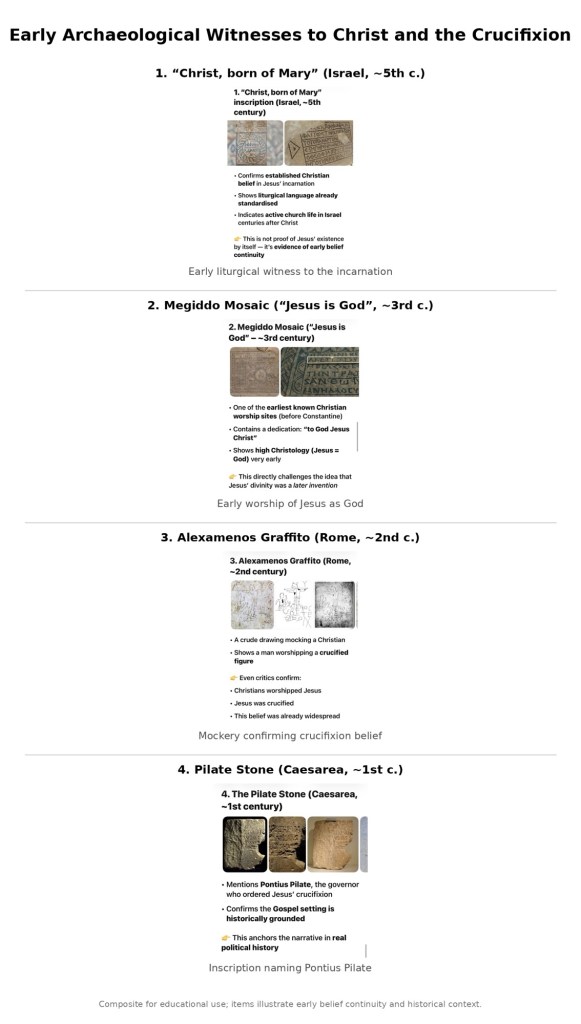
Selected archaeological and historical artefacts reflecting early belief in the crucifixion and identity of Jesus Christ. While not proof in isolation, they collectively demonstrate continuity between the Gospel accounts and early historical witness.
The turning point in Christian thought is not a rule, but a person. The crucifixion of Christ reframes honour entirely. In a world that equated honour with status, power, and public recognition, Jesus embodies a radically different logic. Stripped, mocked, and executed, He appears utterly dishonoured. Yet Scripture insists that this is the very moment of glory.⁸
This is not poetic exaggeration. It is an epistemic reversal.
At the cross, honour is no longer defined by self-preservation or social approval. It is defined by alignment with truth, even at great cost. It is self-giving rather than self-protecting. It is grounded not in perception, but in reality as defined by God.
This matters profoundly for how we see others.
If every person bears the image of God, then honour is not optional. It is the appropriate response to reality. To reduce a person to their behaviour, their past, their label, or our immediate impression is not merely unkind. It is inaccurate.
Of course, honour does not mean the absence of discernment. Romans 12 begins with “abhor what is evil; hold fast to what is good”.⁹ Honour does not blur moral clarity. It sharpens it. It allows us to distinguish without dehumanising, to disagree without diminishing.
Practically, this reshapes everyday interactions in ways that are both simple and surprisingly difficult.
It means:
Listening before formulating a response Refusing to collapse a person into a single trait or moment Speaking in ways that reflect weight, not impulse
None of this is particularly glamorous. It will not trend online. It does not lend itself to dramatic displays of virtue. But it is quietly transformative.
And, if we are honest, it is often where we fail.
Perhaps the greatest irony is that we live in an age saturated with information, yet increasingly marked by misunderstanding. We have more access to knowledge than any generation before us, and yet clarity often feels elusive.
Maybe the issue is not the absence of truth.
Maybe the issue is the absence of honour.
Because if honour is a condition for seeing rightly, then its erosion inevitably leads to distortion. We do not simply lose civility. We lose clarity.
Which brings us back to Paul’s instruction.
“Outdo one another in showing honour.”
It is an unusual kind of competition. Not for status, but for recognition of others. Not for visibility, but for weight-giving. Not for self, but for the other.
And perhaps, in practising it, we recover something we did not realise we had lost.
The ability to see clearly.

Practical Application
Honour is not abstract. It is practised in the ordinary moments of life, often when no one is watching and nothing is gained.
It begins with small, deliberate shifts:
– Choosing to listen before reacting, especially when we disagree
– Refusing to reduce people to labels, moments, or assumptions
– Speaking in ways that reflect weight and dignity, not impulse
– Becoming aware of how often we centre ourselves, and gently reordering that instinct toward others
These are not dramatic acts. They are quiet disciplines.
Yet over time, they reshape how we see.
And perhaps that is where honour begins to do its deepest work, not only in how we treat others, but in how we perceive reality itself.
Prayer
Father, Son, and Holy Spirit,
We come before You acknowledging how easily we drift into dishonour.
Forgive us for the ways we have honoured only what serves our ambitions, and for the ways we have diminished others to protect our insecurities. Above all, forgive us for failing to honour what You have called weighty, true, and worthy.
Form in us the likeness of Christ, that we may learn to honour rightly, not for appearance, but in alignment with Your truth.
Lord Jesus, we recognise that we cannot out-honour You. Yet we thank You for revealing what true honour is through Your life, Your humility, and Your obedience to the cross. Forgive us for the ways we have taken Your work lightly, or reduced it to something familiar.
Holy Spirit, teach us to become people of honour in thought, word, and action. Give us the courage to honour others even when it costs us, and the clarity to recognise the weight of what You have placed before us.
May our lives reflect Your glory, not our own.
In the name of Jesus Christ, our Messiah, King, Lord, and God,
Amen.
TRACK TO ENJOY:

References
¹ Romans 12:9–10 (ESV).
² Romans 1:21 (ESV).
³ Esther Lightcap Meek, A Little Manual for Knowing (Eugene, OR: Cascade Books, 2014), 7.
⁴ Alvin Plantinga, Warranted Christian Belief (Oxford: Oxford University Press, 2000), 153.
⁵ Charles Taylor, A Secular Age (Cambridge, MA: Harvard University Press, 2007), 37–40.
⁶ Ludwig Wittgenstein, Philosophical Investigations, trans. G. E. M. Anscombe (Oxford: Basil Blackwell, 1953), 43–45.
⁷ James 3:9 (ESV).
⁸ John 12:23–24 (ESV).
⁹ Romans 12:9 (ESV).

 #Hayibo