


Love is not chaotic or invented, it is woven into the structure of reality and finds its fulfilment in God.
Harmony.
I sit in my living room, then outside the salon between clients, and the word harmony keeps returning to me, plucking at my mind like the strings of a harp. My Bible reading plan today is Colossians 3:12-15, and one phrase in particular arrests me: “And above all these put on love, which binds everything together in perfect harmony.” It strikes me that agapē love, self-giving love, is not merely associated with warmth, affection, or good intention, but with harmony. That is wonderfully precise.
And yet it also unsettles me.
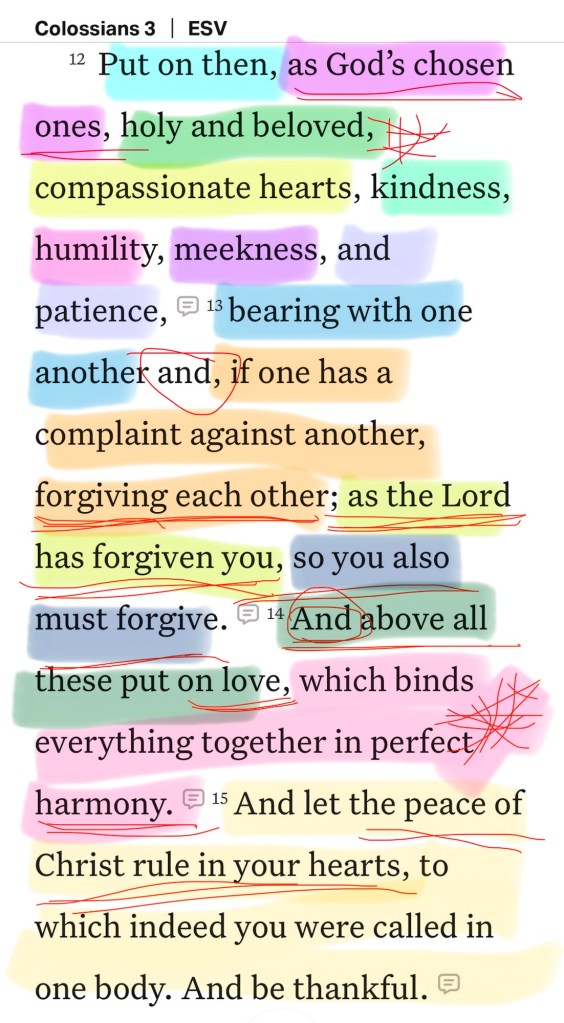
I have known what it is to have love without harmony, or at least what called itself love. I have also known forms of harmony without love, where peace was little more than silence, compliance, or the avoidance of discomfort. So what does this connection between love and harmony truly mean? What sort of harmony is Paul describing?
The more I read through scholarly work on Colossians 3, the more persuaded I become that this harmony is far more than communal cohesion. It is not simply people getting along. It is not sentimental togetherness. It is not agreement for agreement’s sake. Rather, it points to something weightier, a rightly ordered wholeness, a binding together of persons and virtues under the rule of Christ, so that what is held together is not merely a community, but a community aligned with truth.
To understand this, we must begin where Paul begins, with the nature of the new humanity.
Colossians 3:12-15 does not describe isolated individuals trying to behave better. It describes a people who have been clothed together in a new way of being human. The language is corporate. The old humanity has been put off, and the new humanity has been put on. This is not merely personal moral improvement, but participation in a shared life in Christ.¹ The grammar itself resists an individualistic reading. What is removed and what is put on are singular realities embraced by a plural people.²
Into this new identity, Paul speaks an imperative: “Put on.” It is the familiar pattern of the Christian life, become what you are. The community is addressed as God’s chosen, holy, and beloved, not as a reward for moral achievement, but as a declaration of divine initiative and purpose.³ These are not titles of superiority but of calling. To be chosen is to be sent. To be loved is to love.
The virtues that follow are not random. Compassion, kindness, humility, meekness, and patience are relational virtues. They are the habits that reduce friction, restrain ego, and make life together possible.⁴ They are not abstract ideals but lived dispositions that shape how we bear with one another and forgive one another. Forgiveness, in particular, is not grounded in preference but in imitation: “as the Lord has forgiven you.”⁵
And then Paul reaches his climax.
“And above all these put on love.”
Here the language intensifies. Love is not added as one more virtue alongside the rest. It is placed over them, as that which completes them. The term Paul uses for love, agapē, does not describe mere feeling or attraction. It is covenantal, self-giving, other-directed love, defined most fully in Christ himself.⁶ In fact, as some scholars argue, this love does not merely accompany the other virtues, it governs them. It is the controlling ethical force within the passage.⁷
Paul then describes this love as “the bond of perfection.” The imagery is striking. The word used suggests something like a fastening, a ligament, or a clasp that holds everything together.⁸ Love is not decorative. It is structural. Without it, the virtues remain disconnected, capable even of distortion. As one commentator notes, pursued without love, the virtues themselves become unbalanced.⁹
But what, precisely, does this “perfection” mean?
The Greek term points to completeness, maturity, and fullness. It is not shallow harmony. It is not the absence of tension. It is the coming together of parts into a coherent and rightly ordered whole. In this sense, love is the bond that brings the community into maturity. It binds not only virtues but persons into a unified life directed toward its proper end.¹⁰
This is where the idea of harmony must be handled carefully.
Not all harmony is good. Not all unity is true. Not all peace is righteous.
A group may be internally cohesive, relationally stable, and outwardly harmonious, and yet fundamentally disordered. History offers many examples of communities that functioned with remarkable internal unity while being profoundly misaligned with truth. Harmony, in the shallow sense, can coexist with error.
This is why harmony must be defined not merely as agreement or cohesion, but as alignment.
Johannes Kepler once observed that harmony is not something we invent but something introduced into the order of creation by the Creator himself, who does not depart from his own design.¹¹ Harmony, in this sense, is discovered, not constructed. It reflects alignment with the structure of reality as God has made it.
Seen in this light, Paul’s claim becomes far more demanding.
Love does not simply bind people together. It binds them together rightly. It brings them into a completeness that is shaped by truth, grounded in Christ, and oriented toward God. Harmony without truth is not harmony at all. It is organised error.
This is reinforced by the broader context of Colossians. Renewal, Paul says, is a renewal “into knowledge.” This knowledge is not merely intellectual. It is relational and moral. It is a knowledge of God that results in becoming like him.¹² To know God is to be conformed to his image, which is Christ. This transformation is not solitary but communal. It unfolds through shared life, shared practice, and shared love.¹³
Love, then, is not validated by how it feels, but by what it produces. And what it produces, according to Colossians, is a community marked by maturity, unity, and peace under Christ.
This brings us uncomfortably close to our present moment.
We live in a culture that speaks constantly about love, yet often defines it in ways that detach it from truth. Love is frequently reduced to affirmation, non-interference, or emotional intensity. To challenge is to hate. To correct is to oppress. To disagree is to harm.
The result is not harmony, but fragmentation.
When love is severed from truth, it cannot bind. It can only scatter. When it is detached from telos, from a proper end, it loses its ability to order life. What remains is a collection of desires, identities, and claims, each demanding validation, but none able to produce lasting unity.
Paul’s vision stands in sharp contrast.
He does not offer a sentimental definition of love. He offers a demanding one.
Love bears with others Love forgives as it has been forgiven Love restrains pride through humility Love produces patience in the face of difficulty Love binds everything into maturity
And when love does its work, the result is peace. Not a superficial peace, but the peace of Christ, which acts as an umpire within the community, settling disputes and guiding hearts.¹⁴ This peace is not merely internal. It is communal. It is the lived reality of a people who are, in fact, one body.
It is precisely this vision that feels so counter-cultural.
We prefer autonomy to alignment.
We prefer affirmation to transformation.
We prefer peace without repentance.
We prefer unity without truth.
But the question remains:
If what we call love leaves behind confusion, division, and disorder, can it truly be love?


Practical Application
Colossians invites us to ask harder questions of ourselves.
Where am I calling sentiment love when it is really avoidance?
Where am I preserving false peace rather than pursuing true harmony?
Where do I need to forgive as I have been forgiven?
Where do I need to submit my understanding of love to Christ?
The answer is not found in constructing a new definition of love, but in returning to the one revealed in Christ.
Love is not whatever we feel it to be.
Love is what binds us into truth-shaped wholeness under God.
And that changes everything.

Prayer
Lord Jesus,
Teach us to love as You define love, not as we have imagined it. Strip away our shallow versions of love that comfort but do not transform. Form in us a love that is patient, humble, and forgiving.
Bind us together in truth, not merely in agreement. Let Your peace rule in our hearts and in our communities. And lead us into the kind of harmony that reflects Your design and Your glory.
In Your Holy Name Lord Jesus,
Amen.
TRACK TO ENJOY:

Footnotes
1. John Frederick, The Ethics of the Enactment and Reception of Cruciform Love (2019), 207-210.
2. Ibid.
3. C. F. D. Moule, “The New Life in Colossians 3:1-17,” Review & Expositor 70, no. 4 (1973): 491.
4. Ibid., 491-492.
5. N. T. Wright, Colossians and Philemon, sec. “iii. Do all in the name of the Lord Jesus (3:12-17).”
6. John Frederick, Ethics of the Enactment and Reception of Cruciform Love, 207-209.
7. Ibid.
8. C. F. D. Moule, “The New Life,” 491-492.
9. N. T. Wright, Colossians and Philemon, sec. “iii. Do all in the name of the Lord Jesus (3:12-17).”
10. John Frederick, Ethics of the Enactment and Reception of Cruciform Love, 207-210.
11. Johannes Kepler, Harmonies of the World, trans. Charles Glenn Wallis (London: Global Grey, 2018), 16, 34, 63-64.
12. C. F. D. Moule, “The New Life,” 490-491.
13. John Frederick, Ethics of the Enactment and Reception of Cruciform Love, 189-191.
14. C. F. D. Moule, “The New Life,” 492; N. T. Wright, Colossians and Philemon, sec. cited above.

 #Hayibo