

Foreword
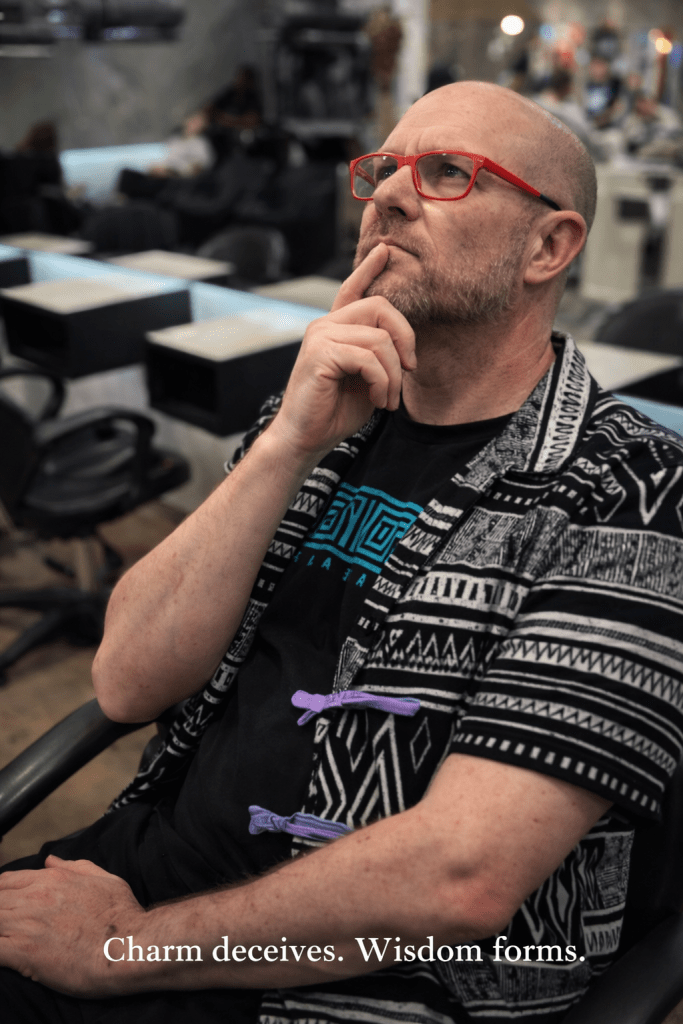
Recently, in church and in the salon, someone piped up, “What should I think of you as a hairstylist with no hair?”
Years ago, my reply was always a bit sheepish: “Ask God.”
Now, I answer differently: “That I have the confidence not to wear it.”
As I read Proverbs 31 this morning, a deeper response emerged to what is, at its core, a vanity-centred, if not subtly cutting, question about my baldness. The passage reframes the entire conversation. It exposes how easily we measure worth by appearance, while God’s economy works on entirely different terms.
It echoes the answer I often give when someone says, “You look nice today.” I reply, “Thank you. But I am less concerned with how I appear than with the character of my heart.”
This is not deflection. It is formation.
I have been engaging the self for a long time, and Proverbs 31 names with clarity what that journey has been circling: wisdom is not found in the pursuit of charm, beauty, or charisma. Through God’s lens, wisdom cuts deeper. It reshapes what it means to be seen at all.
And perhaps, in that light, even a bald hairstylist becomes beside the point.

Section 1: Introduction
You’re so vain, you probably think this blog is about you.
It is a clever line because it exposes something most of us would rather not admit: we instinctively centre ourselves. Every comment, every compliment, every critique quietly bends back toward the question, “What does this say about me?”
That instinct does not disappear with age. If anything, it becomes more refined. We learn to dress it up as confidence, self-awareness, even authenticity. But beneath it sits the same gravitational pull, the self as reference point.
A lyric in Flutter by Hunter Plake, I heard recently sharpened that tension:
“When I was a kid, my father said you better find a woman that talks to God… so she can remind you that you’re not one.”
That line lands harder the longer you sit with it.
Because the problem is not merely vanity in the obvious sense, appearance, charm, attractiveness. The deeper issue is far more subtle. It is the quiet assumption that we are, in some sense, central. That our perspective defines reality. That our worth is something we construct, curate, and project.
“I was blind,” Hunter continues.
Not just to appearance.
But to orientation.
Proverbs 31 does not begin by correcting behaviour. It confronts vision. It dismantles the framework that places charm, beauty, and self-presentation at the centre, and replaces it with something far more demanding: wisdom rooted in the fear of the Lord.
This is not an attack on beauty. It is a reordering of value.
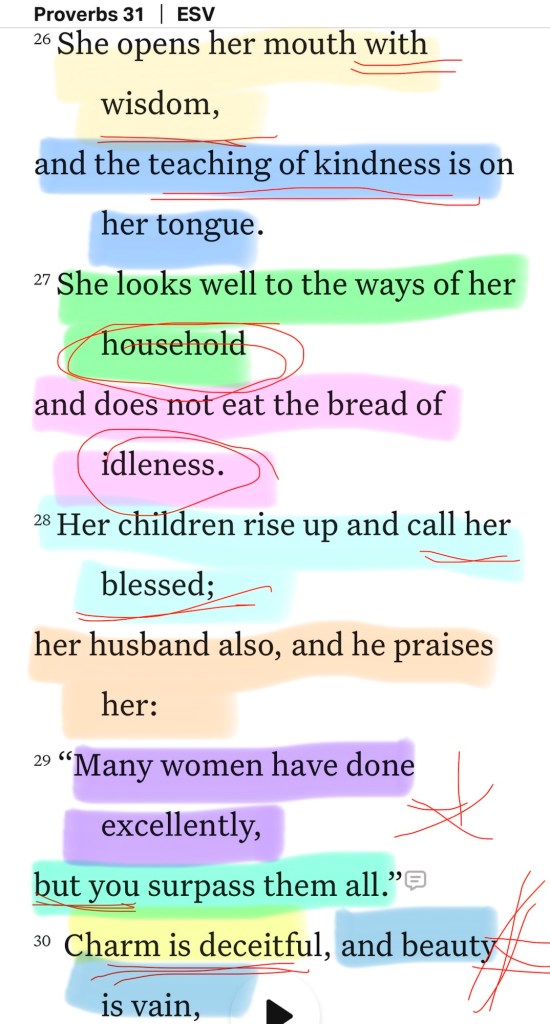
Because when Scripture says, “Charm is deceitful and beauty is vain,” it is not dismissing appearance. It is exposing its instability. Its inability to carry the weight we place upon it.
And in its place, it offers something far less visible, but far more substantial:
A life formed in relationship with God.
A wisdom that reshapes not how we appear, but who we are.
Which means this blog might not be about you.
But it is certainly about what you are becoming.
Section 2: Why Is Wisdom a “She”?
At first glance, the personification of wisdom as a woman in Proverbs can feel either obvious or uncomfortable. Some dismiss it as a relic of an ancient, patriarchal world. Others attempt to elevate it into something overtly theological, even divine. Yet both approaches miss the precision of what the text is doing. The feminine portrayal of wisdom is neither accidental nor simplistic. It is deliberate, literary, and deeply formative.
The Hebrew word for wisdom, ḥokmah, is grammatically feminine. That much is straightforward. However, grammar alone does not explain why wisdom is not merely described with feminine agreement, but is actively embodied as a woman who speaks, calls, invites, and even competes for attention. In Proverbs 1 to 9, wisdom stands in the streets, raises her voice, and beckons the simple toward life. She is not presented as an abstract principle, but as a presence that demands response.
This is where the text begins to move beyond grammar into strategy. Wisdom is not only described. She is staged. Michael Fox observes that these passages function as a kind of poetic “mythos,” a literary construct that communicates realities which cannot be reduced to straightforward propositional language.¹ Wisdom, in this sense, is made personal so that it can be encountered, not merely understood.
At the same time, this personification is not neutral. It operates within a carefully constructed contrast. Alongside Woman Wisdom stands another figure: Woman Folly. Both call. Both invite. Both promise something to those who follow. Claudia Camp highlights that the effectiveness of this contrast lies in its ambiguity. The student must discern between two voices that can initially appear similar.² Wisdom is not presented as dry instruction, but as something compelling, even desirable. The imagery draws on the language of attraction, not to eroticise wisdom in a crude sense, but to recognise that human beings are shaped as much by what they desire as by what they know.
This reframes the question entirely. The issue is not why wisdom is female, but why wisdom is presented in a way that engages longing, attention, and allegiance. The text is not defining women. It is shaping readers. By presenting wisdom as a woman who calls out, prepares a feast, and invites participation, Proverbs moves wisdom out of the realm of detached intellect and into the arena of relationship.
Importantly, this does not mean that wisdom is a goddess, nor that the text is covertly introducing a divine feminine counterpart to God. Roland Murphy notes that while Wisdom is described as present with God before creation, she is not identical with God, nor is she an independent deity.³ Rather, she represents a reality that originates in God and extends into human life, bridging the gap between divine order and human action.
What emerges, then, is something far more profound than a cultural artefact. Wisdom is written as a woman because the text seeks to form not only understanding, but desire. It calls the reader into a relationship that must be chosen, pursued, and embodied. The feminine imagery serves this purpose with remarkable effectiveness. It invites, it confronts, and it refuses to remain abstract.
Wisdom is not female. But she is written as one so that you will learn how to desire her.
Section 3: Wisdom Over Beauty, Charm, and Performance
If Proverbs 1 to 9 teaches us how to recognise wisdom, Proverbs 31 shows us what it looks like when wisdom is lived. The shift is subtle but decisive. We move from poetic personification to embodied practice. The woman of Proverbs 31 is not merely symbolic. She is concrete, active, and deeply integrated. And yet, the conclusion of the passage refuses to let the reader settle on appearances.
“Charm is deceitful, and beauty is vain, but a woman who fears the Lord is to be praised.”
This is not a dismissal of beauty so much as a reordering of value. Beauty and charm are acknowledged, but they are exposed as unstable currencies. They fluctuate. They fade. They can be manipulated. In contrast, the fear of the Lord anchors a person in something enduring, something that does not collapse under time or scrutiny.
Bruce Waltke notes that the woman described in Proverbs 31 embodies the very qualities attributed to Wisdom earlier in the book. She is industrious, discerning, generous, and instructive.⁴ In other words, she does not merely admire wisdom. She incarnates it. This is crucial, because it prevents a shallow reading of the text as a celebration of domestic virtue alone. The passage is not prescribing a narrow role. It is presenting a holistic life shaped by reverence for God.
This is where provocation lands with force. The text is not ultimately about women. It is about wisdom taking form in a human life. The so called “feminine duties” are not restrictions. They are illustrations. They demonstrate what it looks like when wisdom governs action, speech, relationships, and responsibility. Men are not exempt from this vision. They are summoned into it.
Katharine Dell reminds us that Proverbs is a collection shaped over time, drawing from lived experience, instruction, and reflection within a community.⁵ This means the portrait in Proverbs 31 is not abstract idealism. It is grounded in reality. It reflects what wisdom looks like when it is worked out over time in ordinary life. The marketplace, the household, the community. All become arenas where wisdom is either embodied or ignored.
What makes this deeply confronting is that wisdom is not measured by external markers. It is not charisma. It is not presentation. It is not even competence alone. It is rooted in relationship with God. The “fear of the Lord” is not terror, but orientation. It is the recognition that one’s life is lived before God, accountable to Him, shaped by Him.
Leo Perdue highlights that in wisdom literature, the fear of God is the beginning of knowledge because it places the human person in proper relation to the Creator.⁶ Without that orientation, wisdom collapses into technique or performance. With it, wisdom becomes formative, shaping not only what we do, but who we become.
This brings us back to the foreword in a way that cuts through the noise. The question about appearance, whether flattering or critical, assumes that identity is something to be seen, evaluated, and approved externally. Proverbs dismantles that assumption. It redirects attention to something far less visible but far more decisive.
Wisdom is not about how you present. It is about what you are becoming in relation to God.
And that is precisely why charm deceives and beauty fades. They can be seen. Wisdom must be formed.
Section 4: Wisdom as Relationship, Not Acquisition
There is a quiet danger in how we often speak about wisdom. We talk about gaining it, learning it, applying it, almost as if it were a skillset to be mastered or a tool to be acquired. But Proverbs consistently resists that reduction. Wisdom is not merely something you possess. It is something you participate in.
This is where the language of “osmosis” becomes surprisingly accurate, though it needs sharpening. Wisdom in the biblical sense is not absorbed passively, but it is formed relationally. It emerges through proximity to God, through attentiveness, through a life lived in response to Him. It is less like downloading information and more like being shaped over time by presence.
Michael Fox captures this tension well. He argues that the figure of Lady Wisdom is not simply a poetic flourish, but a way of expressing a reality that transcends individual human understanding while still being accessible within it.⁷ Wisdom exists beyond us, yet calls to us, inviting participation rather than mere observation. It is not reducible to human intellect, even though it engages it fully.
This is why Proverbs portrays wisdom as calling out in the streets, inviting, urging, even pleading. It is not hidden behind esoteric knowledge. It is relationally available. Yet it cannot be forced or controlled. One must respond.
Roland Murphy expands this further by showing that Wisdom’s origins “from God before creation” place her within the very fabric of reality itself.⁸ Wisdom is not an optional spiritual add on. It is woven into the structure of life. To live wisely is to live in alignment with how reality is ordered under God. To reject wisdom is not merely to make poor decisions. It is to live out of sync with the grain of existence.
This reframes everything.
Wisdom is not primarily about intelligence. It is about alignment.
It is not about appearing insightful. It is about being rightly oriented.
It is not about collecting principles. It is about entering into a way of being that reflects God’s own ordering of the world.
This is where relationship becomes central. The fear of the Lord is not just the beginning of wisdom. It is the environment in which wisdom grows. Without relationship, wisdom becomes abstraction. With relationship, wisdom becomes transformation.
Claudia Camp’s work helps us see why the feminine imagery matters here. Wisdom is portrayed not as a rigid system, but as something inviting, relational, even compelling.⁹ The imagery draws the reader into engagement. It is meant to attract, to provoke desire, to create movement towards wisdom rather than mere agreement with it.
In that sense, wisdom is not imposed. It is pursued.
And this pursuit is deeply personal. It confronts not just what we know, but what we love, what we prioritise, what we chase. Which brings us back, again, to the tension between wisdom and vanity.
Vanity is performative. It seeks validation from the outside.
Wisdom is formative. It reshapes the inside.
Vanity asks, “How am I seen?”
Wisdom asks, “Who am I becoming before God?”
So no, wisdom is not something we casually pick up along the way. It is something we grow into as we walk with God. Slowly. Unevenly. Honestly.
And perhaps that is the most confronting truth of all. Because it means wisdom cannot be faked.
Section 5: The Provocation We Cannot Avoid
At this point, the text stops being theoretical and becomes uncomfortably personal. If wisdom is relational, embodied, and rooted in the fear of the Lord, then it inevitably exposes the metrics we actually live by.
Proverbs 31 does not simply praise a woman. It confronts a worldview.
“Charm is deceitful, and beauty is vain…”
This is not poetic exaggeration. It is diagnostic. It names the human tendency to prioritise what is immediate, visible, and socially rewarded. Charm persuades. Beauty captivates. Both can be leveraged. Both can be curated. Both can become currencies of identity.
But they are unstable.
Christine Yoder observes that the figure of Woman Wisdom and the woman of Proverbs 31 together frame the entire book, forming a theological inclusio that centres the fear of the Lord as the defining principle of wisdom.¹⁰ This means the final words of Proverbs are not an afterthought. They are the conclusion the entire book has been building towards.
And that conclusion is deeply subversive.
Because it tells us that what God praises is not what culture celebrates.
God is not impressed by presentation.
God is not persuaded by charisma.
God is not captivated by appearance.
God looks for something else entirely.
This is where the story in the foreword lands with sharp clarity. The question about appearance, whether disguised as humour or framed as critique, operates within a value system that assumes visibility equals worth. It assumes that what can be seen is what matters.
Proverbs dismantles that assumption without apology.
Katharine Dell’s work on the social and theological context of Proverbs reminds us that wisdom literature emerges from lived realities, where reputation, honour, and social perception mattered deeply.¹¹ Yet even within that world, the text dares to relativise external markers. It refuses to let them define ultimate value.
That is the provocation.
Not that beauty exists.
Not that charm has influence.
But that neither has ultimate significance before God.
Instead, the text elevates something far less tangible and far more demanding. The fear of the Lord. A life oriented towards God. A character shaped in relationship with Him.
Leo Perdue notes that this orientation carries ethical weight. It is not merely internal devotion. It manifests in how one lives, speaks, works, and relates to others.¹² Wisdom is visible, but not in the way vanity is visible. It is seen in consistency, integrity, generosity, and truthfulness.
In other words, wisdom is recognised over time, not in a moment.
This cuts against everything that thrives on immediacy. Social validation, first impressions, aesthetic appeal. All of it depends on being quickly seen and quickly judged.
Wisdom refuses that pace.
It forms slowly.
It reveals itself gradually.
It cannot be reduced to an image.
And this is why the text is ultimately confronting. Because it forces a question that cannot be avoided:
What are we actually cultivating?
Are we shaping a life that can be admired at a glance?
Or are we allowing God to shape a life that can be trusted over time?
Those two pursuits are not the same. And Proverbs makes it clear that only one of them endures.
Section 6: Seeing Clearly at Last
By the time we reach the end of this journey, the question that opened the conversation feels almost trivial, yet it is precisely the kind of question wisdom is meant to dismantle.
“What should I think of you as a hairstylist with no hair?”
It is a question rooted in surface logic. It assumes coherence must be visible. It assumes credibility must match appearance. It assumes identity is something externally verified.
But wisdom, as Proverbs has patiently shown, does not operate on those terms.
It reframes sight itself.
What looks like absence may in fact be freedom. What appears as contradiction may in fact be integrity. What seems lacking through the lens of vanity may be entirely irrelevant through the lens of God.
This is where Christian beingness quietly matures into something far more profound than confidence. Like my response to a question about baldness, “That I have the confidence to not wear it” is no longer just a clever reply. It becomes a statement about orientation. It signals a shift away from needing to be perceived in a certain way, towards being grounded in something deeper.
And that is the work of wisdom.
Roland Murphy reminds us that Wisdom’s scope is “as broad as life itself,” touching every domain of human existence.¹³ There is no separation between the spiritual and the ordinary. The salon, the conversation, the quiet moments of reflection. All of it becomes the ground where wisdom is either formed or ignored.
This is why the text does not end with admiration, but with recognition.
“Her children rise up and call her blessed… her husband also, and he praises her.”
Praise here is not flattery. It is acknowledgement. It is the recognition of a life that has been consistently shaped by something real. Something enduring. Something not dependent on performance.
Michael Fox notes that wisdom ultimately becomes visible not by dramatic display, but through the cumulative effect of a life aligned with it.¹⁴ It is not loud. It is not self-advertising. It is recognised because it proves itself over time.
Which brings us full circle.
The tension between vanity and wisdom is not resolved by rejecting appearance altogether. It is resolved by refusing to let appearance define reality. Wisdom does not deny the visible. It simply refuses to grant it ultimate authority.
And so the bald stylist becomes more than a passing anecdote. It becomes a lens.
A way of seeing how quickly we default to surface judgements.
A way of exposing how easily we confuse presentation with substance.
A way of revealing how deeply we need wisdom to retrain our vision.
Because in the end, wisdom does not just change how we live.
It changes how we see.
And once you begin to see through the lens of God’s wisdom, the question is no longer, “How do I appear?”
It becomes, “Am I becoming who I am meant to be before Him?”
That is a far more demanding question.
And a far better one.
Conclusion: Beyond the Mirror
In the end, Proverbs does not leave us with an abstract idea of wisdom. It leaves us with a choice.
Not between being wise or foolish in some distant philosophical sense, but between two ways of seeing and living. One shaped by what is immediate, visible, and affirmed by others. The other shaped by what is enduring, relational, and grounded in God.
“Charm is deceitful, and beauty is vain…”
The words linger because they confront something deeply ingrained. We are drawn to what can be seen, measured, and admired. We instinctively build identities around what others can recognise quickly. Yet Scripture quietly but firmly redirects us.
A woman who fears the Lord is to be praised.
Not because she performs well.
Not because she presents well.
But because she is rightly oriented.
This is the thread that has run through everything. Wisdom is not performance. It is formation. It is not about curating an image, but about cultivating a life. And that life is shaped, not by public approval, but by relationship with God.
Which brings us back, one last time, to the tension that started it all.
The question about appearance was never really about hair. It was about how we measure worth. And Proverbs answers that question in a way that refuses to flatter our instincts.
Worth is not found in what is seen.
It is revealed in what is formed.
So perhaps the most honest response is no longer clever, or even provocative, but clear.
You can think what you like about how I appear. But I am far more concerned with who I am becoming before God. Because in the end, that is the only vision that does not fade.
We are so vain, we assume the story is about us. Yet wisdom reminds us it never was.
It has always been about who He is.
Prayer
Father God, Jesus, Holy Spirit,
Please help us see how deep our performed self runs, and help us to step into wise relationship with You Lord as our Saviour, Guide, and Healer.
In Your Mighty Name Lord Jesus,
Amen.

Footnotes
1. Michael V. Fox, Proverbs 1–9: A New Translation with Introduction and Commentary (New Haven: Yale University Press, 2000), Essay 4.
2. Claudia V. Camp, Wisdom and the Feminine in the Book of Proverbs (Sheffield: Almond Press, 1985), 125–126.
3. Roland E. Murphy, The Tree of Life: An Exploration of Biblical Wisdom Literature, 3rd ed. (Grand Rapids: Eerdmans, 2002), 137.
4. Bruce K. Waltke, The Book of Proverbs: Chapters 1–15 (Grand Rapids: Eerdmans, 2004), 1746–1749.
5. Katharine J. Dell, The Book of Proverbs in Social and Theological Context (Cambridge: Cambridge University Press, 2006), 3–5.
6. Leo G. Perdue, Wisdom Literature: A Theological History (Louisville: Westminster John Knox Press, 2007), 240–241.
7. Fox, Proverbs 1–9, Essay 4.
8. Murphy, The Tree of Life, 137.
9. Camp, Wisdom, 102.
10. Christine Roy Yoder, Proverbs 31:10–31: A New Translation with Introduction and Commentary (New Haven: Yale University Press, 2021), 1–4.
11. Dell, The Book of Proverbs, 3–5.
12. Perdue, Wisdom Literature, 240–241.
13. Murphy, 137.
14. Fox, Essay 4.

 #Hayibo