

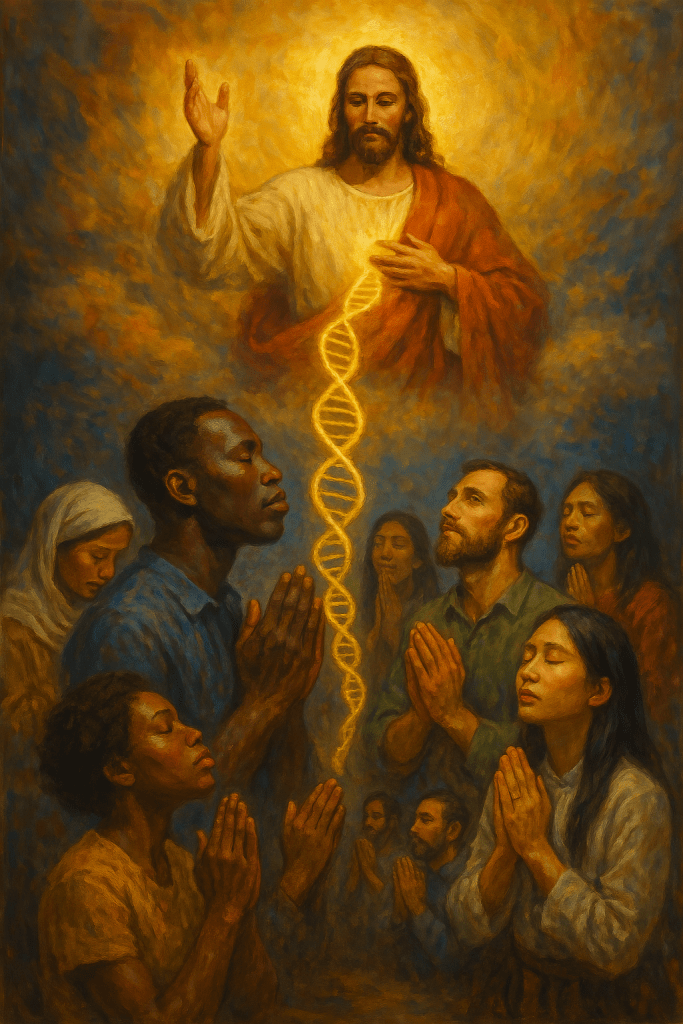
In the age of genetic archaeology, ancient DNA (aDNA) is often hailed as the ultimate truth-teller. It peels back the dust of millennia to reveal who we were, where we came from, and what we looked like. But as the field of paleogenomics grows, so too must our discernment. For beneath the sequencing software lies a deeper question: Are we uncovering facts, or assembling narratives?
How Far Back Does Albinism Go in DNA Tracing?
Albinism, a genetic condition marked by a near-total absence of melanin, can be traced back over 200,000 years through mutations in genes like TYR, OCA2, and SLC45A2.¹ These mutations are globally distributed, occur across all ethnicities, and have likely been present in low frequencies throughout human history.
This reminds us that the human genome has long carried the potential for paleness, but in the case of albinism, this paleness is non-adaptive, often associated with health complications and UV sensitivity. It stands apart from the more familiar light-skinned phenotypes, which spread in northern climates due to environmental selection.
Yet even here, a critical assumption must be examined: that mutation equals advancement. Albinism is a stark counterexample, it shows that not all mutations are “progress.” It reveals the genetic possibility of paleness as a recessive vulnerability, not a selective triumph.
Whiteness and the Misuse of Mutation
From a mainstream evolutionary standpoint, the depigmentation seen in most modern Europeans is considered a beneficial mutation, but only in specific environments. Genes like SLC24A5 and SLC45A2 became prevalent because they enabled better Vitamin D synthesis in low-UV climates.²
However, describing these mutations as “beneficial” invites a dangerous slope. History shows that such language has often been interpreted to mean: More evolved superior and a marker of progress.
This false equivalence gave rise to Social Darwinism, an ideology that framed selective adaptation as a measure of human worth, ignoring that evolutionary processes are contextual, not moral.
Worse, this assumption contradicts evolutionary biology itself, which recognises that most genetic changes are neutral, environment-specific, or even degenerative.³ Depigmentation is not an upgrade, it is one response among many to differing sunlight conditions.
Social Darwinism and #BlackExcellence: Science Misapplied as Supremacy
In the late 19th and early 20th centuries, Social Darwinists weaponised evolutionary theory to justify white supremacy, colonialism, eugenics, and genocide. They claimed that white Europeans were the most evolved humans, evidenced, they said, by their pale skin, technological advancement, and political dominance.⁴
This was a fatal misuse of science. Evolution has no hierarchy. No gene is morally superior. No adaptation is universally “better.” Yet science was co-opted into a racial framework that justified oppression, conquest, and the dehumanisation of others.
However, modern attempts to invert this hierarchy can become equally dangerous. In response to the sins of white supremacy, some have constructed a black supremacist narrative, arguing that blackness represents the genetic origin of humanity, the “pure” or “true” form of human identity, and that all other populations are mutations, dilutions, or even degenerations.
This idea, too, is profoundly flawed.
It turns melanin into a moral metric. It implies that proximity to Africa, or to ancestral pigmentation, makes one more human, more righteous, or more spiritually intact. Just as whiteness was once exalted as an evolutionary pinnacle, blackness is now sometimes exalted as the primordial ideal. In both cases, identity becomes a biological caste system dressed up as historical truth.
This reversal is not redemption. It is revenge dressed as restoration.
The logic remains the same: Skin tone as essence, genetic chronology as virtue, physical difference as moral status.
Whether it is white or black supremacy, the core deception is identical: that worth can be located in melanin, mutation, or ancestral timeline.
Both white supremacy and its inverted counterpart share a false anthropology. They assume that skin defines soul, that origin defines essence, and that variation implies inferiority. They reduce divine image-bearers into pigment proxies, flattening spiritual dignity into genetic labels.
The biblical vision shatters all of this.
Scripture declares that all people are made in the image of God, all have sinned and fallen, and all are offered redemption in Christ, regardless of their ancestry or complexion.
“From one man He made every nation of mankind to live on all the face of the earth…”– Acts 17:26
The gospel levels the ground at the foot of the cross. Supremacy, in any shade, is not liberation, it’s idolatry.
Convergent Evolution or Entropic Decline?
Some scholars frame depigmentation as convergent evolution: different populations (Europeans, East Asians, some Arabs) developed light skin independently in cold or cloudy environments, using different genetic pathways to achieve similar results.⁵
Others propose that light skin may not be adaptive progress, but entropic decline. Melanin performs critical functions: UV protection Folate preservation Anti-inflammatory defense.⁶
From this angle, depigmentation could reflect loss of function, not evolutionary brilliance. This interpretation aligns strikingly with a biblical theology of entropy: the world was created good, but now groans under decay (Romans 8:20–22). Adaptation, then, is often compensation, not perfection.
How Much DNA Have We Actually Recovered?
Ancient DNA findings are limited by degradation. Most fossils yield:
Less than 1% usable DNA in warm climates Up to 70–90% in rare cold-preserved conditions⁷
To reconstruct full genomes, researchers use statistical imputation, filling gaps with data from modern humans. While powerful, this practice depends on inference, not direct evidence.⁸
So when headlines proclaim, “Early Europeans were black,” or “Whiteness only emerged 3,000 years ago,” we must ask:
Based on how many bodies? In what condition? With how much uncertainty?
These reconstructions are remarkable, but they are probabilistic, not absolute.
Did Pale Populations Exist in Arabia and Asia?
Yes, but at different times and via different genetic mechanisms:
East Asians developed depigmentation genes like OCA2 and DDB1/TMEM138 between 5,000–10,000 years ago.⁹ Some Arab and Levantine populations became lighter-skinned through admixture with Indo-European and Central Asian lineages during the Bronze Age.¹⁰
These events were independent of European whiteness. There is no single whitening timeline, only regionally specific adaptations.
So, What Was the Original Skin Colour?
Most geneticists agree that early humans had dark skin:
They evolved in high-UV Africa They carried ancestral melanin-rich alleles There is no genomic evidence of light skin in early Homo sapiens¹¹
Thus, melanin concentration was likely the original baseline. Light skin is best understood as an environmental adaptation, or, in theological terms, a gracious degeneration for survival.
Biblical Reflection: One Ancestor, One Race
Modern genetics affirms what Scripture declared long ago:
“From one man he made all nations, that they should inhabit the whole earth.”– Acts 17:26
Despite regional differences in appearance, we are: Genetically united, spiritually equally valuable to God, universally fallen, and universally redeemable.
The gospel rejects every attempt to ground worth in skin tone or DNA. God’s justice is colourblind, but not indifferent. In His kingdom:
“Man looks at the outward appearance, but the Lord looks at the heart.”– 1 Samuel 16:7
Conclusion: Genetic Truths and Gospel Clarity
Ancient DNA reveals fascinating truths, but it can also be misused.
It shows where we’ve been, but not who we are.
It uncovers variation, but not value.
It tracks origins, but not destinies.
When pigmentation becomes a proxy for supremacy, whether white or black, we must return to a deeper story. A gospel story. A truer anthropology.
Your melanin may vary.
Your ancestry may be ancient.
But your value is eternal.
Because your identity was never meant to be coded in base pairs, it was meant to be written on God’s heart.
Epilogue: When the Data Fades
So why does any of this matter?
Because lies have power. And for centuries, false stories about skin and origin have ruled nations, broken bodies, and divided the Church. But there’s a higher truth, one not found in bone fragments or gene markers.
God does not audit DNA.
He does not measure melanin.
He looks at the heart.
It’s worth noting that not all genetic timelines are speculative. While pigmentation reconstructions rely heavily on inference, lineage-based genetics, such as Y-chromosome and mitochondrial DNA studies, demonstrate striking accuracy in tracing humanity back to a shared origin. These genetic clocks, based on measurable mutation rates, often align with a post-catastrophic repopulation scenario consistent with the biblical account of Noah’s descendants. Secular science may hesitate to name Noah, but the math quietly testifies to him.¹²
Science may serve justice. But it must never become our god. Pigmentation can teach history. But it must never become our hierarchy. In the end, the question is not “Where do you come from?” but “To whom do you belong?” And those who belong to Christ will not stand divided by continent, by caste, or by chromosome.
They will gather.
“A great multitude that no one could number, from every nation, from all tribes and peoples and languages, standing before the throne and before the Lamb, clothed in white robes, with palm branches in their hands…”– Revelation 7:9
That is where the story ends. Not in skin. But in worship.
References
¹ Grønskov, Karen, Jens Ek, and Karen Brondum-Nielsen. “Oculocutaneous Albinism.” Orphanet Journal of Rare Diseases 2, no. 43 (2007): 1–8.
² Mathieson, Iain, et al. “Genome-Wide Patterns of Selection in 230 Ancient Eurasians.” Nature 528, no. 7583 (2015): 499–503.
³ Prüfer, K., et al. “The Complete Genome Sequence of a Neanderthal from the Altai Mountains.” Nature 505, no. 7481 (2014): 43–49.
⁴ Saini, Angela. Superior: The Return of Race Science. London: Fourth Estate, 2019.
⁵ Norton, Heather L., et al. “Genetic Evidence for the Convergent Evolution of Light Skin in Europeans and East Asians.” Molecular Biology and Evolution 24, no. 3 (2007): 710–722.
⁶ Crawford, Nathan G., et al. “Loci Associated with Skin Pigmentation Identified in African Populations.” Science 358, no. 6365 (2017): eaan8433.
⁷ Hofreiter, Michael, et al. “DNA Sequences from Multiple Amplifications Reveal Artifacts Induced by Cytosine Deamination in Ancient DNA.” Nucleic Acids Research 29, no. 23 (2001): 4793–4799.
⁸ Brace, Selina, et al. “Ancient Genomes Indicate Population Replacement in Early Neolithic Britain.” Nature Ecology & Evolution 3, no. 5 (2019): 765–771.
⁹ Ju, Dong-Dong, et al. “Genetic Signatures of High-Altitude Adaptation in Tibetans.” PNAS 118, no. 6 (2021): e2021147118.
¹⁰ Lazaridis, I., et al. “Ancient Human Genomes Suggest Three Ancestral Populations for Present-Day Europeans.” Nature 513, no. 7518 (2014): 409–413.
¹¹ Jablonski, Nina G., and George Chaplin. “The Evolution of Human Skin Coloration.” Journal of Human Evolution 39, no. 1 (2000): 57–106.
¹² Jeanson, Nathaniel T. Traced: Human DNA’s Big Surprise. Green Forest, AR: Master Books, 2022.
 #Hayibo