

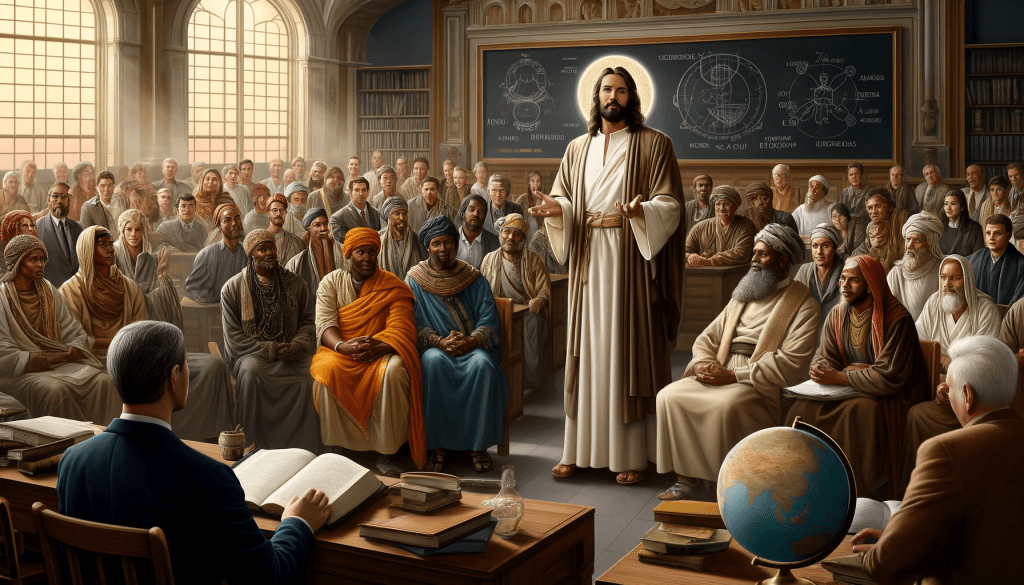
Christian scholars have shaped intellectual landscapes across cultures and disciplines, blending faith and reason to advance knowledge. Their contributions, validated by non-Christian scholars, demonstrate the enduring value of faith-driven inquiry. From the apostles to modern scholars like Dr. William Lane Craig, Frank Turek, Sam Shamoun, African-American theologians, and Indian and Asian thinkers, their work exemplifies the unity of faith and intellect.
Dr. William Lane Craig’s defence of the cosmological argument and his debates with prominent atheists like Christopher Hitchens and Richard Dawkins have elevated Christian philosophy. Even atheist philosopher Quentin Smith acknowledged that Craig’s work has revitalised the philosophy of religion.¹ Similarly, Frank Turek’s engaging arguments in I Don’t Have Enough Faith to Be an Atheist have garnered respect from figures like physicist Lawrence Krauss, who noted Turek’s skill in articulating faith-based views.² Sam Shamoun, known for his expertise in Islamic-Christian dialogue, has earned recognition from Muslim academics like Shabir Ally for his mastery of Islamic and biblical texts.³
African-American Christian scholars have significantly enriched theological and cultural discourse. Howard Thurman, a theologian and civil rights leader, explored the intersection of faith and justice, inspiring figures like Martin Luther King Jr. Non-Christian scholar Vincent Harding described Thurman’s Jesus and the Disinherited as “one of the great spiritual and intellectual treasures of the 20th century.”⁴ Similarly, Dr. James Cone, the father of Black Liberation Theology, redefined theology’s engagement with social justice. Cone’s influence extended beyond Christian circles, with Cornel West, a secular scholar, affirming that Cone’s work “reshaped how we think about race, religion, and democracy.”⁵
From India, Vishal Mangalwadi stands as a leading Christian intellectual. His book The Book That Made Your World argues for the Bible’s transformative role in shaping modern civilisation. Even secular thinkers have praised his scholarship; philosopher and atheist Thomas Nagel highlighted Mangalwadi’s compelling analysis of the Bible’s cultural impact.⁶ In Asia, Dr. Sungho Choi, a South Korean theologian, integrates Confucian ethics with Christian theology, fostering cross-cultural understanding. Choi’s work is recognised globally for bridging Eastern and Western thought.⁷
In history, the apostles laid the foundation for this intellectual legacy. Paul’s writings engaged deeply with Greco-Roman philosophy, and Friedrich Nietzsche, though critical of Christianity, acknowledged Paul’s intellectual mastery.⁸ Augustine of Hippo’s Confessions, a cornerstone of Christian thought, continues to influence both theology and philosophy. Ludwig Wittgenstein admired Augustine’s insights into language and cognition, referencing them in his Philosophical Investigations.⁹
Christian contributions to science are equally significant. Johannes Kepler, a devout Christian, saw his astronomical work as uncovering God’s design, a perspective affirmed by historian A.C. Crombie.¹⁰ Sir Isaac Newton, profoundly influenced by his faith, connected his scientific inquiries to divine order. James Gleick, Newton’s secular biographer, noted that his theological convictions informed his understanding of the cosmos.¹¹
In literature, Marilynne Robinson’s novels explore themes of grace and redemption, earning acclaim from critics like James Wood, who called her “a writer of theological depth.”¹² Alvin Plantinga, a Christian philosopher, revolutionised discussions on faith and reason. Even atheist philosopher Thomas Nagel admitted that Plantinga’s work deserved serious consideration.¹³
The legacy of Christian scholarship spans cultures and centuries, exemplifying the unity of faith and reason. It inspires believers to engage with the world intellectually while pointing to the ultimate source of wisdom—God.
A Prayer for Wisdom

Heavenly Father,
Thank You for the gift of wisdom and for scholars who have sought to honour You through their intellect. From the apostles to modern thinkers, their legacy points to Your truth and glory.
Teach us to love You with all our minds and to seek truth that deepens our faith and reveals Your presence. Bless Christian scholars today—may their work inspire faith, foster understanding, and glorify You across the world.
Let this prayer encourage us to grow in wisdom and walk closer to You each day.
In Jesus’ Mighty name, we pray.
Amen.
References

¹ Quentin Smith, “The Metaphilosophy of Naturalism,” Philo 4, no. 2 (2001): 3. https://philoonline.org.
² Lawrence Krauss and Frank Turek, Debate, “What Best Explains Reality: God or Atheism?” University of Calgary, April 2013. https://www.youtube.com/watch?v=ew_szr9XPZI.
³ Shabir Ally and Sam Shamoun, Debate, “Is the Bible Reliable?” University of Toronto, 2005. https://answering-islam.org/Shamoun/debate.
⁴ Vincent Harding, “The Legacy of Howard Thurman,” The Christian Century, February 15, 1984, 176. https://www.christiancentury.org/article/1984-02/legacy-howard-thurman.
⁵ Cornel West, “James Cone’s Vision of Liberation,” Union Seminary Quarterly Review 55, no. 3 (2001): 18. https://utsnyc.edu/journal/james-cone.
⁶ Vishal Mangalwadi, The Book That Made Your World: How the Bible Created the Soul of Western Civilization (Nashville: Thomas Nelson, 2011). https://vishalmangalwadi.com.
⁷ Sungho Choi, Christianity and Confucianism: A Dialogue of Ethics (Seoul: Yonsei University Press, 2010).
⁸ Friedrich Nietzsche, The Antichrist, trans. Walter Kaufmann (New York: Vintage Books, 1968), 61.
⁹ Ludwig Wittgenstein, Philosophical Investigations, trans. G.E.M. Anscombe (Oxford: Blackwell, 1953), 1.
¹⁰ A.C. Crombie, Science, Art and Nature in Medieval and Modern Thought (London: Hambledon Press, 1996), 79.
¹¹ James Gleick, Isaac Newton (New York: Pantheon, 2003), 96.
¹² James Wood, “Acts of Devotion,” The New Yorker, November 28, 2004, 68. https://www.newyorker.com/magazine/2004/11/28/acts-of-devotion.
¹³ Thomas Nagel, Mind and Cosmos: Why the Materialist Neo-Darwinian Conception of Nature Is Almost Certainly False (Oxford: Oxford University Press, 2012), 26.
 #Hayibo