(John 12:31–33)
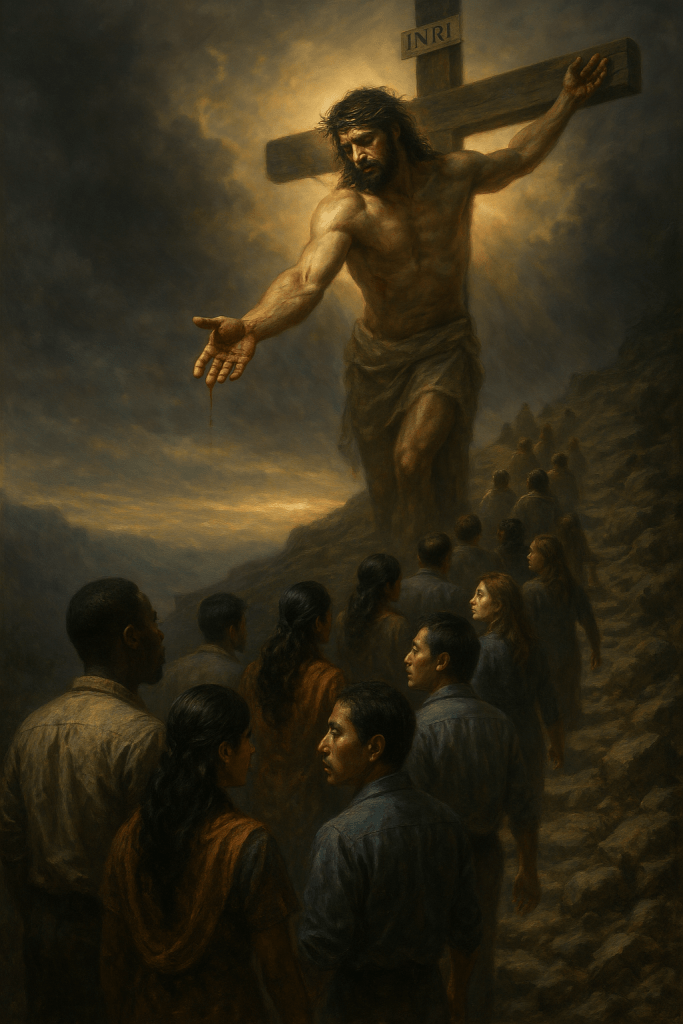
“And I, if I am lifted up from the earth, will draw all peoples to Myself.” — John 12:32

The Climb That Was Never Ours
I have, intentionally, been studying and reading since Covid. For years prior, I read bits and bobs, investigated all sorts of things. Years of various therapies, and much work with the Holy Spirit guiding and correcting me, have shaped me deeply.
I wish I could say it made me a perfect human, but my longing for perfection was really my attempt to escape judgment. It was a psychological mindgame, a disguised desire for control. That craving was born from violence that stripped value and from therapeutic narratives that promised freedom through self-management, “control the narrative,” they said.
One of those narratives, pluralistic relativism, claims that all beliefs are equally valid. This notion collapses under its own contradiction. The same culture that celebrates equality will defend practices that degrade it. Some ideologies even weaponise inclusion to erase moral distinction.
But in John 12, we find a truth so rare, it stands alone in history: an exclusive act that births inclusive grace.
The Cross: Judgment of False Inclusion
“Now is the judgment of this world.” — John 12:31a
The world (kosmos) here does not mean creation itself but the moral order in rebellion against its Maker, the system that, as D. A. Carson notes, “lives in darkness precisely because it will not receive the Light.”¹
The Cross is not only the judgment of sin; it is the judgment of every false narrative about love, tolerance, and worth. It exposes what Miroslav Volf calls “the culture of exclusion masquerading as inclusion,” where acceptance demands silence on truth.²
The Dethronement of the Pretender
“Now the ruler of this world will be cast out.” — John 12:31b
Here, Christ announces the eviction of the great deceiver. The word ekballō (“cast out”) echoes both Eden and Exodus; the driving out of the usurper who enslaved creation through lies.
As Karl Barth reminds us, the Cross is not defeat but divine overthrow:
“The Judge judged in our place.”³
Satan’s power lay in accusation; once sin was atoned for, his jurisdiction collapsed. Every ideology that builds identity apart from grace belongs to that fallen order.
The Magnetism of the Lifted Christ
“And I, if I am lifted up… will draw all peoples to Myself.” — John 12:32
The Greek helkō (“to draw”) denotes inward attraction, not external coercion. It’s the same verb used in John 6:44, speaking of the Father’s gentle pull of grace. Jesus does not drag souls by fear but draws them by truth, the gravitational field of divine love.
N. T. Wright describes this as the “reversal of Babel”: humanity once scattered by pride is now gathered by cruciform mercy.⁴
This is inclusion without dilution, attraction that sanctifies, not affirmation that anaesthetises.
The Inclusive Scope of Exclusive Grace
“…will draw all peoples…” — John 12:32
“All peoples” (pantas) signifies all without distinction, not all without exception. Salvation is offered universally but applied particularly, to those who look to the lifted One.
The exclusivity is not elitism; it’s ontology. Only the sinless can save sinners. As C. S. Lewis noted, “The invitation is to all, but it is still a wedding, you must wear the right clothes.”⁵
Thus, divine inclusion does not erase boundaries; it redeems them.
The Throne That Looked Like Defeat
“This He said, signifying by what death He would die.” — John 12:33
The Cross is both crucifixion and coronation. The verb hypsōthō (“lifted up”) carries the double meaning of raised high and exalted. John’s Gospel fuses suffering and glory into a single event.
John Stott captures it perfectly:
“The essence of sin is man substituting himself for God; the essence of salvation is God substituting Himself for man.”⁶
On this throne of nails, Christ rules, not through domination, but through surrender.
The Healing of Disordered Desire
Where the world preaches, “Be whatever you want,” the Cross whispers, “Be who you were made to be.”
Christ’s magnetism draws us out of the dysphoria of self-invention and into the peace of divine conferral. He doesn’t demand that we climb toward worthiness; He descends to draw us into Himself.
At Calvary, all the narratives of self-definition die, and resurrection begins.
Conclusion: The Door That Draws
At the Cross, Jesus says:
“You do not have to climb to Me; I will draw you.”
All nations, all histories, all wounds, but all through one Door.
The Cross is God’s final word against pluralistic relativism and therapeutic self-salvation. The world offers inclusion without transformation; Jesus offers transformation that includes all who believe.
True belonging has one condition, to come through the Crucified Christ.
Prayer
Lord Jesus, lifted up above every lie and label,draw me again to the place where striving ceases.
Deliver me from the world’s false inclusions, and make my heart rest in the exclusivity of Your grace.
Teach me to love truth more than comfort, and to trust that Your arms are wide enough for all, but narrow enough for the Cross.
In Your Powerful, and Holy Name Lord Jesus,
Amen.

Practical Application: Living from the Draw, Not the Climb
The Cross did not just redeem the world; it redefined how we live within it.
If Jesus says, “I will draw all peoples to Myself,” then Christian life begins not in self-assertion but in yielded attraction. We are not called to climb ladders of achievement, virtue, or validation to reach God; we are called to be drawn, to consent to grace.
This changes everything about how we approach purpose, inclusion, and holiness.
1. Stop Managing Your Worth
The world trains us to curate ourselves, to be marketable, impressive, and perpetually “becoming.” Yet, as long as our worth depends on performance, we remain enslaved to comparison. The magnetism of Christ invites us to rest in conferral.
You are not valuable because you are ascending; you are valuable because He descended.
2. Replace Tolerance with Transformation
The cultural counterfeit of inclusion says: “All ways are valid.”
The gospel’s inclusion says: “All people are invited, but through one Way.”
Practically, this means we love without compromise. We welcome everyone to Christ, not to relativism. When truth and grace meet, love becomes redemptive, not permissive.
3. Discern the Voices of False Attraction
Not every “draw” is divine. The world’s draws, attention, applause, affirmation, promise acceptance while deepening alienation. Jesus’ draw sanctifies desire; it doesn’t exploit it. When something offers you belonging at the cost of truth, it is the serpent’s whisper in modern disguise.
4. Allow the Cross to Judge Your Culture Before You Judge It
“Now is the judgment of this world.” (John 12:31)
Before condemning the culture, let the Cross expose your own idols: control, perfectionism, fear, resentment. Let the judgment fall there first. You will discover that divine judgment is also divine healing.
5. Live as One Who Is Being Drawn
Discipleship is not a sprint up the mountain; it is a steady gravitational pull toward the heart of God.
Spiritual maturity means cooperating with that pull, through prayer, surrender, and obedience, rather than resisting it with self-protection or pride.
The more we yield, the freer we become.
Reflection
Every human life is magnetised by something. The question is not “Am I being drawn?” but “Who is drawing me?”
When you let Christ lift you by His love, you discover that the arms stretched wide on Calvary were not a gesture of exclusion, but of invitation.

References
1. D. A. Carson, The Gospel According to John (Grand Rapids, MI: Eerdmans, 1991), 445.
2. Miroslav Volf, Exclusion and Embrace: A Theological Exploration of Identity, Otherness, and Reconciliation (Nashville, TN: Abingdon Press, 1996), 64–66.
3. Karl Barth, Church Dogmatics IV/1: The Doctrine of Reconciliation (Edinburgh: T&T Clark, 1956), 220.
4. N. T. Wright, John for Everyone, Part 2 (Louisville, KY: Westminster John Knox, 2004), 49–50.
5. C. S. Lewis, Mere Christianity (New York: HarperOne, 2001), 177.
6. John R. W. Stott, The Cross of Christ (Downers Grove, IL: InterVarsity Press, 1986), 160.
 #Hayibo