


Sitting in my cosy and colourful living room, coffee on hand, financial crises scary, thesis needing a final page-number check before submission, and assignments waiting to be wrestled with, I am surrounded by a surprising gentleness. This gentleness is not of my own making. It is the quiet presence of the Holy Spirit, infusing my Bible reading and my quiet time before God.
Opening to the suggested reading in my plan in Book of Nehemiah 8, I discover something profoundly relevant to our time. At first, my inner activist wants to sprint toward writing a hard-hitting post about contriteness.
But God seems to have other plans.
As I sit in the gentleness, I realise something before I say anything else: I need this passage myself. I need God’s kindness in conviction, perhaps more than most.
So instead of analysing the text first, perhaps we should allow the text to read us.

When Truth Was Heard
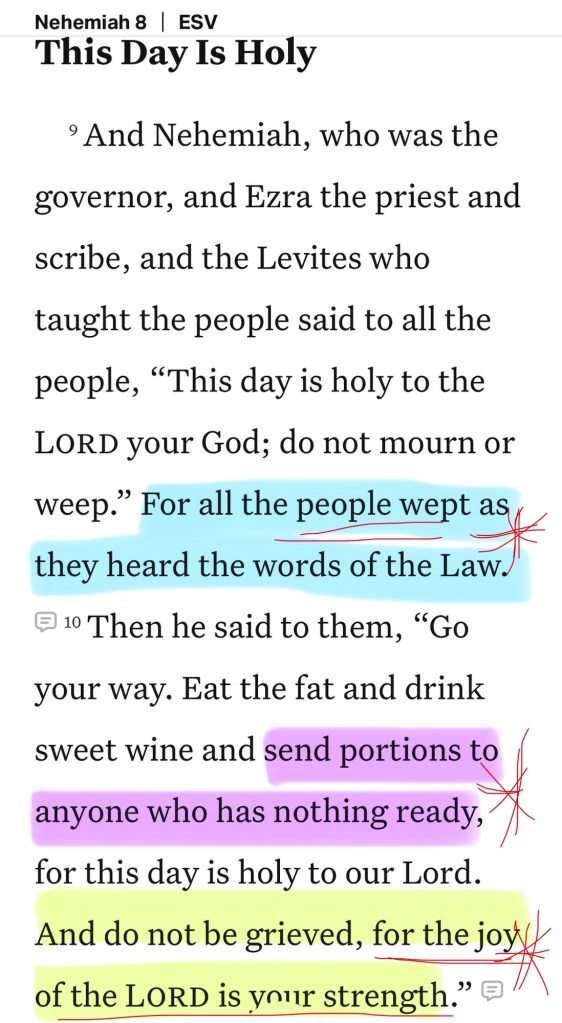
The scene in Nehemiah 8 is striking. The people of Israel gather as Ezra reads the Law aloud. Something unexpected happens:
“All the people wept as they heard the words of the Law.” (Neh. 8:9)
They do not argue with the text.
They do not reinterpret it to soften its implications.
They do not accuse the reader of intolerance or cultural insensitivity.
They weep.
Not because they hate themselves, but because they suddenly see the distance between their lives and the holiness of God.
This kind of moment is what theologians have long called conviction, the awakening that occurs when truth confronts us honestly.
Why We Resist Truth
Our modern instinct is often very different. Instead of allowing truth to confront us, we frequently attempt to negotiate with it.
Psychologist Leon Festinger famously described this phenomenon as cognitive dissonance: the discomfort we experience when our behaviour conflicts with what we know to be true. Instead of changing our behaviour, we often change the interpretation of truth so that we can feel consistent again.
Similarly, social psychologist Jonathan Haidt has argued that human beings are remarkably skilled at moral rationalisation. Rather than discovering truth objectively, we often behave more like lawyers defending our prior beliefs.
In other words, the human mind is extraordinarily capable of protecting itself from uncomfortable truth.
Perhaps this explains why the scene in Nehemiah 8 feels so foreign to us.
The people did not defend themselves.
They allowed the Word of God to correct them.
The Surprising Response of the Leaders
But something even more surprising happens next.
Nehemiah and Ezra interrupt the crying.
They say:
“This day is holy to the LORD your God; do not mourn or weep.” (Neh. 8:9)
Why stop the mourning?
Because conviction is not meant to end in despair.
God exposes our brokenness so that restoration can begin.
The leaders tell the people to celebrate, eat good food, and share with those who have nothing prepared. The joy of the Lord, they say, will become their strength.
Notice the order carefully:
Truth
→ Conviction
→ Alignment
→ Joy.
Modern spirituality often tries to skip directly to joy without passing through the honesty of conviction. But the biblical pattern is different. Joy is not the denial of truth; it is the gift that follows when truth is finally welcomed.
Joy That Becomes Generosity
The instruction to share food with those who have none is also significant. Restoration with God does not end with private relief. It spills outward into compassion for others.
Contrite hearts become generous hearts.
Those who recognise how much mercy they have received become eager to extend mercy themselves.
Letting Scripture Read Us
Perhaps this is the quiet invitation of Nehemiah 8 for our own time.
Before we rush to interpret Scripture, defend our positions, or argue our perspectives, we might first ask a simpler question:
What would happen if we allowed God’s Word to read us?
Not to shame us.
Not to crush us.
But to gently expose the places where we need restoration.
Because the same passage that caused the people to weep also gave them one of the most beautiful promises in Scripture:
“The joy of the LORD is your strength.” (Neh. 8:10)
And perhaps that joy begins the moment we stop resisting truth and allow God’s kindness to correct us.
Prayer
Father God, Jesus, Holy Spirit,
Thank You for Your gentle presence today. I confess that sometimes I become so eager to serve You with the gifts You have given me that I forget to slow down and allow You to wash my own heart as well.
Teach us to respond to You with genuine humility. Help us to weep before You not as a performance or out of shallow regret, but with true contriteness as we remember how holy You are and how far we often fall short.
Help us to receive Your discipline as love. You teach us that You correct those You care for. Give us the wisdom to recognise that growth, even when painful, is evidence of Your mercy at work in us.
Break through our illusions of self-sufficiency and soften the stubborn places in our hearts. Lead us away from defensiveness and toward surrender, so that we may experience the transforming power of Your truth.
And in that transformation, restore to us the joy that comes from belonging to You.
In the holy and powerful name of Jesus Christ: Messiah, King, Lord, and God,
Amen.
TRACK TO ENJOY:

References
Festinger, Leon. A Theory of Cognitive Dissonance. Stanford, CA: Stanford University Press, 1957.
Haidt, Jonathan. The Righteous Mind: Why Good People Are Divided by Politics and Religion. New York: Pantheon Books, 2012.
 #Hayibo