

There is tension in God’s presence this morning. In fact, there has been tension for days. It is a spiritual weight familiar to those who have walked with God long enough to discern His nearness in disruption. Over the last twenty-two years of following Jesus, I have learned that divine tension is often the prelude to revelation. At first, I feared it, conditioned by theological worldviews that overemphasised God’s love while muting His wrath. But biblical faith does not sanitise God’s justice for the sake of modern sentimentality. A truly moral God must oppose evil. If He were tolerant of wickedness in the name of love, He would cease to be holy and love would cease to be love.
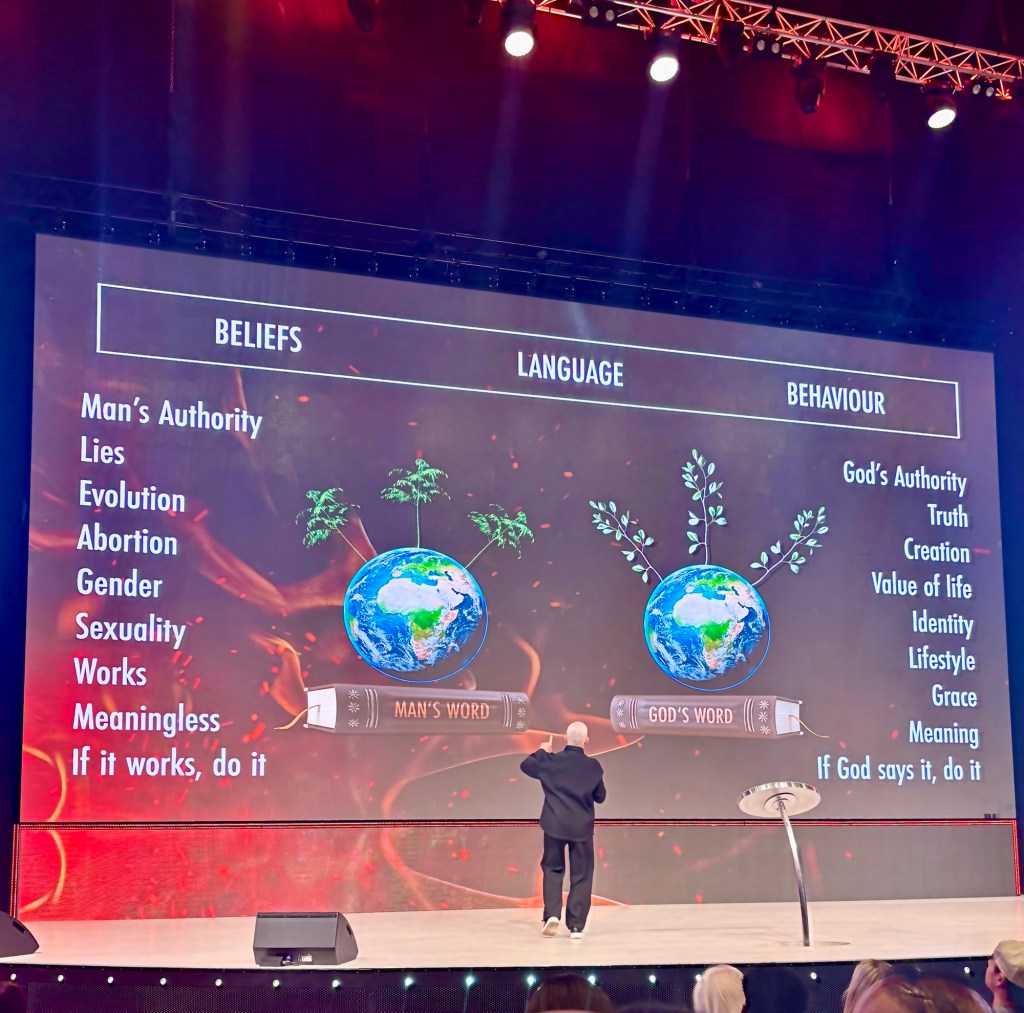
This Monday, 31 March 2025, I sense God’s voice cutting through illusion. I am researching the foundations of South Africa’s secular Constitution, and simultaneously being drawn, undeniably, into the words of Jesus in John 5:21–23. What began as academic labour has become spiritual confrontation. And then, in church, our pastor shared a chart on worldviews: Man’s word versus God’s word. The line that pierced me came from Os Guinness: “A worldview is not simply the lens through which we see the world; it also shapes the world we choose to see.”¹
That is precisely the indictment of John 5. Jesus, the Son of God, says: “For as the Father raises the dead and gives life to them, even so the Son gives life to whom He will. For the Father judges no one, but has committed all judgment to the Son, that all should honour the Son just as they honour the Father. He who does not honour the Son does not honour the Father who sent Him.”
The claim is staggering. Jesus does not simply reflect the Father, He executes the Father’s authority. He gives life to whom He chooses. He judges on behalf of heaven. He is the final moral arbiter, the decisive voice over death and eternity. If this is true, what right does any human court or constitution have to legislate morality without reference to the Son?
Yesterday, God gave me a vision in church: a nightscape city, shrouded in darkness. Above it hovered a glitchy, noisy distortion; a spiritual dissonance. And breaking through the clouds came Jesus, close and overwhelming. The symbolism was clear. The city is us, sedated by self-serving ignorance. The glitch is our attempt to define truth and justice apart from divine revelation. It is the Enlightenment legacy, secular humanism, constitutional frameworks, psychological constructs, all claiming autonomy while borrowing morality from a God they deny. And above it all stands Christ, not distant but near, ready to judge.
* How can the South African Constitution built on Enlightenment philosophy claim to deliver justice when it explicitly denies the Lordship of the Judge?
* How can it protect dignity while denying the imago Dei in the unborn?
* How can it legislate equality while treating all moral worldviews as equally valid, even those that contradict reality itself?
* Is this truly justice, or is it a reframing of rebellion?
Bernard Bekink states, “The relationship between the concepts of constitutionalism, secularism and an individual’s fundamental right to freedom of religion has been strenuous over many centuries.”— Bernard Bekink, “The Intrinsic Uneasy Triangle Between Constitutionalism, Secularism and the Right to Freedom of Religion: A South African Perspective,” Potchefstroom Electronic Law Journal 11, no. 4 (2008), https://hdl.handle.net/10520/EJC55191.
The Enlightenment promised freedom through reason. But divorced from God, reason becomes raw material for pride. As Cornelius Van Til warned, secular man sits in God’s chair while denying His existence.² N. T. Wright calls this the great lie of modern justice: that evil can be managed by systems, and righteousness achieved without grace.³ R. J. Rushdoony went further, insisting that all law is theological. If it does not come from God, it comes from man, and when man becomes god, injustice becomes law.⁴
Timothy Keller affirms this from a pastoral lens: true justice flows not from social theory, but from grace-infused righteousness grounded in the heart of God.⁵ David Guzik’s commentary on John 5 reinforces that Jesus’ authority to judge is not a metaphor, it is the structural reality of the kingdom of God.⁶
Even among well-meaning legal thinkers, the idea persists that justice can be a neutral framework. But as Stanley Fish has argued, no system of law is ever value-free; all law flows from a vision of the good life, and that vision is never neutral.⁷ Jorge Elorza’s critique of “hyper-secularism” shows how modern governance increasingly excludes religious perspectives under the guise of fairness.⁸ Peter Danchin builds on this, demonstrating how religious freedom has been manipulated into a tool of exclusion, where public life is slowly sanitised of God.⁹
So where does this leave South Africa today?
We have a Constitution globally praised for its liberal ideals, yet we remain a nation in moral crisis. Could it be that we have confused tolerance with truth? That we have enthroned man’s voice above God’s? That we have created a structure which, though well-meaning, is spiritually illegitimate because it refuses to honour the Son?
What would happen if we returned to John 5: to a justice defined not by consensus but by Christ? Could we reimagine governance under the Kingship of Jesus, where law begins with honouring the Son and flows from the heart of the Father? Would our vision clear, our noise still, our cities awaken?
Practical Application

For believers, the call is not merely to critique. It is to prophesy, to speak truth to systems that pretend neutrality while rejecting God. It is to honour the Son publicly, politically, and personally. To remember that any justice not anchored in Christ will ultimately be judged by Him.
“If my people, which are called by my name, shall humble themselves, and pray, and seek my face, and turn from their wicked ways; then will I hear from heaven, and will forgive their sin, and will heal their land.”— 2 Chronicles 7:14 (KJV)
Prayer
Lord Jesus,
Judge of the living and the dead, we repent of the ways we have honoured the systems of man while dishonouring You. Break through our noise, silence our delusions, and draw near in power. May South Africa, and our own hearts, recognise that all judgment has been entrusted to You, and that to know justice, we must first know the Son.
In Your Holy Name King Jesus,
Amen.
References

1. Os Guinness, The Call: Finding and Fulfilling the Central Purpose of Your Life (Nashville: Thomas Nelson, 2003).
2. Cornelius Van Til, Christian Apologetics (Phillipsburg, NJ: P&R Publishing, 1976).
3. N. T. Wright, Evil and the Justice of God (Downers Grove, IL: InterVarsity Press, 2006).
4. Rousas John Rushdoony, The Institutes of Biblical Law (Nutley, NJ: The Craig Press, 1973).
5. Timothy Keller, Generous Justice: How God’s Grace Makes Us Just (New York: Dutton, 2010).
6. David Guzik, “Commentary on John 5,” Enduring Word, https://enduringword.com/bible-commentary/john-5/.
7. Stanley Fish, The Trouble with Principle (Cambridge, MA: Harvard University Press, 1999).
8. Jorge Elorza, “Secularism and the Constitution: Can Government Be Too Secular?” University of Pittsburgh Law Review 72, no. 1 (2010).
9. Peter G. Danchin, “Religious Freedom as a Technology of Modern Secular Governance,” University of Maryland School of Law, 2014.
 #Hayibo