


Two ways of knowing:
One tries to control reality.
The other learns to listen to it.
“Knowledge would be fatal. It is the uncertainty that charms one. A mist makes things wonderful.” – Oscar Wilde

Introduction
I have lived a life that includes experiences many would describe as “spooky.” Not because they are inherently irrational or fantastical, but because our categories for understanding them are often limited, misapplied, or, at times, deliberately distorted. There are indeed abuses in this space, where claims of spiritual insight are manipulated for power or financial gain. Such distortions rightly produce scepticism. Yet scepticism alone does not resolve the deeper issue: some forms of knowing resist easy explanation within conventional academic frameworks.
My own life has included moments that I cannot adequately account for through purely naturalistic categories. I have, at times, experienced what can only be described as prophetic insight, instances in which knowledge preceded events. I do not offer this as an argument for the validity of such experiences, nor as a claim to authority. Rather, I offer it as a confession: that my lived experience has included forms of knowing that challenge the assumption that all knowledge originates from within the closed system of human cognition.
There have been moments where I have seen events before they occurred: an uncle’s death by drowning in the ocean, a neighbour’s arrest for diamond smuggling, a client’s unexpected pregnancy despite medical impossibility. These are not presented as spectacles, but as data points in a life that has repeatedly confronted me with a simple but disruptive realisation: not all knowledge fits comfortably within naturalistic explanations. There appears to be, at least at times, a form of knowing that is given rather than constructed.
This conviction is not limited to extraordinary experiences. As a Christian, I encounter it regularly in the ordinary act of reading Scripture. There are moments when passages illuminate questions I have carried for years, or speak directly into situations with a clarity that feels less like discovery and more like disclosure. It is as though understanding is not merely achieved, but granted. My thesis for my degree is riddled with insights after the Holy Spirit asked me questions I didn’t even know to ask, yet as I investigated them understanding opened up which strengthened my research.
It is within this context that I approach John 14:25–28. When Jesus speaks of the Holy Spirit teaching and reminding His disciples, He is not merely offering comfort. He is making a claim about the nature of knowing itself. For those who have experienced knowledge as something received rather than constructed, His words resonate with a particular force. They suggest that what we call “knowing” may be far more expansive, and far more relational, than modern assumptions allow.
This raises a fundamental question: if there are forms of knowing that do not originate from the self, how should we understand knowledge at all?
Section 1 begins by addressing this question at its most basic level: what epistemology is, and why it matters.
Section 1: What Is Epistemology and Why It Matters?
Epistemology is the branch of philosophy concerned with knowledge: what it is, how it is justified, what counts as warrant for belief, and how human beings come to know anything at all. At first glance, this can sound abstract, technical, or remote from ordinary life. Yet that impression is deeply misleading. Epistemology is never merely about ideas in the air. It concerns the structure of human contact with reality itself. Esther Lightcap Meek, drawing on Parker Palmer, notes that the nature of the knower, the nature of the known, and the nature of the relation between them are not questions confined to academic philosophy. Rather, “the shape of our knowledge becomes the shape of our living; the relation of the knower to the known becomes the relation of the living self to the larger world.”¹ Epistemology matters because the way we believe we know reality inevitably shapes the way we act within it.
This is why a discussion of epistemology is not an optional intellectual luxury. It bears directly on human experience, pedagogy, morality, identity, and spiritual life. If knowledge is understood merely as detached observation, then human beings will increasingly imagine themselves as spectators rather than participants. If knowledge is understood as self-generated, then autonomy will be elevated over humility. If knowledge is conceived as the possession of neutral facts alone, then wisdom, authority, testimony, embodiment, love, and reverence will all be quietly pushed to the margins. Meek exposes this modern default with great force when she describes what she calls a “daisy of dichotomies,” in which knowledge is set over against belief, facts against values, reason against faith, theory against application, science against religion, objectivity against subjectivity, mind against body, and the public sphere against what is treated as merely personal or private.² Such a framework does not merely organise information. It deforms the knower.
Robert Audi’s work helpfully clarifies why epistemology matters at this level. He argues that knowledge is intimately connected to justified belief. A person may hold a belief, but unless that belief is appropriately grounded, it lacks the positive epistemic status that makes it fitting for rational creatures to hold.³ Justification, in other words, is not an ornamental extra attached to belief after the fact. It is what marks belief as responsible, appropriate, and cognitively serious. Audi also notes that although justified belief and knowledge are closely related, they are not identical. One may justifiedly believe something false, but one cannot know what is false.⁴ This distinction is essential, because it means that epistemology is not only about what we happen to think. It is about whether our beliefs are grounded in a way that genuinely connects us to reality.
Audi further shows that perception is among our most basic sources of knowledge.⁵ We see, hear, touch, smell, and taste the world, and these modes of contact provide the raw material from which beliefs may arise. Yet perception is already more complex than modern simplifications often allow. He distinguishes between merely perceiving an object, perceiving it to be something, and perceiving that a proposition about it is true.⁶ That distinction is philosophically important because it reveals that human knowing is not reducible to passive sensory intake. Perception already involves layered acts of apprehension, interpretation, and belief formation. We do not simply receive the world as a camera might record pixels. We come to understand it in structured ways.
This is precisely why the modern myth of detached objectivity is inadequate. Michael Polanyi rejects the ideal of scientific detachment as a sufficient account of knowing and insists instead that all knowing involves personal participation.⁷ Knowledge is not less objective because the knower is involved. Rather, the knower’s involvement is one of the conditions by which contact with reality becomes possible. Polanyi famously reconfigures knowing as an active act of comprehension in which particulars are integrated into a meaningful whole.⁸ We attend subsidiarily to clues in order to focus on what they disclose. Such knowing is not arbitrary, but neither is it impersonal. It requires skill, commitment, and the shaping activity of the knower. In that sense, human knowing is always more than mechanical data accumulation. It is an act of responsible contact.
This insight becomes especially important when modern accounts of knowledge pretend that neutrality is the highest virtue. Neutrality, in fact, is often a disguised metaphysical commitment. It assumes that reality is best known when the knower’s loves, loyalties, embodiment, and situatedness are minimised. But Polanyi argues that into every act of knowing there enters the passionate contribution of the person knowing what is being known, and that this is not a defect but a vital component of knowledge itself.⁹ Meek extends this insight by showing that the reigning modern picture of knowledge has systematically excluded precisely those dimensions most central to human life: faith, moral seriousness, imagination, authority, embodiment, and relationship.¹⁰ The result is not purification, but impoverishment.
This is where theological reflection becomes indispensable. Meek observes that religious communities have often failed to identify and mine the epistemological riches of their own commitments.¹¹ Yet if theology has genuine resources for understanding knowledge, then it must be allowed to speak into the philosophical conversation. John Frame does precisely this by grounding knowledge in the covenant lordship of God. He argues that the Creator-creature relation is covenantal, and that divine lordship involves control, authority, and presence.¹² This has immediate epistemological consequences. If God is Lord, then human knowing is never autonomous. It is always already situated under divine authority, within divine presence, and in relation to a world that is not self-grounding but dependent upon God.
This covenantal account of knowledge also prevents the collapse into two opposite errors. On the one hand, God must not be conceived as so distant and unknowable that revelation becomes impossible. On the other hand, He must not be collapsed into the world in such a way that divine speech becomes indistinguishable from natural process. Frame’s account of lordship preserves both transcendence and immanence without sacrificing either.¹³ God is exalted above creation, yet actively present to it. He is not merely an abstract principle, nor merely an immanent force. He is the living covenant Lord. This is epistemologically decisive, because it means that knowledge is not finally grounded in the isolated self but in a reality already interpreted by God’s own presence and authority.
Nicholas Wolterstorff, approaching from a different angle, identifies another crucial problem. Philosophers have given surprisingly little direct attention to divine discourse, despite the fact that the sacred texts of Judaism, Christianity, and Islam are saturated with claims that God commands, promises, blesses, warns, and addresses.¹⁴ Part of the neglect, he argues, stems from the mistaken assumption that divine speech can simply be reduced to divine revelation. Yet speaking and revealing are not identical acts.¹⁵ Moreover, once contemporary speech-act theory distinguishes between uttering words and performing acts such as commanding, promising, or asserting, it becomes far easier to see that speech need not be reduced to physical vocalisation alone.¹⁶ This opens a fresh philosophical path for taking seriously the possibility that God speaks and that human beings may genuinely know through divine address.
At this point, the real stakes of epistemology become visible. The issue is not simply whether we can define knowledge with analytic neatness. The issue is whether human beings live in a reality where truth is self-generated, socially negotiated, biologically conditioned, or personally conferred by a speaking God. Modernity has often trained us to think of knowledge as detached, neutral, impersonal, and self-validating. But the combined force of Audi, Polanyi, Meek, Frame, and Wolterstorff points in another direction. Knowledge is grounded, relational, interpretive, morally conditioned, and often mediated through testimony and trust. It requires not only cognition but posture.
That posture matters profoundly. For if knowledge is not merely extracted from a mute world but received in relation to reality, then the knower’s stance becomes central. Are we humble or defensive? Open or controlling? Obedient or evasive? Frame presses this point with exceptional force when he argues that obedience is the criterion of knowledge, because the God whom we seek to know is not an abstraction but the living Lord who is profoundly involved with every area of life.¹⁷ In that light, epistemology can never be morally neutral. How we live affects how we know.
Section 1, then, establishes a necessary foundation for everything that follows. Epistemology matters because every life already rests upon some answer to the question of how knowing works. The modern answer has often reduced knowledge to detached observation, rational control, and the management of facts. But a richer account is possible. Human knowing is participatory, relational, embodied, and dependent. It involves perception, testimony, memory, interpretation, trust, and commitment. And if that is true at the human level, then the possibility that Jesus in John 14 is teaching not merely comfort but a profound account of knowing itself is no longer strange. It becomes philosophically and theologically unavoidable.
Section 2: Jesus Teaches Epistemology
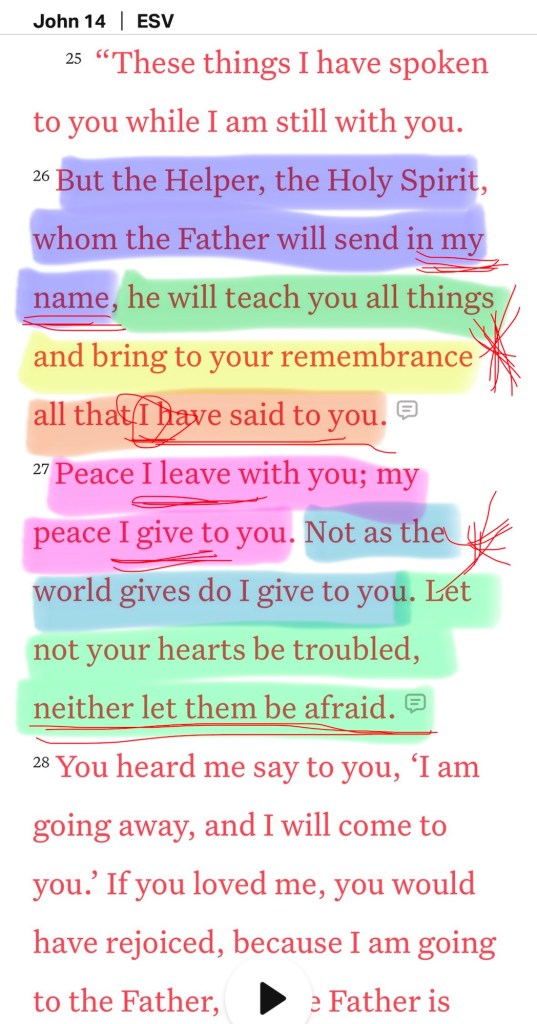
If epistemology concerns how knowledge is possible, then the claim that Jesus teaches epistemology in John 14 may initially seem unexpected. The passage is often read devotionally, as a source of comfort in the face of uncertainty. Yet such a reading, while not wrong, is incomplete. Jesus is not merely consoling anxious disciples. He is reconfiguring their understanding of knowledge itself. His statements are not only pastoral. They are epistemological.
The context is crucial. The disciples are disoriented. Their expectations of Messiah, kingdom, and future are collapsing. Into that uncertainty Jesus does not offer abstract principles or detached arguments. He offers Himself. “I am the way, and the truth, and the life” is not simply a theological declaration. It is an epistemic claim. Knowledge is not presented as something external to the knower, nor as something constructed internally by the knower. It is mediated through a person. The structure of knowing is thus immediately transformed. To know truly is to be rightly related to Christ.
This already challenges modern assumptions. In many contemporary frameworks, knowledge is treated as the product of correct method, empirical verification, or rational coherence. The knower stands over against the known, analysing, testing, and validating. But in John 14, the direction is reversed. Knowledge is not achieved by the subject mastering the object. It is received through encounter with the One who discloses reality. This aligns with the broader epistemic insight that knowledge is not purely inferential or constructed, but often arises through direct acquaintance and trustworthy mediation. Audi’s account of perception and testimony helps clarify this point. He shows that belief can arise non-inferentially, either through direct perception or through credible testimony that we are disposed to trust.¹⁸ In both cases, knowledge is not always the result of step-by-step reasoning. It is frequently grounded in contact and trust.
Jesus’ teaching in John 14 operates precisely within this structure. When He says, “No one comes to the Father except through me,” He is not merely stating exclusivity in a doctrinal sense. He is identifying the condition for access to reality as it truly is. If knowledge of God is the highest form of knowledge, then the means of that knowledge is not autonomous reasoning but mediated relationship. This resonates strongly with Frame’s insistence that knowledge of God is covenantal. God is not an object to be studied from a distance but a Lord to whom one stands in relation.¹⁹ Knowledge, therefore, is inseparable from posture. It involves trust, obedience, and participation.
This is made even clearer in Jesus’ response to Philip: “Whoever has seen me has seen the Father.” Here the language of perception is explicit. Seeing Christ is equated with seeing God. Yet this cannot be reduced to mere visual perception. Audi’s distinctions help us again. There is a difference between perceiving of something, perceiving it to be something, and perceiving that something is the case.²⁰ Jesus’ statement operates at all three levels simultaneously. The disciples have seen Him. They have perceived Him to be teacher, healer, and Messiah. But they have not yet fully perceived that He is the definitive revelation of the Father. Their epistemic problem is not lack of exposure but lack of recognition.
This is a profoundly important insight. It shows that proximity to truth does not guarantee knowledge of truth. One may encounter reality and yet fail to interpret it rightly. This aligns with the broader epistemological claim that perception alone does not determine belief. Conceptual frameworks shape what we are able to recognise.²¹ If one lacks the appropriate categories, one may see without understanding. Jesus’ teaching, therefore, is not merely informational. It is transformative. It reshapes the conceptual and relational framework through which reality is apprehended.
At this point, Polanyi’s account of tacit knowledge becomes particularly illuminating. He argues that all knowing involves a movement from subsidiary awareness of particulars to focal awareness of a coherent whole.²² The disciples possess many clues. They have witnessed miracles, heard teaching, and experienced Christ’s presence. Yet these clues have not yet been integrated into a unified understanding. Jesus, in John 14, is effectively reorienting their focal awareness. He is telling them how to interpret what they have already experienced. Knowledge, in this sense, is not the accumulation of new data but the reorganisation of existing experience under a true interpretive centre.
This also explains why Jesus emphasises the coming of the Spirit. “The Helper, the Holy Spirit… will teach you all things and bring to your remembrance all that I have said to you.” The role of the Spirit is not to replace Christ’s teaching but to illuminate it. The Spirit enables proper recognition, proper integration, and proper understanding. This is epistemologically significant. It suggests that knowledge is not merely a natural cognitive achievement but involves divine assistance. The knower requires transformation, not merely information.
Here again, Audi’s work on testimony provides a helpful parallel. He notes that testimony can function as a source of belief that is not always inferential but often immediate, especially when the speaker is trusted.²³ In everyday life, we rely extensively on such testimony. We “just believe” credible sources unless we have reason not to. This structure of trust is not a weakness of human cognition. It is one of its fundamental features. When applied to divine revelation, the implication is striking. If human testimony can produce justified belief through credibility, then divine testimony, grounded in perfect authority and truthfulness, provides an even stronger basis for knowledge.
Wolterstorff presses this point by arguing that God’s speech should be understood in terms of speech acts.²⁴ God does not merely convey information. He performs actions through speaking. He commands, promises, warns, and invites. This means that divine communication is not reducible to propositions detached from context. It is relational and authoritative. When Jesus speaks in John 14, He is not offering neutral data. He is addressing His disciples as covenant partners, calling them into trust and alignment. Knowledge, therefore, is not merely cognitive assent but relational response.
This brings us to one of the most challenging aspects of Jesus’ epistemology: the role of obedience. Frame argues that obedience is the criterion of knowledge because to disobey is to be culpably ignorant of God’s presence and authority.²⁵ This is not a popular claim in modern contexts, where knowledge is often treated as morally neutral. Yet in John 14, Jesus repeatedly links love, obedience, and knowing. “If you love me, you will keep my commandments.” The implication is not that obedience earns knowledge, but that knowledge is inseparable from rightly ordered relationship. One cannot claim to know God while rejecting His authority, because such rejection distorts the very conditions under which knowledge is possible.
This reframes the epistemic problem at a deeper level. The issue is not merely whether we have sufficient evidence or correct reasoning. It is whether we are rightly oriented toward reality. Polanyi’s emphasis on personal commitment is relevant here. He argues that all knowing involves an element of intellectual commitment that is inherently risky but necessary for contact with reality.²⁶ One must entrust oneself to a framework in order to see. Jesus’ call to trust Him is thus not an abandonment of reason but its fulfilment. It is the necessary commitment that allows reality to be rightly perceived.
At the same time, Jesus’ teaching guards against the collapse into subjectivism. Knowledge is not grounded in the individual’s internal state but in the objective reality of who Christ is. “I am the truth” anchors knowledge outside the self. Yet because this truth is personal, knowledge of it cannot be reduced to abstract propositions alone. It involves relationship, recognition, and participation. Meek’s covenant epistemology captures this balance well. Knowledge is neither detached objectivity nor subjective construction. It is covenantal contact, in which the knower is responsibly engaged with a reality that is both given and personal.²⁷
Thus, John 14 presents a radically integrated account of knowing. It affirms that knowledge involves perception, but not perception alone. It involves belief, but not belief detached from justification. It involves testimony, but not testimony without trust. It involves reason, but not autonomous reason. It involves relationship, but not relationship severed from truth. Above all, it locates the possibility of knowledge in the person of Christ and the work of the Spirit.
Seen in this light, Jesus is not merely providing comfort for troubled hearts. He is offering a comprehensive reorientation of epistemology. The modern question, “How do I know?” is answered not with a method but with a person. The modern assumption that knowledge is constructed is replaced with the claim that knowledge is received. And the modern tendency to separate knowing from living is overturned by the insistence that to know rightly is to be rightly related.
But if knowledge is indeed received rather than constructed, then the problem cannot lie in the absence of access, but in the condition of the receiver. The question shifts decisively: not “Is truth available?” but “Why is it resisted?” This moves the centre of epistemology from method to posture, from technique to disposition, and ultimately from inquiry to response.
Section 3: Why We Are Afraid of Hearing from God
If reality is indeed the kind of reality in which God speaks and the Spirit teaches, then the central problem is no longer epistemic access but human posture. The question is not whether God can be known, but why we resist knowing Him. The issue shifts from capacity to disposition. In other words, the barrier to knowing God is not primarily intellectual. It is moral, existential, and volitional.
Esther Lightcap Meek reframes the problem with precision: “The question is not, where do I get knowledge, but how do I comport myself to invite it?”²⁸ This is a decisive shift. Modern epistemology tends to treat knowledge as something to be acquired through correct method. Meek, however, recognises that knowing is relational and therefore requires a certain kind of posture. Knowledge is not seized. It is received. It is not the product of control, but of openness.
This immediately exposes why hearing from God is unsettling. To hear God is not merely to gain information. It is to be addressed. And to be addressed is to be placed under authority. John Frame’s insistence that knowledge is “under authority” applies here with full force.²⁹ If God speaks, then His speech is not one voice among many. It is the ultimate criterion by which all other claims are judged. This threatens the modern ideal of autonomy, where the self positions itself as the final arbiter of truth.
The fear, then, is not abstract. It is deeply personal. To hear from God is to lose control.
Meek articulates this in terms of commitment. “Commitment… involves the knower’s exercising responsibility to own the truth he or she claims, not as over against reality, but in deference to it.”³⁰ This language is crucial. Knowing requires deference. It requires the surrender of the posture that stands over reality in judgment. Instead, the knower must submit to reality as it discloses itself. When that reality is personal, when it is the living God, this deference becomes even more demanding. It is no longer merely intellectual humility. It is existential surrender.
This helps explain why detached knowing is so attractive. If knowledge can be framed as neutral, impersonal, and method driven, then the knower can remain in control. Truth becomes something we handle rather than something that confronts us. The self remains sovereign. But if knowledge is relational and covenantal, then the knower is no longer sovereign. He is addressed, evaluated, and called to respond.
At this point, the fear deepens into moral exposure. To hear God is not only to receive truth about the world. It is to receive truth about oneself. Scripture consistently links knowledge of God with moral transformation, and Frame makes this explicit: obedience is the criterion of knowledge.³¹ To know God is to be drawn into alignment with His will. Conversely, to resist obedience is to resist knowledge.
This introduces a profound tension. If knowing God entails moral accountability, then ignorance can become a strategy. Not necessarily a conscious one, but a functional one. It is safer, in a sense, not to hear. For to hear is to be responsible.
Plantinga’s analysis of sin and knowledge sharpens this point. The failure to know God is not merely a lack of evidence. It is a distortion of the cognitive faculties themselves.³² If this is the case, then resistance to God’s voice is not neutral. It is an active misalignment of the knower with reality. And this misalignment affects not only theological knowledge but all knowledge. As Plantinga argues, without knowledge of God, our understanding of ourselves, others, and the world becomes fundamentally disordered.³³
Thus, the fear of hearing God is not irrational. It is, in a sense, perceptive. It recognises, even if only implicitly, that hearing God destabilises the illusion of autonomy. It exposes the self as contingent, accountable, and dependent.
Meek captures the positive side of this with striking beauty: “The source of knowing is the gracious intrusion of the Other.”³⁴ Knowledge begins not with our initiative but with God’s. It is an intrusion because it comes from outside the self. It interrupts our constructions, our assumptions, and our attempts at control. Yet it is gracious because it is given for our good, inviting us into reality as it truly is.
This notion of intrusion is critical. It means that knowing cannot be reduced to a closed system. It cannot be fully managed or predicted. If knowledge originates in the self disclosure of God, then it always retains an element of gift. This stands in sharp contrast to modern epistemology, which seeks to secure knowledge through method and control. The intrusion of the Other cannot be domesticated. It can only be received or resisted.
At this point, the underlying issue can be named more clearly: epistemic pride.
Epistemic pride is the insistence that the self must remain the final authority in knowing. It is the refusal to submit one’s beliefs, interpretations, and frameworks to an external authority. This pride does not always appear as arrogance. It often appears as a commitment to neutrality, objectivity, or intellectual independence. But beneath these forms lies a deeper assumption: that the self is capable of determining truth on its own terms.
The epistemology of Jesus directly confronts this assumption. If the Spirit teaches, then knowledge is not autonomous. It is mediated. It comes through relationship with God, not apart from it. This does not negate reason or evidence, but it places them within a larger framework in which God is the ultimate source and standard of truth.
The resistance to this framework is therefore not merely philosophical. It is spiritual. To accept it is to acknowledge that we are not self sufficient knowers. We are dependent creatures who must receive truth rather than generate it.
And this is precisely what many fear.
To hear God is to be drawn out of self reference. It is to move from a closed, self validating system of knowing into an open, responsive relationship. It is to exchange control for trust, autonomy for dependence, and self assertion for deference.
Yet, paradoxically, this is also the path to true knowledge.
For if reality is indeed the speech of God, then to resist His voice is to resist reality itself. And to receive His voice is not to lose knowledge, but to gain it in its fullest sense.
Section 4: Histories of Hearing
If the preceding sections have argued that reality is communicative and that knowing is covenantal, then this claim must be tested not only philosophically but historically. If God speaks, then there should be instances in which individuals have acted as though they were addressed by a reality beyond themselves, and where such action proved coherent, fruitful, and morally clarifying. The question is not whether these figures were infallible, but whether their lives exhibit a pattern of knowing that cannot be reduced to self reference, impulse, or mere social conditioning.
Blaise Pascal provides one of the most striking examples. A mathematician and physicist of extraordinary ability, Pascal was no stranger to rational inquiry. Yet his “Memorial”, written after a profound encounter with God, records not an abstract conclusion but a personal address: “Fire. God of Abraham, God of Isaac, God of Jacob, not of the philosophers and scholars.”³⁵ What is significant is not merely the intensity of the experience, but its epistemic character. Pascal does not abandon reason. Rather, he recognises its limits. Knowledge of God, for him, is not achieved through detached speculation but through encounter. His later writings, particularly the Pensées, continue to wrestle rigorously with reason while insisting that ultimate truth is known through a form of participation that exceeds it. His life reflects a synthesis rather than a collapse: intellectual brilliance ordered under a reality that addresses the knower.
A different but equally compelling case is that of George Müller. Müller’s life was marked by a radical dependence on what he understood to be divine guidance. Refusing to solicit funds for his orphanages, he relied instead on prayer, recording in meticulous detail the provision that followed.³⁶ What makes Müller significant is not merely that he believed God spoke, but that his actions consistently aligned with that belief in a way that produced tangible, sustained outcomes. Thousands of orphans were cared for, not through institutional security or strategic fundraising, but through a posture of dependence. While scepticism may question the interpretation of these events, the coherence between Müller’s convictions, decisions, and outcomes resists easy reduction. His life suggests a form of knowing that is responsive rather than self generated, and that proves itself through sustained faithfulness and practical fruit.
Florence Nightingale offers another dimension of this pattern. Known primarily as the founder of modern nursing, Nightingale understood her vocation in explicitly theological terms. She described her calling as a response to God’s voice, a summons that reoriented her life away from societal expectations and into service.³⁷ What is particularly notable is the integration of this sense of calling with rigorous empirical work. Nightingale was a pioneer in statistical analysis and public health reform, using data to transform medical practice. Yet she did not see this as a departure from her sense of divine guidance. Rather, her intellectual labour was an expression of it. In her case, hearing from God did not lead to irrationality or withdrawal from the world. It led to disciplined engagement, moral clarity, and systemic change.
Dietrich Bonhoeffer presents a more sobering example. Writing and acting under the pressures of Nazi Germany, Bonhoeffer wrestled deeply with the demands of obedience to God in a context of political and moral crisis.³⁸ His involvement in the resistance against Hitler, including participation in a plot to assassinate him, reflects a form of knowing that is neither simplistic nor detached. Bonhoeffer did not claim easy certainty. His writings reveal tension, struggle, and a willingness to bear the cost of obedience. Yet his actions were grounded in a conviction that God’s command must take precedence over all other authorities. His eventual execution underscores the seriousness of this commitment. Here, hearing from God does not produce comfort or success. It produces costly faithfulness.
William Wilberforce adds yet another perspective. His campaign against the transatlantic slave trade was sustained over decades, often in the face of political opposition and personal discouragement.³⁹ Wilberforce understood his work as a calling from God, a moral imperative grounded in the conviction that all humans bear the image of the Creator. What is striking is the perseverance that flowed from this conviction. The abolition of the slave trade was not the result of a single moment of insight, but of sustained action informed by a deeply held sense of divine accountability. His life illustrates how hearing from God can generate long term moral vision, shaping not only personal decisions but entire social structures.
Across these examples, several patterns emerge.
First, knowing is not merely cognitive but vocational. Each figure experiences knowledge as a call that directs action. Pascal turns to a life of theological reflection, Müller to radical dependence, Nightingale to reform, Bonhoeffer to resistance, and Wilberforce to abolition. In each case, knowledge is inseparable from lived response.
Second, this knowing produces coherence rather than fragmentation. Their lives, though diverse, exhibit an alignment between belief, action, and outcome. This does not eliminate struggle or ambiguity, but it resists the disintegration often associated with purely subjective or self constructed forms of knowing.
Third, this knowing is not irrational. On the contrary, it frequently involves rigorous intellectual engagement. Pascal’s mathematics, Nightingale’s statistics, and Bonhoeffer’s theology all demonstrate that responsiveness to divine address does not negate reason. It situates reason within a larger framework.
Finally, this knowing is costly. It demands surrender, perseverance, and, in some cases, suffering. It is not a technique for gaining advantage but a posture of obedience to a reality that transcends the self.
These histories do not function as proofs in a strict sense. They do not compel belief. But they do provide evidence of a pattern of knowing that is difficult to explain within a purely naturalistic or impersonal framework. They suggest that human beings are capable of responding to a form of address that is not reducible to internal processes or external conditioning.
If the epistemology of Jesus is true, then such lives are not anomalies. They are glimpses of what it means to know within a reality that speaks.
Conclusion
We began with a simple but disruptive claim: that in John 14, Jesus does not merely offer comfort to His disciples, but articulates a radically different account of knowing. Knowledge is not autonomous, not detached, and not self generated. It is mediated, relational, and covenantal. The Spirit teaches. The Father sends. The Son reveals. To know, in this framework, is not to master reality but to be addressed by it.
From this starting point, the implications unfolded with increasing force.
Epistemologically, knowing cannot be reduced to method or data. It requires posture. It involves trust, obedience, and participation. As Frame argues, knowledge is always under authority, and as Meek insists, it must be received in deference to reality rather than asserted over it. The knower is not sovereign. He is responsive.
Metaphysically, this epistemology demands a different kind of reality. If the Spirit teaches, then reality must be the kind of reality in which divine personal communication is possible. It cannot be fundamentally impersonal, mute, or closed. It must be grounded in a personal God who speaks, sustains, and makes Himself known. As Meek observes, reality itself is God’s speech, and without the covenant Lord, there would be no knowers and no knowledge.
This stands in direct contrast to naturalism and materialism, which struggle to account for the reliability of cognition, the meaningfulness of truth, and the correspondence between mind and world. If our knowing is the product of blind processes, then its trustworthiness is always in question. But if our knowing is grounded in a Creator who intends truth, then knowledge becomes not only possible but meaningful.
Yet the problem, as we saw, is not merely theoretical. It is deeply human.
We are not simply ignorant of God. We are often resistant to Him. The fear of hearing from God is the fear of losing control, of being morally exposed, of relinquishing epistemic autonomy. To hear God is to be addressed, and to be addressed is to be accountable. It is to move from self reference to dependence, from control to trust.
And yet, when we turn to history, we find lives that have embraced this posture. Pascal, Müller, Nightingale, Bonhoeffer, and Wilberforce each, in different ways, lived as though reality speaks. Their lives were not marked by irrationality or fragmentation, but by coherence, moral clarity, and sustained action. They did not withdraw from the world. They engaged it more deeply, precisely because they believed they were responding to something beyond themselves.
Taken together, these threads converge on a single, unavoidable insight: the question of knowledge is inseparable from the question of God.
If God does not speak, then we are left to construct meaning within a silent universe, relying on faculties whose reliability we cannot ultimately justify. But if God does speak, then knowledge is not something we secure on our own terms. It is something we receive, something that calls us, confronts us, and invites us into alignment with reality as it truly is.
The issue, then, is not whether knowledge is possible in the abstract. It is whether we are willing to adopt the posture that makes true knowledge possible.
Not, “Can we know?”
But, “Will we listen?”
And if reality is indeed speaking, if, as Jesus claims, the Spirit teaches and reminds, then the most pressing question is no longer simply epistemological or metaphysical, but deeply personal:
What will we do because God is actually speaking?

Practical Application
If knowledge is not merely constructed but received, then the question is no longer simply what do I know? but how am I positioned to receive?
This shifts daily life in quiet but profound ways:
Slow down before reacting: Not every situation needs immediate analysis. Some require attentiveness.
Read Scripture as encounter, not information Instead of asking only, “What does this mean?” also ask, “What is God saying to me here?”
Hold your conclusions with humility: If knowledge is received, then we are always learners, never final authorities.
Create space for listening Silence is not empty. It is often where clarity begins.
Test what you sense with truth and fruit What comes from God aligns with Scripture, produces coherence, and leads toward love, truth, and integrity.
In short:
Move from control → attentiveness
From certainty → trust
From construction → reception

Prayer
Yahweh, Jesus, Holy Spirit
Teach me to listen.
Where I try to control, help me to be still.
Where I rely only on my own understanding, open me to Your truth.
Shape my posture so that I may receive what You are already speaking.
Give me wisdom to discern, courage to obey,and humility to remain teachable.
In Your Holy name Jesus:Messiah, King, Lord, God,
Amen.
TRACK TO ENJOY:

Footnotes
1. Esther Lightcap Meek, Loving to Know: Covenant Epistemology (Eugene, OR: Cascade Books, 2011), 4-5.
2. Ibid., 8-9.
3. Robert Audi, Epistemology: A Contemporary Introduction to the Theory of Knowledge (London: Routledge, 1998), 3-4.
4. Ibid., 4.
5. Ibid., 3-4.
6. Ibid., 14-17.
7. Michael Polanyi, Personal Knowledge: Towards a Post-Critical Philosophy (London: Routledge, 1958), preface.
8. Ibid.
9. Ibid.
10. Meek, Loving to Know, 8-9.
11. Ibid, 148.
12. John M. Frame, The Doctrine of the Knowledge of God (Phillipsburg, NJ: P&R Publishing, 1987), 9-15.
13. Ibid., 11-15.
14. Nicholas Wolterstorff, Divine Discourse: Philosophical Reflections on the Claim that God Speaks (Cambridge: Cambridge University Press, 1995), 8-13.
15. Ibid., 19-25.
16. Ibid., 37.
17. Frame, Doctrine of the Knowledge of God, 42-45.
18. Audi, Epistemology, 130-133.
19. Frame, Doctrine of the Knowledge, 9-15.
20. Audi, Epistemology, 14-17.
21. Ibid., 16-17.
22. Polanyi, Personal Knowledge, preface.
23. Audi, Epistemology, 130-132.
24. Wolterstorff, Divine Discourse, 37.
25. Frame, Doctrine of the Knowledge, 42-45.
26. Polanyi, Personal Knowledge, preface.
27. Meek, Loving to Know, 4-5.
28. Ibid., 416.
29. Frame, Doctrine of the Knowledge, 42–43.
30. Meek, 169.
31. Frame, 42.
32. Plantinga, 244.
33. Ibid., 244.
34. Meek, 418.
35. Blaise Pascal, Pensées, trans. A. J. Krailsheimer (London: Penguin Classics, 1995), 309.
36. George Müller, A Narrative of Some of the Lord’s Dealings with George Müller, vol. 1 (London: J. Nisbet, 1837), 105–110.
37. Florence Nightingale, Notes on Nursing: What It Is, and What It Is Not (London: Harrison, 1859), 3–5.
38. Dietrich Bonhoeffer, Ethics, ed. Eberhard Bethge (London: SCM Press, 1955), 47–55.
39. William Wilberforce, A Practical View of Christianity (London: T. Cadell, 1797), 12–18.
 #Hayibo