


“Unregenerate fear drives from God, gracious fear drives to him.” – C.H. Spurgeon
Foreword
Recently, my pastor shared a story about a leader who had fallen. When asked what led to his downfall, the man answered with striking simplicity:
“I lost the fear of the Lord.”
Those words lingered with me.
After twenty-two years of walking with Christ, I have passed through many seasons of faith. There have been moments when my honour for God was rightly ordered, and moments when it was not. More than once I have stumbled because, without noticing, my posture toward God quietly shifted. Instead of relating to Him as the Almighty, I began relating to Him more like a comfortable companion.
Yet the God of Scripture is not merely a companion. He is the God who can speak galaxies into existence, and whose whisper could just as easily end mine.
In recent years I have been learning something that many modern Christians seem hesitant to admit: we are meant to both revere God and fear Him. Not a manipulative terror, but a sober awareness of who He truly is.
To be honest, I sometimes grow frustrated with the tendency to soften this reality into something sentimental. The fear of the Lord is often reduced to a vague idea of “awe,” stripped of the gravity that Scripture repeatedly gives it.
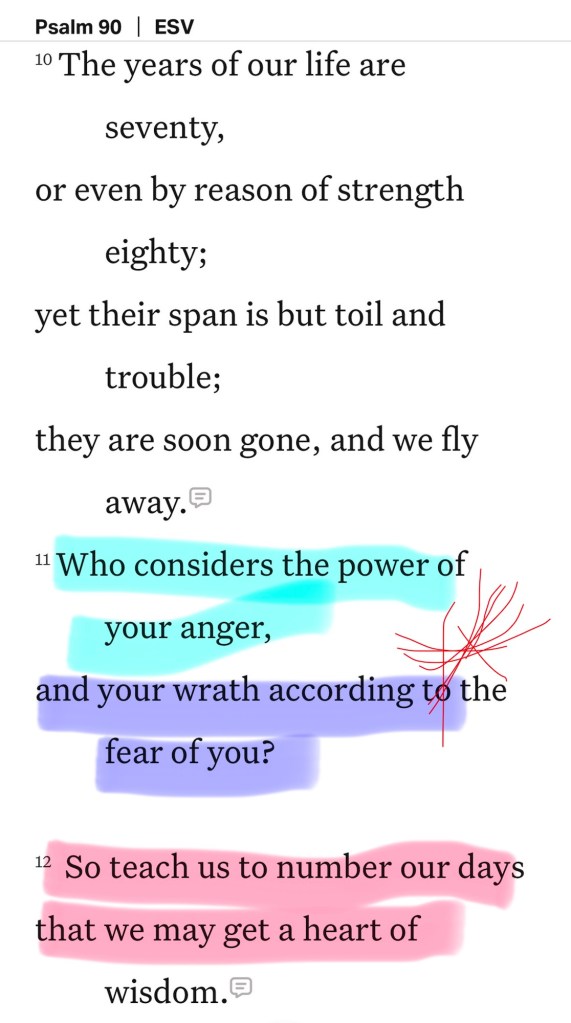
Today my Bible reading brought me to Psalm 90. Verse 12 is well known:
“Teach us to number our days that we may gain a heart of wisdom.” (Ps. 90:12)
But it was the verse just before it that stopped me in my tracks:
“Who considers the power of your anger, and your wrath according to the fear of you?” (Ps. 90:11)
There is a pattern hidden here.
Fear precedes wisdom.

The Fear We Try to Forget
Human beings have always struggled with this reality.
We live as though the universe is morally flexible. We behave as though consequences are negotiable. We assume that because judgement has not yet arrived, perhaps it never will.
But Scripture repeatedly reminds us that this assumption is an illusion.
The God of the Bible is not a symbolic idea or a philosophical principle. He is the Creator of existence itself. If His speech can create life, His speech can also undo it. If He sees the secrets of the cosmos, He also sees the secrets of the human heart.
There is no place to hide. No argument to construct. No performance capable of deceiving Him.
And yet, remarkably, we continue living as though none of this were true.
The Hidden Kindness of Fear
Here is the surprising twist.
The fear of the Lord is not meant to crush us.
It is meant to wake us up.
Psalm 90 was written by Moses, a man who had personally witnessed the terrifying holiness of God. He saw plagues fall upon Egypt, mountains tremble at Sinai, and judgement strike those who rebelled. When Moses speaks about the power of God’s anger, he is not speaking theoretically.
And yet the same Psalm contains a prayer for wisdom.
Why?
Because recognising the seriousness of God does something important to the human soul. It dismantles arrogance. It dissolves the illusion of invincibility. It reminds us that our lives are fragile, brief, and accountable.
In other words, the fear of the Lord restores perspective.
Ironically, this fear is actually an act of divine kindness.
Because the very fact that we are still breathing means God is restraining the judgement we deserve. Every sunrise is evidence of divine patience. Every heartbeat is proof that mercy is still available.
Fear, rightly understood, does not drive us away from God.
It drives us toward Him.
Wisdom Begins When We Remember Who We Are
When we begin to grasp the seriousness of God, something else begins to happen: we start to live more wisely.
We become less impressed with our own cleverness. Less confident in our own moral intuition. Less inclined to assume we are the centre of reality.
Instead, we begin to recognise something humbling but liberating: We are not the authors of existence. We are participants in it. And wisdom begins when we learn to live accordingly.
The Final Reality
Scripture never allows us to forget that this story is moving toward a conclusion.
History is not drifting endlessly forward. It is moving toward a moment when truth will finally be revealed and justice will finally be done.
The last pages of the Bible record the words of Christ Himself:
“Behold, I am coming soon, bringing my recompense with me, to repay each one for what he has done.” (Revelation 22:12)
Those words are not meant to terrify those who seek Him.
They are meant to remind us that life matters.
Our choices matter.
Our hearts matter.
And perhaps the greatest kindness God offers us is this: He tells us the truth before that day arrives.
So that we might learn to fear Him.
And in fearing Him, finally begin to live wisely.

Practical Application
If the fear of the Lord truly leads to wisdom, then it must shape how we live our ordinary days.
First, it calls us to honest self-examination. Instead of assuming our motives are pure, we allow God’s presence to search our hearts. When we remember that nothing is hidden from Him, we become slower to justify ourselves and quicker to repent.
Second, it teaches us humility. When we recognise that our lives are brief and numbered, pride loses much of its power. The fear of the Lord gently dismantles the illusion that we are in control and reminds us that we are participants in a story far larger than ourselves.
Third, it cultivates gratitude for mercy. Every day we wake up is another reminder that God’s patience continues. The fact that judgement has not yet come is not proof that it never will, it is evidence of God’s kindness giving us time to return to Him.
Finally, the fear of the Lord invites us into wisdom-filled living. Instead of drifting through life assuming tomorrow is guaranteed, we begin to live deliberately—seeking truth, practising justice, and walking humbly with God.
In this way, the fear of the Lord does not shrink life.
It actually makes life more meaningful.
Prayer
God,
Help me. Help us.
It is so easy for us to forget that You are Almighty. Teach us again what it means to live with the quiet awareness that You are both perfectly merciful and perfectly just.
Your kindness is beyond our comprehension, yet so often we take it for granted. Forgive us when we grow casual about mercy, forgetting that Your patience is meant to lead us toward repentance and wisdom.
Restore in us an authentic reverence for You. Form within us hearts that kneel with humility, speak with honesty, and recognise that You alone are God, the One who holds all authority to say yes or no.
Clear our minds from pride and self-deception. Renew our hearts with a genuine hunger for holiness. Teach us to number our days so that we may live wisely within the brief years You have given us.
And in that humility, help us discover the deeper joy of belonging to You, the One who calls us beyond dust and into eternity.
Help us, Lord.
In the majestic and powerful name of Jesus Christ:
Messiah, King, Lord, and God.
Amen.
TRACK TO ENJOY:
Final Reflection
Perhaps the wisdom Moses prayed for begins the moment we remember that our days are numbered, and that the One who numbers them will one day ask what we did with them.
 #Hayibo