

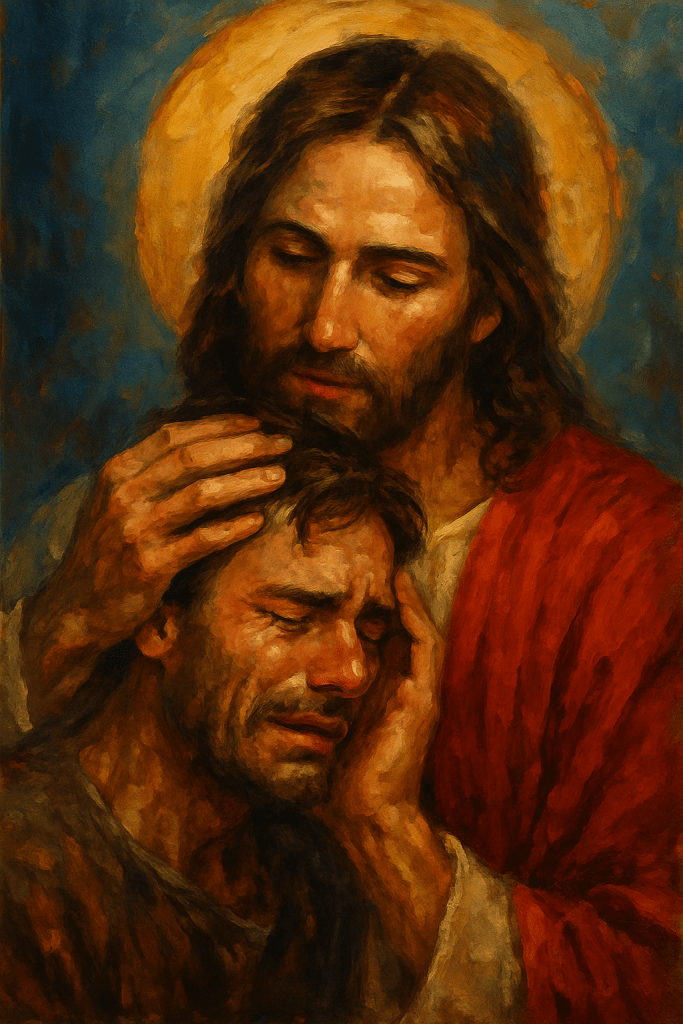
“Jesus heard that they had cast him out; and when He had found him, He said to him, ‘Do you believe in the Son of God?’”
– John 9:35
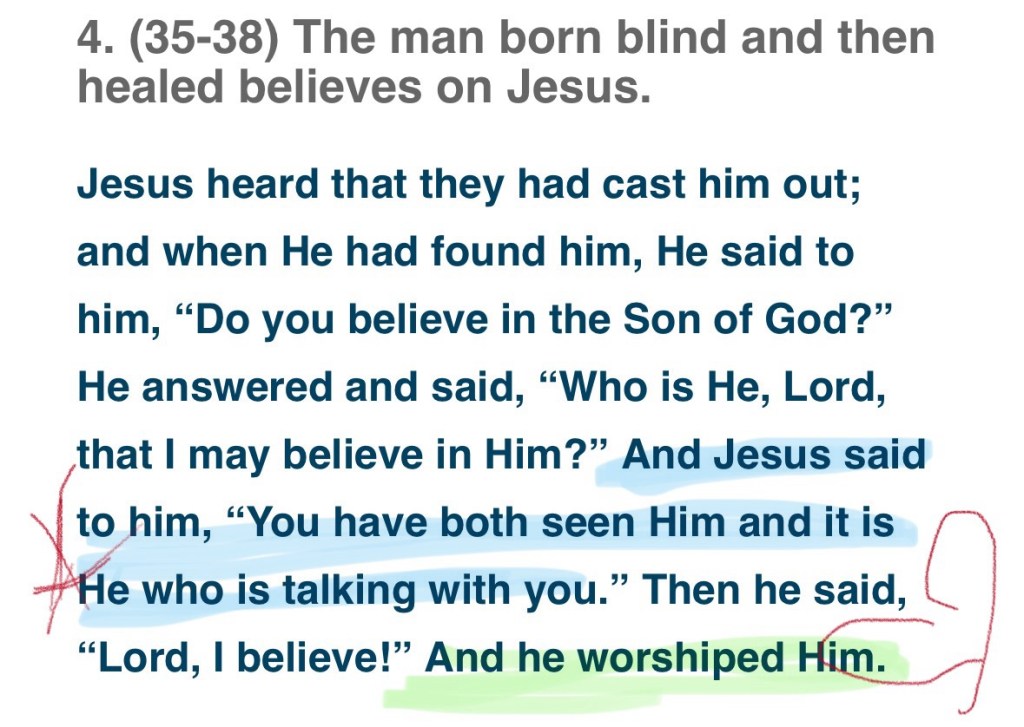

The Arc We Didn’t Want to See
The gospel of John does not give us disembodied theology; it confronts us with the consequences of control. In John 8, we witness the unraveling of identity under the religious elite, people who claim Abraham but reject the Truth. They cling to the structures that make them feel right, even as they plot to kill the One who is Righteous. Jesus speaks not only as a teacher but as the I AM, and for this, they pick up stones.
John 9 brings that tension into the streets. A man born blind is healed by Jesus, not merely physically but with sight that grows ever clearer as he walks toward truth. Meanwhile, those in control grow ever more threatened. The formerly blind man speaks with courage; the ones who see cling to their authority. And when all their questioning fails, they do the only thing power ever does when threatened: they cast him out.
But the story doesn’t end with rejection. It ends with Jesus finding.
“Jesus finding the man implies divine initiative and care, contrasting the cruelty of the synagogue rulers,” writes Craig Keener. “Jesus does not merely heal bodies …He restores rejected souls.”¹
The final verses of this chapter are not a doctrinal conclusion, they are a love story. A heart-rending one. It is here that the gospel rips through cold religion, psychology, academia, social delusions, politick, and meets the pain of the cast out.
Jesus Found Me Too
The tears just come.
I read the words of John 9:35 repeatedly. My ritualistic morning coffee and cream are extra delicious. The Holy Spirit soaks through me as I remember the 21 years of being found, every day, by Jesus.
“Jesus heard that they had cast him out; and when He had found him, He said to him, ‘Do you believe in the Son of God?’”
I was found by Jesus long before I chose to follow Him. My mom and others prayed relentlessly. I didn’t know they were praying. Honestly, I don’t think I would have cared. The depth of pain was so intense that I was sprinting as fast as I could on the crowded highway to hell. I didn’t know that either. Not that I cared anyway.
My story of being a metaphorical blind man begins when this man was just an innocent little boy born into a very cruel world. By the age of seven, I had already been labelled horrible names, nearly murdered by my father, sexually abused by men and women, and bullied relentlessly in the schoolyard. I needed remedial lessons because my brain worked faster than I could speak or write. I often skipped words. The world said I was wrong. That I deserved to die. That I was a sextoy. That my mind was faulty. That I didn’t deserve friends. I grew up a loner.
And as a child trying to make sense of it, I came to this conclusion: “If God is good, and all these horrible things are happening to me, then I must be very bad.” I decided I was the Antichrist the Bible speaks about. That thought stayed with me until I was sixteen. By then, it wasn’t just a thought, it had become how I thought of myself: Rejected. Hated. Not worth much.
Jesus kept reaching out to me. But I was so “useless” I brushed it off as imagination. I couldn’t believe anything good was meant for me.
Finally, at age thirty, desperate in rehab, I surrendered. I accepted Jesus. Not nobly. Desperately. Selfishly. Nothing else worked, not therapy, not drugs, not counsellors, not trends. I had tried to die five times. Each time, God intervened.
Days later, I had an encounter. One I can’t explain theologically. I woke up speaking to Someone in my room, but no one was there. God told me to read Romans 1. I didn’t know Romans was a book. I didn’t have a Bible. I hadn’t touched one in 17–20 years.
The nursing station gave me a Bible; no cover, half the pages missing. But it had Romans 1. Funny, that Bible was hanging by a thread. So was I.
Romans 1:32 killed me.
“Though they know God’s righteous decree that those who practice such things deserve to die, they not only do them but give approval to those who practice them.”
I saw how I had approved of dysfunction because I was dysfunction. I didn’t agree with immoral behaviour, but I lived it. I carried shame because I wasn’t who I wanted to be… and didn’t know how to stop. I wasn’t born blind. But I was soul-blind. A living zombie. Dying because I believed God hated me.
Jesus showed me that who I had become was not who He created me to be.
As Thomas Torrance writes, Christ “brought the divine judgment to bear directly upon our human nature… and in sanctifying it brought healing and redeeming power to bear upon it in Himself.”²
Rejected by Man, Found by God
I’ve been a Christian for 21 years. Probably a terrible one. But I get better year by year, because I stick like glue to Jesus. Like the blind man, I say: “Lord, I believe!”
But it hasn’t been easy. I lost my LGBTQ “friends” when I walked away from that life. Some overly religious people judged me. Society called me trash. However, I judged myself most. I argued with God often. About everything. But if it wasn’t for Jesus, who found me and kept finding me, I wouldn’t be here, writing this in the safety of my home.

“Jesus comes to us and stands in the place of pain… not from a distance, but as one who enters the wound,” writes N.T. Wright.³
Dalit theologians echo: “Jesus identifies himself with the outcasts, not as pity but as protest.”⁴
Neuroscience backs it: “Toxic trauma-based thoughts can rewire the brain toward fear and shame… but can be renewed through reconnection and belief.”⁵
Cast Me Out – I’ve Been Found
I’ve lost everything seven times in my life. But Jesus heard they had cast me out. And when He found me, He asked:
“Do you believe in the Son of God?”
I believe.
And in believing, I found the love I didn’t know existed.
These days I say,
“Cast me out – I got Jesus. And He rocks my world.”
JESUS LOVES YOU. Let Him.
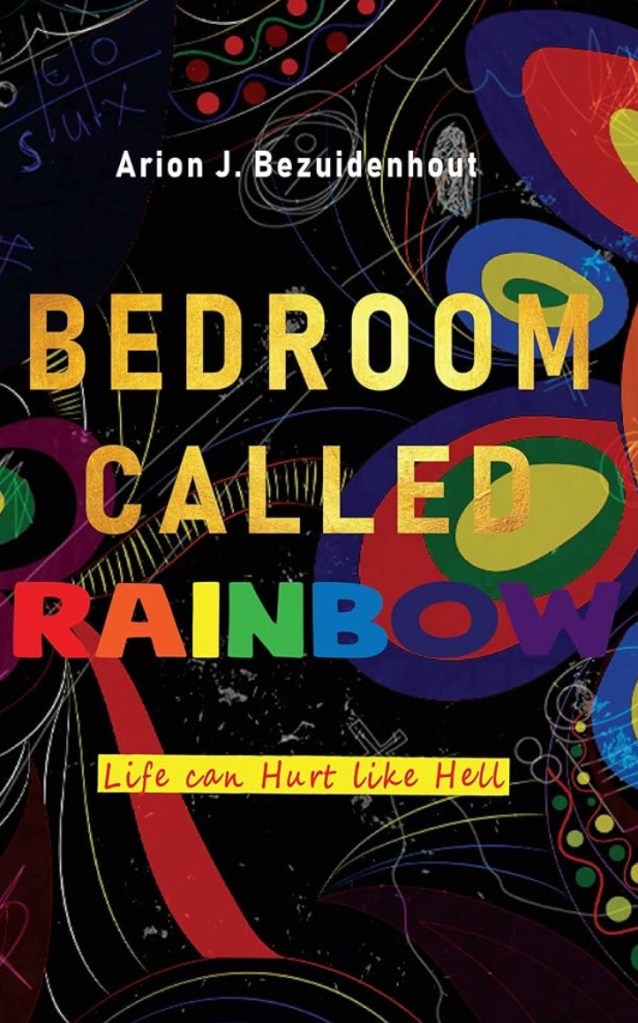
You can read more of my story in my memoir Bedroom Called Rainbow. I let all the secrets out of the bag. 😂 – https://www.amazon.com/Bedroom-Called-Rainbow-Life-Hurt-ebook/dp/B09SV6K58V

Living This Out: When You’ve Been Cast Out
Some of you reading this have lived John 9. Maybe you’re the one people left behind when you stopped being useful. Maybe your theology got too honest. Maybe your honesty got too theological. Maybe you dared to let Jesus change you, and the crowd didn’t follow.
Here are three small steps to walk toward the One who finds you:
Let Jesus find you again. Whether it’s been 30 minutes or 30 years, His voice still calls, “Do you believe in the Son of God?” You don’t have to find Him. He already knows where you are.
Stop trying to be “worth it.” You were never supposed to earn your worth. That’s religion’s game. Jesus didn’t say, “Prove yourself,” He said, “Believe.” Let go of the scorekeeping.
Don’t waste your pain. Let it testify. Your scars might be the very evidence that God still heals. You don’t need a pulpit. Just tell someone the truth. “I was blind, but now I see.”
A Prayer for the Cast Out
Jesus,
You find those who’ve been thrown away.
You speak when our names are only whispered in gossip or erased from the group chat.
You see the soul behind the shame, and You still ask us,
“Do you believe in the Son of God?”
We say, “Lord, we want to.”
For those too tired to believe, give them strength. For those drowning in theology but starving for love, be near. For those who still feel blind, open their eyes not just to see You, but to be seen by You.
Find us again, Lord.
And let us fall at Your feet like the man who worshiped You in John 9.
In Your Mighty, Magnificent, Majestic, Undefeatable, Holy Name Messiah King Jesus,
Amen.

Footnotes
1. Craig S. Keener, The Gospel of John: A Commentary, Vol. 1 (Peabody, MA: Hendrickson, 2003), 803.
2. Thomas F. Torrance, The Mediation of Christ (Colorado Springs: Helmers & Howard, 1992), 41.
3. N. T. Wright, Simply Christian: Why Christianity Makes Sense (New York: HarperOne, 2006), 132.
4. V. Devasahayam, ed., Frontiers of Dalit Theology (Delhi: ISPCK, 1997), 98.
5. Caroline Leaf, Switch On Your Brain: The Key to Peak Happiness, Thinking, and Health (Grand Rapids: Baker Books, 2013), 33.
 #Hayibo