

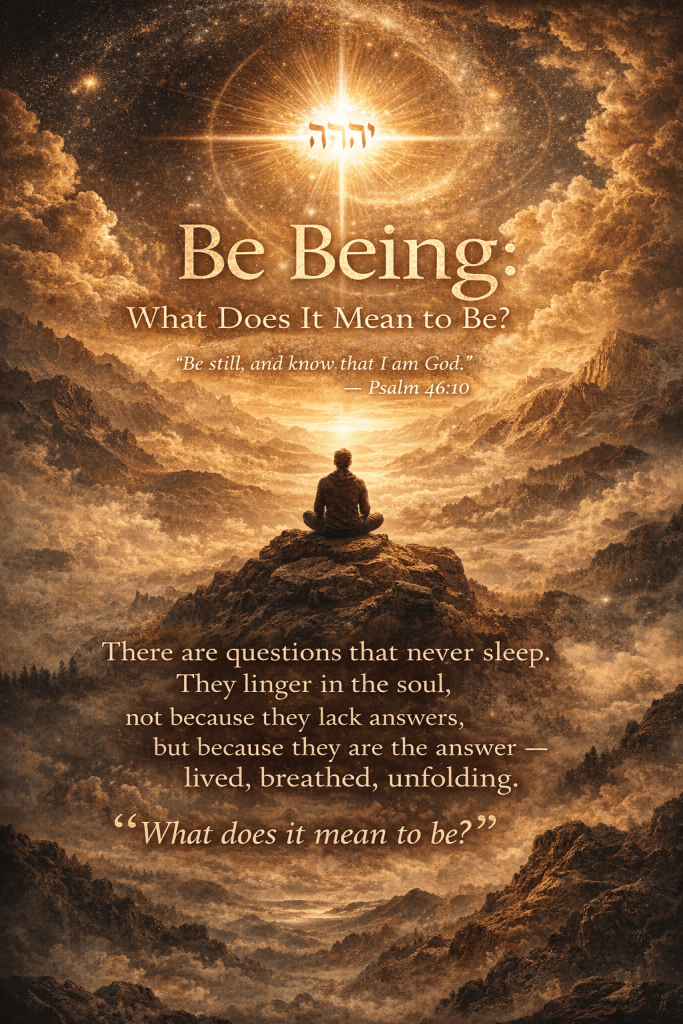
“Be still, and know that I am God” – Psalm 46:10

Introduction
There are questions that never sleep.
They linger in the soul, not because they lack answers, but because they are the answer, lived, breathed, unfolding.
“What does it mean to be?”
It sounds simple, almost childish, a question we might expect from a philosopher in a quiet library or a child staring at the stars. Yet it’s the first and final question of existence. Before doing, before believing, before achieving, there is being.
And somehow, that’s the one thing we keep running from.
The Weight of the Word “Be”
Few words bear as much mystery, or as much metaphysical weight, as the word be. In every tongue, it hides in plain sight, quietly carrying the burden of all that exists. To utter “to be” is to touch the hinge between nothing and everything; the pulse of presence itself. From Aristotle’s reflections on ousia to Heidegger’s meditations on Sein, philosophers have wrestled with this smallest yet most expansive verb. What does it mean simply to be, before we act, achieve, or define?
“To be” is the smallest verb with the greatest gravity. It carries the full weight of creation, of existence itself.
Aristotle spoke of ousia (being as essence):
“‘Substance’, the conventional English rendering of Aristotle’s word ousia, is in fact misleading, suggesting as it does a kind of stuff. The English term ‘substance’ entered the philosophical vernacular as a translation of the Latin substantia, which was itself an inadequate attempt to translate Aristotle. What ‘substance’ and substantia both miss is the connection of the word ousia to the verb ‘to be’ (einai). A better rendition might be ‘reality’ or ‘fundamental being’, but ‘substance’ is deeply entrenched in the philosophical literature and will be used here. A good gloss would be to say that ousiai are the ‘ontologically basic entities’ (Loux 1991: 2).”¹
Heidegger’s Sein (being as presence) marks his attempt to move beyond traditional metaphysics, seeking to uncover how Being itself discloses all beings within the horizon of time.
“In Die Grundprobleme der Phänomenologie (1927), Heidegger reenters and ‘swims through’ the uncharted waters left by Sein und Zeit, taking up the question of Being from a new direction. These lectures form, as Heidegger notes, a ‘new working-out’ of the missing division of Sein und Zeit, in which he seeks to reveal Time as the horizon of all comprehension of Being. As von Herrmann observes, Heidegger’s movement—or ‘swim’—through this inquiry marks his effort to overcome the limits of metaphysical language and to retrieve the Seinsfrage from within the Western ontological tradition itself, rather than from existential or merely phenomenological motives.”²
Many thinkers have tried, and still try, to capture the meaning of “be.” Yet even our language betrays the mystery: we say “be still,” “be good,” “be strong,” “be yourself.”³
But who is this self we’re supposed to be?
We have mastered doing, calendars, plans, productivity apps, but have forgotten being.
Being isn’t about survival; it’s about presence. It’s not the ticking of the clock, but the stillness between its beats.
The word be stands as the threshold of mystery, both utterly ordinary and unfathomably profound. Aristotle sought it in essence, Heidegger in presence, yet its fullness forever escapes capture, flickering between verb and vision. Perhaps that is its gift: being is not a concept to be grasped, but a reality to be entered. In the end, to be is to participate, to dwell, to attend, to open ourselves to the unfolding of existence itself.
If the word be bears the mystery of existence, then in God that mystery finds its source and fulfillment. What philosophers sought through essence and presence, Scripture proclaims in a voice from the fire: “I AM WHO I AM.”
The Ontology of Divine Being
To speak of divine Being is to approach the burning center of reality itself. In every age, philosophers and theologians have sought language vast enough to name the One in whom all being finds its source. When Scripture records the words, “I AM WHO I AM,” it does not merely reveal a title, it unveils the grammar of existence. God names Himself not as an object among others, but as Being itself, the inexhaustible ground from which all else flows.
When God said, “I AM WHO I AM,” He revealed not just His name, but the nature of existence itself.
God is Being, not one being among many, but the ground of all being. All created things are not being itself, but borrowed being. As Thomas Aquinas wrote, God is ipsum esse subsistens, existence existing, writing that:
“God is not only His own essence but also His own existence. If a thing’s existence differs from its essence, that existence must be caused by another. But since God is the first cause, His essence and existence are identical. For existence makes every form actual; and since there is no potentiality in God, His essence does not differ from existence. Thus, God is His own existence.”⁴
To exist apart from Him is to slowly unravel into non-being, the quiet entropy of meaninglessness. Christ enters this paradox as the Word made flesh, the fusion of divine Being and human becoming. In Him, being and becoming reconcile, eternity kisses time.
Our “to be” becomes complete only when grafted into His “I AM.”
The mystery of divine Being is not solved by reason but received in revelation. To know God is not to master an idea, but to enter into communion with the One whose is-ness sustains every breath. The ontology of God is thus the ontology of grace, He is that we might be. Every act of existence whispers His name, and every moment of true being is a participation in the eternal I AM.
Modernity and the Loss of Being
If divine Being is the ground of all existence, then modernity marks the tremor of a world that has forgotten that ground. Having unmoored “to be” from its source in the I AM, humanity drifts between noise and nothingness, full of motion, yet emptied of meaning.
We live in an age where doing has replaced being. Our worth is quantified by productivity, not presence. We say, “I am busy,” as if busy were a form of existence.
We post curated lives, speak fluent hustle, and celebrate burnout as achievement. We don’t be anymore; we perform.
Kierkegaard called it “the sickness unto death,” a self so divided that it forgets its own ground, arguing that:
“The self is the conscious synthesis of infinitude and finitude which relates itself to itself, whose task is to become itself, a task which can be performed only by means of a relationship to God.[But to become oneself is to become concrete. But to becomeconcrete meansneither to become finite nor infinite, for that which is to become concrete is a synthesis. Accordingly, the development consists in moving away from oneself infinitely by the process of infinitizing oneself, and in returning to oneself infinitely by the process of finitizing. If on the contrary the self does not become itself, it is in despair, whether it knows it or not. However, a self, at every instant it exists, is in process of becoming, for the self κατὰ δύναμιν does not actually exist; it is only that which it is to become.”⁵
Heidegger called it “fallenness”: existing only in the noise of the world, forgetting the silence of Being:
“Fallenness” names Dasein’s absorption in the world of its everyday concerns and its being lost in the publicness of the ‘they.’ In this state, Dasein falls away from itself as an authentic potentiality-for-Being and becomes fascinated by the world and others. Yet this ‘inauthenticity’ is not a fall from purity, but a mode of Being-in-the-world in which Dasein mostly maintains itself.”⁶
Our modern tragedy is not that we have lost God, but that we’ve lost ourselves in the process. The self has become a project instead of a presence, an algorithm instead of a soul. Gadamer reminds us that genuine understanding is not achieved by distancing ourselves from the text or the other, but by entering into a dialogical participation with it.
“A person trying to understand a text is prepared for it to tell him something. … A hermeneutically trained consciousness must be sensitive to the text’s alterity. But this kind of sensitivity involves neither neutrality nor the extinction of one’s self, but the appropriation of one’s own fore-meanings and prejudices.”⁷
To recover being in the modern world is not to abandon action but to rediscover presence, to live once more from the still point rather than the scroll. In the silence beneath performance, in the listening that precedes speech, we begin to hear again the faint echo of the I AM within us. For only the one who is, and knows it, is truly alive.
Be Being: The Invitation
To “be being” is not redundancy; it’s revelation.
It is the conscious act of returning to the origin, of choosing to exist from Being rather than busyness. “Be being” means to dwell within divine presence, to become aware that existence itself is a participation in grace.
We don’t manufacture meaning; we mirror it. We don’t build identity; we breathe it. Christ calls us not to performance but to participation, John 15:4 (New International Version): “Abide in Me, and I in you.”
To be being is to live from the inside out, not as a human doing, but as a human becoming. It is to let presence replace pretense, stillness replace striving, and communion replace control.
For the mystery of be is not something to master but to enter. It is the rhythm of creation and the heartbeat of redemption. To be being is to come home, to rest again in the One whose very name is existence.
The Practice of Being
To practice being is to unlearn distraction.
It’s to choose silence over speed, depth over noise, communion over consumption.
Prayer is the language of being.
Stillness is its grammar; Psalm 46:10 (New King James Version): “Be still, and know that I am God.”
Gratitude is its poetry.
We return to our truest selves not by achievement but by awareness, the holy recognition that existence is a gift, not a performance. When we are fully being, we are closest to the One who never ceases to be.
“We don’t manufacture meaning; we mirror it.
We don’t build identity; we breathe it.”
The Stillness of “I AM” (Prayer)
Lord,
Teach me to be in You, not just to do for You. Let my breath remember its Source. In a world obsessed with production, help me rediscover presence.
Still me until Your stillness speaks.
In the name of the One who simply is, thank You Yahweh, Messiah King Jesus, Holy Spirit,
Amen.
Track To Enjoy

Footnotes
1. S. Marc Cohen, “Aristotle’s Metaphysics: The Theory of Substances,” University of Washington, accessed January 17, 2026, https://faculty.washington.edu/smcohen/433/CohenSubstances.pdf.
2. Michael E. Zimmerman, “Heidegger’s ‘Completion’ of Sein und Zeit,” Philosophy and Phenomenological Research 39, no. 4 (1979): 537, https://doi.org/10.2307/2106899.
3. Michael Reddan, Heidegger and the Mystery of Being (University of Wollongong, 2009), 44–47, https://ro.uow.edu.au/ndownloader/files/50595195/1; see also A. H. Rosenfeld, “‘The Being of Language and the Language of Being’: Heidegger and Modern Poetics,” The Centennial Review 20, no. 4 (1976): 687–703, https://www.jstor.org/stable/302152.
4. Thomas Aquinas, Summa Theologica, trans. Fathers of the English Dominican Province (New York: Benziger Brothers, 1947), Pt. I, Q.3, Art.4. — Aquinas identifies God as ipsum esse subsistens (“being itself subsisting”).
5. Søren Kierkegaard, The Sickness Unto Death, trans. Alastair Hannay (London: Penguin Classics, 1989), 41–45 esp. 44. — Kierkegaard defines despair as the self’s failure to relate properly to itself and to God.
6. Martin Heidegger, Being and Time, trans. John Macquarrie and Edward Robinson (New York: Harper & Row, 1962), 219–224, esp. 220. — Heidegger’s exploration of Dasein (being-there) and fallenness underpins the modern crisis of presence.
7. Hans-Georg Gadamer, Truth and Method, 2nd rev. ed., trans. Joel Weinsheimer and Donald G. Marshall (London: Bloomsbury, 2013), 269–271. — Gadamer reminds us that understanding and meaning emerge through participation, not distance — echoing the relational dynamic of divine being.
 #Hayibo