“That awkward moment when you finish a math problem and your answer isn’t even one of the choices.” – Ritu Ghatourey
Sometimes rebellion isn’t rage or denial, it’s simply answering reality without the right constant. The world keeps solving for life, meaning, and morality, but without the Logos in the equation, every answer looks wrong.
(A continuation of “The Fruit of the Logos”)
Foreword
This Christmas, just when I thought I’d finally unwind from the madness of consumerism, the salon’s December chaos, and my ongoing thesis refinements, the Holy Spirit decided otherwise, and knocked me clean for a six.
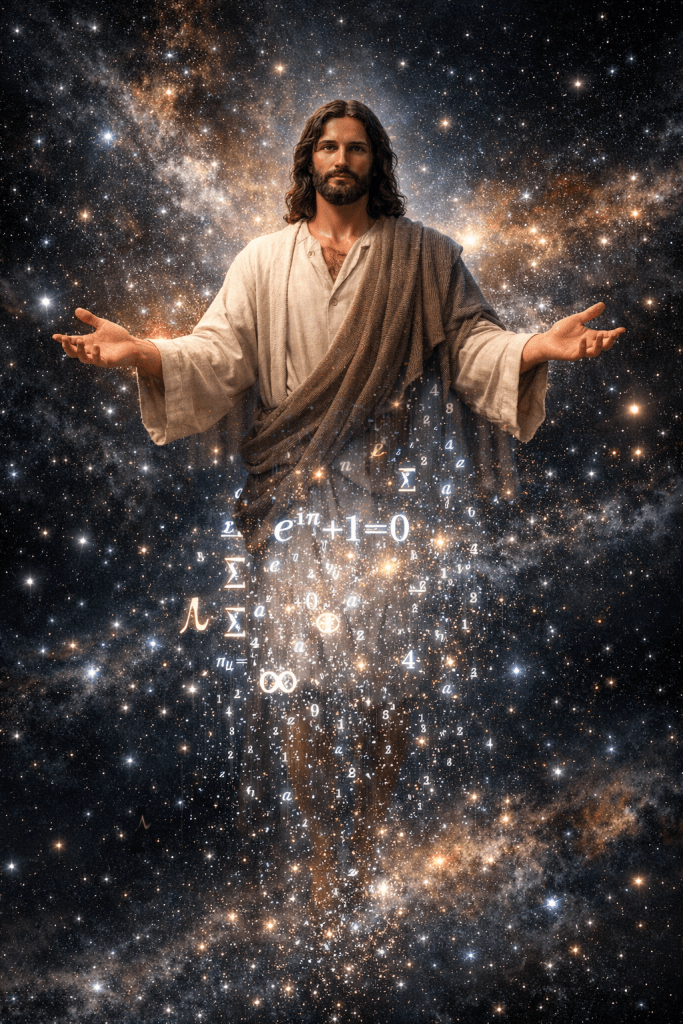
What began as a quiet attempt to understand Christmas through the lens of Logos has turned into an unexpected journey across the frontiers of thought, where philosophy, mathematics, and theology collide.
It’s as if new galaxies have exploded into my consciousness.
This new blog, a continuation of The Fruit of the Logos, moves us from obedience as fruit to obedience as alignment with the divine Mathematician Himself: the One who makes the maths math.
It’s here we begin to see that rebellion isn’t merely emotional or moral, it’s an act against logic itself, against the very order that holds existence together.

When Reason Meets Resistance
Somewhere between the elegance of mathematics and the madness of modernity, there stands an equation that mathematicians quietly call “the God Equation,” Euler’s Identity.

Five constants, e, i, π, 1, and 0, bound together in perfect harmony, merging infinity and nothingness, imagination and reason, order and beauty, into a single statement of truth.
Richard Feynman once said it was “the most remarkable formula in mathematics.” Others call it “proof of elegance,” “the fingerprint of the divine,” or simply “beautiful.”
But perhaps that word, beautiful, is the most revealing of all. Because to describe something as beautiful is to assume there exists a standard by which beauty can be measured. And that assumption, however quietly, whispers theology.
Human beings adore coherence in creation. We love the precision of equations, the symmetry of the snowflake, the laws of physics that hold galaxies together. But when that same coherence steps into flesh and begins to speak, when the Logos Himself stands before us and says, “I am the truth,” suddenly, we recoil.
In John 15:18–25, Jesus diagnoses this paradox:
“If the world hates you, you know that it hated Me before it hated you… But all these things they will do to you for My name’s sake, because they do not know Him who sent Me.”
The same mind that worships order in physics rejects order in ethics.
The same heart that reveres reason in mathematics resents Reason incarnate in Christ.
Why?
Because Euler’s Identity does not ask for obedience.
The Logos does.
One describes order; the other demands alignment with it. And that is precisely where the rebellion begins, not in ignorance, but in pride. We crave a world that makes sense, but we do not want a God who defines sense itself. The question before us, then, is not merely why the world hates Christ, but why reason itself resists its own Source.
The rest of this essay will explore that mystery through three converging lenses:
The Mathematical Logos – how the structure of the universe reveals divine rationality.
The Biological Logos – how evolutionary thought borrows purpose while denying the Author of purpose.
The Theological Logos – how Jesus, the incarnate Logos, exposes humanity’s hatred of uncontainable order.
Because if Euler’s Identity is the most elegant equation in the universe, then Jesus is its living proof; the rational beauty that cannot be contained, controlled, or computed.
And perhaps that is precisely why the world hates Him.
The Mathematical Logos: Order Written Into Reality
Mathematics is not invented; it is discovered. No one “creates” the number 3 or the ratio π. They simply are. They exist independent of culture, time, and perception, like stars that predate astronomers. This has baffled thinkers for centuries. Eugene Wigner, a Nobel-winning physicist, called it “the unreasonable effectiveness of mathematics in the natural sciences.”
Why should abstract symbols written by human hands describe the behavior of galaxies, black holes, and quarks?
Why should ink on paper mirror the structure of the cosmos?
Because order, it seems, precedes observation. Logic is not a tool we impose on the world, it is the language the world already speaks. At the heart of that language lies one formula above all others, Euler’s Identity.
It unites the five fundamental constants:
e (the base of natural growth and decay, symbol of continuous creation),
i (the imaginary, symbol of the unseen),
π (the circular, symbol of perfection and completion),
1 (unity),
and 0 (nothingness).
In a single breath, infinity meets nothing, imagination meets reason, order meets elegance, and the result is perfect coherence. No human mind made these constants. They are what Augustine called “the thoughts of God,” not divine metaphors, but metaphysical realities, the grammar of creation itself.
Paul Davies, in The Mind of God, writes that mathematics seems “too good to be true, as though the universe were rational because it was designed to be intelligible.”
Roger Penrose echoes this sentiment, describing mathematical truth as “something discovered, not constructed,” existing in a realm that is “astonishingly Platonic.”
John’s Gospel, written millennia before quantum mechanics or complex numbers, opens with a claim that now reads like a metaphysical Rosetta Stone:
“In the beginning was the Logos… and the Logos was with God, and the Logos was God.” (John 1:1)
For the Greeks, Logos was not mere speech, it was the rational principle that orders all reality. John takes that word, revered by philosophers from Heraclitus to the Stoics, and baptizes it into revelation:
“The Logos became flesh.”
That is not poetry. That is ontology.
It means that the same mathematical precision that governs e, i, and π, the same rational harmony that binds atoms and galaxies, is not abstract. It is personal. The cosmos is intelligible because the Creator is intelligent. It is lawful because He is faithful. It is ordered because He is the Order.
When a physicist marvels at Euler’s Identity, they are, perhaps unknowingly, worshiping in the temple of the Logos, not the chaos of chance, but the coherence of mind. Mathematics, in this light, is the poetry of divine thought written into matter. So before we move to biology and philosophy, the first fruit of this realisation is humility; the universe was rational long before we learned to reason.
Our equations are echoes, and the Logos still speaks.
The Biological Logos: When Evolution Borrows Teleology
If mathematics reveals the mind of God, biology reveals His method. And yet, no field has done more to sever life from meaning than biology, or, more precisely, its Darwinian interpretation.
Richard Dawkins famously defined biology as “the study of complicated things that give the appearance of having been designed for a purpose.”
Appearance. Not reality.
In that single caveat, the modern mind betrays itself. For to call something an appearance already presupposes an ideal of what is real. Evolutionary theory, for all its contributions, walks on borrowed teleology. It speaks the language of purpose, function, adaptation, survival, selection, while denying the grammar of a Purposer.
It assumes the logic of design while outlawing the Designer. The paradox deepens when we ask the simplest of questions, “If evolution is blind, how does it recognise fit?”
If nature is indifferent, why does it favour life over death, order over chaos, complexity over entropy?
Teleology, the idea that things move toward a goal, is the ghost in the Darwinian machine. Every description of “advantage,” “optimisation,” or “progress” smuggles purpose through the back door.
Thomas Nagel, himself an atheist philosopher, admitted this in Mind and Cosmos:
“The appearance of physical law that is intelligible to us, and the existence of organisms with minds capable of understanding that law, is not plausibly the result of mere chance.”
In other words, evolution behaves as if the Logos were real, even when it denies Him.
The modern biologist studying cellular machinery, the self-repairing DNA polymerase, the protein-folding algorithms that outsmart supercomputers, the coded syntax of RNA, stands face to face with logos made flesh in molecular form. These are not random assemblies but systems governed by information, feedback, and purpose.
Michael Polanyi called this “the irreducible structure of meaning in life,” where information organises matter according to non-material rules. That is, life does not arise from chaos, but from code.
And code, in any language, implies a coder.
Even Dawkins, in his most lucid moments, cannot escape the teleological undertones of his own argument. In The Blind Watchmaker, he writes:
“Natural selection is the blind watchmaker, blind because it does not see ahead, yet it builds up the illusion of design.”
But the “illusion of design” is not an illusion if it requires laws, order, and intelligibility to function. An illusion still needs light to exist.Which brings us to a theological irony, in trying to escape God, Darwinism built its tower with God’s blueprints.
The Apostle Paul put it more succinctly in Romans 1:20:
“For since the creation of the world His invisible attributes are clearly seen, being understood by the things that are made, so that they are without excuse.”
The biological world bears witness to Logos not by preaching, but by pattern, the pattern of life that reproduces order out of chaos, meaning out of matter, intelligence out of atoms.
The atheist can describe evolution, but he cannot account for why evolution describes anything at all. For in every cell, in every double helix, in every living algorithm, the Word still breathes. The Logos speaks life into dust, and dust, inexplicably, sings back.
The Theological Logos: John 15 and the Hatred of Order
By the time we reach John 15:18–25, Jesus has already peeled away the sentimental veneers of religion and brought His disciples into the furnace of reality. He is no longer teaching crowds in parables but preparing His inner circle for the world’s reaction to truth incarnate.
His words cut to the marrow:
“If the world hates you, you know that it hated Me before it hated you… But all these things they will do to you for My name’s sake, because they do not know Him who sent Me… They hated Me without cause.”
There it is, the Logos, reason Himself, rejected by the very beings made to reason.
Why?
Not because He was irrational, but because He was uncontainable. From the dawn of human history, our deepest rebellion has not been intellectual disbelief but moral insubordination. The problem is not that we cannot understand the Logos, but that we refuse to submit to Him.
The mind resists what the heart fears will unseat its throne.
Jesus exposes this pathology of the soul:
“If I had not come and spoken to them, they would have no sin; but now they have no excuse.”
Truth, once revealed, leaves no room for neutrality. To encounter divine order and still prefer chaos is not ignorance, it is hatred of exposure.
This is the same hatred that sneered at the miracles of Christ, not because they lacked evidence, but because they demanded allegiance. The same logic that adored geometry crucified its Geometer.
John’s language is surgical. “They hated Me without cause” (chōris aitias), literally, “without rational justification.”
The world’s hatred of Christ is not born of reason; it is the collapse of reason before holiness. Jesus embodies what every philosophy groped for but could never hold: He is logic that bleeds, order that forgives, perfection that enters imperfection. And that is intolerable to the prideful mind, because it means that reason itself bows before righteousness.
The Logos does not merely make the world intelligible; He makes it accountable. And therein lies the scandal, humanity loves the fruits of order, knowledge, symmetry, predictability, but despises the moral consequences of that order.
We adore the mathematics that stabilises bridges but reject the morality that stabilises souls. We worship logic in science but crucify it in spirit.
When Jesus says, “The world would love its own,” (John 15:19) He is diagnosing the gravitational pull of sin, the instinct to belong to what affirms our blindness. To “love the world” is to prefer self-made systems of truth where we remain the author and authority. But the Logos threatens our illusion of control.
He is not a principle we can manipulate; He is a Person who commands.
The hatred of Christ, then, is not an ancient phenomenon, it is the ongoing revolt of the creature against coherence. It is the refusal to be read by the very Word that reads all things.
When Jesus says, “They hated Me without cause,” He is not lamenting misunderstanding; He is unveiling the cosmic paradox, humanity’s rebellion is not the absence of light, but the rejection of it.
The Logos was not crucified for being false, He was crucified for being true. And even now, two millennia later, the world still repeats the same protest, “We want the order of science without the obedience of sanctity. We want reason without repentance. We want light without revelation.”
But as long as truth remains personal, the cross will remain scandalous, and the Logos will remain hated by those who love their own illusion of order more than its Author.
The Teleological Fulfilment: Chosen to Bear Fruit
“You did not choose Me, but I chose you and appointed you that you should go and bear fruit, and that your fruit should remain…” (John 15:16)
In one verse, Jesus gathers every thread of cosmic history, from the pre-existent Logos to the dusty footprints of Galilee, and ties it to purpose.
The Logos did not merely explain reality.
He entered it.
And now, through His disciples, He extends it.
1. The Teleology of Being Chosen
Philosophy gropes toward meaning; the Gospel gives it. To be “chosen” in John’s theology is not elitism, it is commissioning.
It means that the Logos who orders galaxies now orders lives, not by coercion but by calling. Jesus’s words are radical for their era. In the rabbinic world, students chose their teachers. Here, the Teacher chooses His students.
That reversal shatters the hierarchy of merit and replaces it with grace.
As William Temple once wrote:
“The only thing of our very own which we contribute to our salvation is the sin which makes it necessary.”
We are not chosen because we are capable of bearing fruit; we are capable of bearing fruit because we are chosen. Teleology flows from election.
The vine defines the branch.
2. The Logos in Motion – From Understanding to Embodiment
Earlier, we traced the Logos as mathematical order and biological code; reason that structures reality.
But in John 15, Jesus transposes that abstract order into relational obedience:
“You are My friends if you do what I command you.”
The Logos is not complete when understood; it is fulfilled when embodied. Knowing the Word is not the same as being conformed to it. Information must become incarnation.
In modern terms, this is where much of Western Christianity falters. Church attendance without obedience is philosophy in liturgical disguise. To “bear fruit” means the Logos has passed from cognition into character, the truth has taken on flesh again.
As the Father once expressed Himself in the Son, so now the Son expresses Himself in the saints. The Incarnation did not end at Bethlehem; it continues wherever divine life produces human transformation.
3. The Fruit That Remains
Jesus is not asking for temporary moral compliance. He is creating eternal coherence.
The fruit that “remains” (menēi) shares the same root as “abide” (menō), the same verb used throughout John 15 to describe the mutual indwelling of Christ and His followers.
Fruit that remains is not achievement; it is alignment. It is the life of the Vine reproducing itself through the branches. Where the mathematical Logos revealed God’s intellect, and the biological Logos revealed His imprint, the theological Logos now reveals His intimacy. And intimacy bears fruit; love that does not decay, truth that does not fracture, obedience that does not waver.
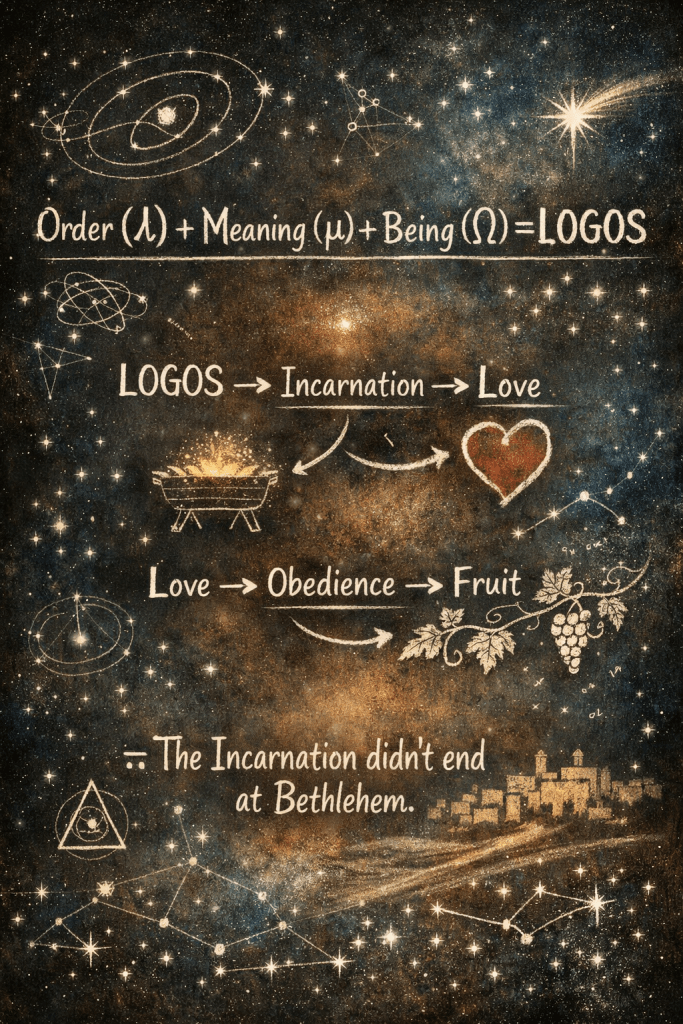
The disciple’s life becomes the living equation:
4. Teleology and the Triumph of Love
In the end, the logic of God is love. Love is not sentiment; it is structure. It is the grammar of creation, the syntax of salvation, the proof that order and affection are one in the heart of God.
The cross, then, is the ultimate teleological event: the intersection where divine reason meets human rebellion, and transforms it into redemption.
Christ bore the fruit of obedience unto death so that we might bear the fruit of life unto eternity. And so, John 15:16 is not an instruction manual. It is a declaration of design.
To “go and bear fruit” is to participate in the ongoing Incarnation, the Logos continuing His work through the redeemed mind, the renewed heart, and the resurrected will. The fruit of the Logos is not merely the moral outcome of belief. It is the evidence that the cosmos is still speaking the language of its Creator.
The Word Still Becomes Flesh
Every philosophy, every scientific model, every trembling attempt to define meaning, all of them strain toward one unspoken desire: coherence. The human heart cannot rest in chaos. It seeks order, truth, love, a pattern that explains why anything matters at all.
That pattern has a name.
John called Him Logos.
In the first century, logos was the most intellectually charged word in the Greek world; the golden thread of logic, language, and law that held the cosmos together.
The Stoics spoke of it as divine reason. Philo called it the mind of God. The philosophers imagined it as an impersonal rationality humming behind the stars.
And then John shattered every definition.
He wrote:
“In the beginning was the Logos, and the Logos was with God, and the Logos was God… And the Logos became flesh and dwelt among us.” (John 1:1,14)
That single claim rearranged the metaphysics of the ancient world. The Greeks sought the logic of life; John declared that Logic had a face.
Reason was not an equation, it was a person.
And that Person was love.
The Cosmic Paradox of Christmas
Bethlehem was not the birth of an idea, but the incarnation of every true idea. It was not the invention of religion, but the revelation of reality. God did not send a philosophy; He sent Himself.
At the manger, the infinite folded Himself into the finite, the Logos breathing within lungs that He had designed, crying through vocal cords that would one day thunder galaxies into worship.
The angels announced peace on earth not because sentiment had arrived, but because structure had.
Love had entered time, not as emotion, but as ontology.
The Incarnation is not sentimental theatre; it is ontological revolution.
God entered His own syntax, the Author writing Himself into the story, not as metaphor, but as matter.
The Continuing Incarnation
And this is why Jesus says, “You did not choose Me, but I chose you… that you should go and bear fruit.”
The Incarnation does not end at Bethlehem; it begins there. Every act of obedience, every expression of truth, every moment when love triumphs over self, is the Logos still becoming flesh through those who abide in Him.
Christ’s life in us is not symbolic; it is sacramental. It is the Word once again speaking light into darkness, order into chaos, meaning into flesh. Every believer is a Bethlehem, a place where the eternal becomes visible.
When we forgive, the Logos breathes.
When we create beauty, the Logos sings.
When we love the unlovable, the Logos shines.
That is what it means to bear fruit that remains; to live so that divine logic continues writing its poetry through the grammar of human lives.
The Word Still Becomes Flesh
In a world drunk on noise, irony, and self-invention, Christmas whispers the oldest truth, reality is not random, it is relational.
Truth is not abstract, it is alive.
And Love is not an idea, He has a name.
The Word still becomes flesh in those who refuse to reduce truth to theory, who live as if order were not oppression but invitation, as if holiness were not restriction but harmony.
Every act of obedience replays the miracle of Christmas.
Every disciple who abides becomes another incarnation of grace, another echo of divine logic restoring the cosmos to its composer.
So when you look at Bethlehem this year, see not a sentimental postcard, but the birth of the structure behind the stars.
The cradle holds the cosmos.
The infant holds infinity.
And through Him, the Word still becomes flesh.
Prayer: The Word Made Flesh in Us
Lord Jesus,
Logos of the Living God,
Who spoke the galaxies into order and yet stooped to breathe among dust, teach us to see that truth is not far away, but alive within the reach of our obedience.
Let Your Word take flesh again in us in every thought that seeks coherence, in every act that chooses love, in every silence that waits for Your will.
As You once entered the world through a manger, enter our minds through wonder, our hearts through faith, and our world through mercy.
May our fruit remain because You remain in us, the Word still becoming flesh, the Logic still redeeming chaos, the Love that will not let go.
Holy Spirit please help us to desire Logos.
In Your Holy, Majestic, and Magnificently Perfect Name, Messiah Lord, King Jesus,
Amen.
TRACK TO ENJOY:

Bibliography
Aristotle. Metaphysics. Translated by W. D. Ross. Oxford: Clarendon Press, 1908.
Augustine, St. Confessions. Translated by Henry Chadwick. Oxford: Oxford University Press, 1991.
Aquinas, Thomas. Summa Theologica. Translated by the Fathers of the English Dominican Province. New York: Benziger Brothers, 1947.
Boethius. The Consolation of Philosophy. Translated by P. G. Walsh. Oxford: Oxford University Press, 1999.
Copleston, Frederick. A History of Philosophy, Volume 1: Greece and Rome. New York: Image Books, 1993.
Dawkins, Richard. The Blind Watchmaker: Why the Evidence of Evolution Reveals a Universe Without Design. London: W. W. Norton, 1986.
Keller, Timothy. The Reason for God: Belief in an Age of Skepticism. New York: Riverhead Books, 2008.
Lewis, C. S. Mere Christianity. New York: HarperOne, 2001.
Logos, John 1:1–5; John 15:16–25. The Holy Bible: New King James Version. Nashville: Thomas Nelson, 1982.
Plantinga, Alvin. Where the Conflict Really Lies: Science, Religion, and Naturalism. Oxford: Oxford University Press, 2011.
Polkinghorne, John. Quarks, Chaos and Christianity: Questions to Science and Religion. New York: Crossroad, 1996.
Sayers, Dorothy L. The Mind of the Maker. London: Methuen, 1941.
Schnitker, Sarah A., Pamela E. King, and Benjamin Houltberg. “Religion, Spirituality, and Thriving: Transcendent Narrative, Virtue, and Telos.” Journal of Research on Adolescence 29 (2019): 276–280.
Schwehn, Mark R. Exiles from Eden: Religion and the Academic Vocation in America. Oxford: Oxford University Press, 1993.
Trench, Richard C. Notes on the Miracles of Our Lord. London: Macmillan, 1862.
Wright, N. T. Simply Christian: Why Christianity Makes Sense. New York: HarperOne, 2006.
 #Hayibo