“It’s difficult to spend time in any carnival or amusement park and not realize that a repressed fear of death may be the one emotion that is constant in the human heart even if, most of the time, it is confined to the unconscious as we go about our business. Thrill rides offer us a chance to acknowledge our ever-present dread, to release the tension that arises from repression of it, and to subtly delude ourselves with the illusion of invulnerability that surviving the Big Drop can provide.” – Dean Koontz

Foreword
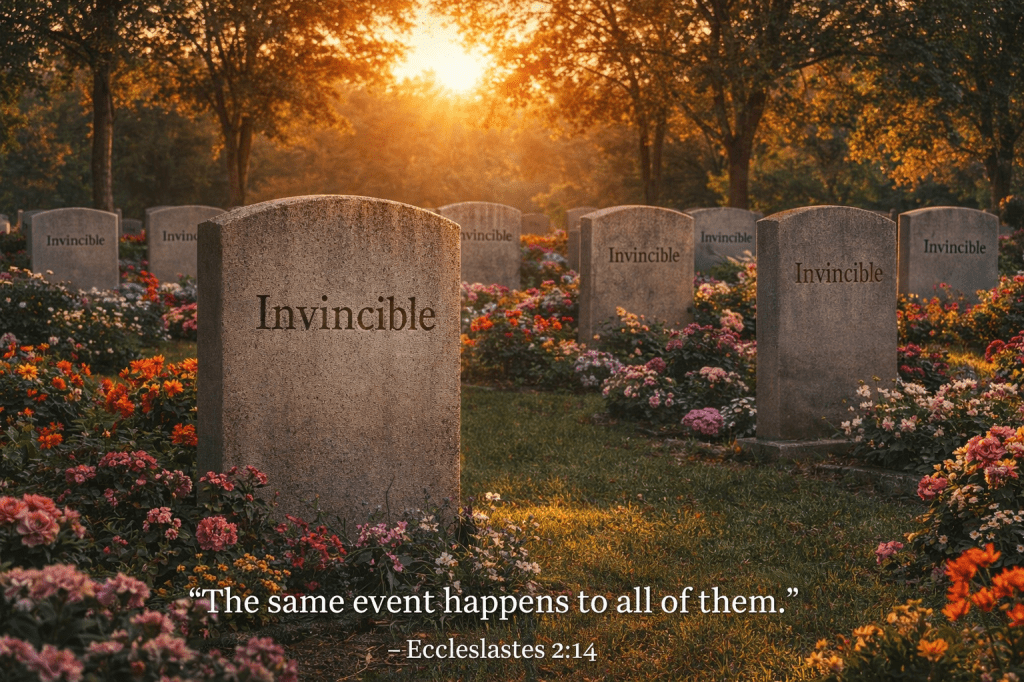
Recently, someone I have known for 33 years made a statement in regards to how aging humbles us. He stated, “I still think that I am invincible.”
I smiled quietly, as memories ran through my mind, but got lodged in the Botox-face staring back at me.
“Invincible,” I thought.
“This,” I thought, “is a perfect teaching topic about the illusion of invincibility. Perfect for my next Chat with a Hair Choreographer posts I write sporadically.”
The Holy Spirit interrupted.
Instead, the conversation lands itself in Scripture.
Let’s walk it out together.
The Universal Lie: “It Won’t Happen to Me”
Human beings have an astonishing ability to believe that life’s hardest realities apply to everyone except themselves.
We know people age.
We know illness happens.
We know consequences eventually arrive.
Yet somewhere within the human heart lives a quiet whisper: It won’t happen to me.
Ecclesiastes dismantles that illusion with startling honesty.
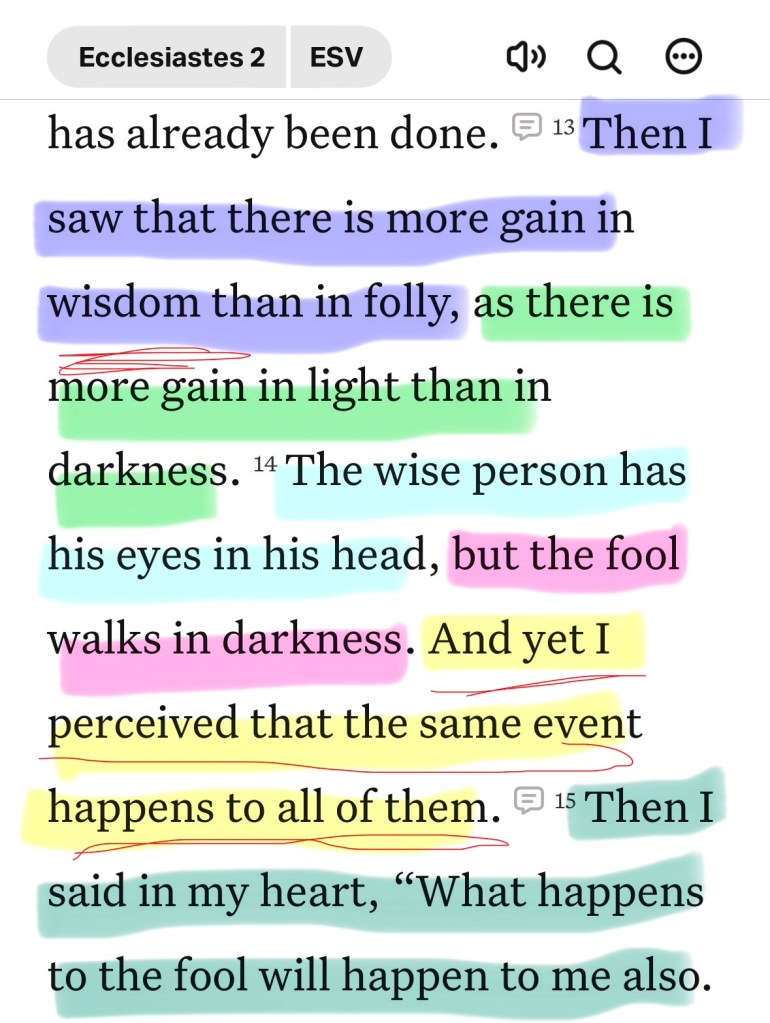
“Then I saw that there is more gain in wisdom than in folly, as there is more gain in light than in darkness. The wise person has his eyes in his head, but the fool walks in darkness. And yet I perceived that the same event happens to all of them.”
(Ecclesiastes 2:13–14)
Solomon observes something deeply unsettling.
Wisdom is better than folly.
Light is better than darkness.
But the wise and the foolish share the same ultimate fate. This observation collapses one of humanity’s favourite myths: that intelligence, success, or discipline somehow makes us untouchable.
Wisdom Is Seeing Reality Clearly
Solomon describes wisdom through a simple but powerful metaphor.
Wisdom is like light.
Folly is like darkness.
The difference between the two is not immunity from suffering but clarity of vision.
The wise person sees reality as it truly is.
The fool walks through life blind to its limits.
Philosopher Esther Lightcap Meek describes genuine knowing as the willingness to invite reality rather than control it.¹ Wisdom requires openness to what is real, even when that reality challenges our preferred narratives about ourselves.
The fool, however, lives in illusion.
He believes his strength will last forever.
He assumes consequences belong to others.
He imagines time will make an exception for him.
Ecclesiastes quietly responds: It will not.
The Ego’s Defence Mechanism
Why do human beings cling so fiercely to the illusion of invincibility?
Part of the answer lies in how the mind protects itself from uncomfortable truths.
Psychologists Daniel Kahneman and Amos Tversky demonstrated that human decision-making is shaped by systematic biases that distort how we evaluate risk and probability.² We instinctively underestimate dangers that threaten us and overestimate our control over outcomes.
In other words, the human mind is naturally inclined toward optimism about itself. Ecclesiastes simply strips away that optimism. Solomon observes that no matter how wise someone becomes, there are forces beyond human control: time, chance, suffering, and death.
The illusion of invincibility collapses under the weight of reality.
Learning Without Catastrophe
Yet Ecclesiastes is not nihilistic.
Solomon still insists that wisdom matters. Wisdom does not make us immune to life’s realities, but it does allow us to navigate them more faithfully. This is one of the great gifts of biblical wisdom literature: it allows us to learn through observation rather than catastrophe.
Proverbs repeatedly encourages the reader to learn from the mistakes of others.
“Let the wise hear and increase in learning.”
(Proverbs 1:5)
Wisdom listens.
The fool insists on discovering every lesson personally.
The Salon Mirror
Working in the beauty industry creates a fascinating vantage point for observing the human struggle with time. Hair salons are spaces where identity is continually negotiated. People come to restore confidence, reinvent themselves, or soften the visible marks of age. There is nothing inherently wrong with that. Beauty, after all, is a gift.
But the mirror in the salon also reflects something deeper. It quietly reminds us that time moves forward.
Every face eventually changes.
Every body eventually weakens.
Every life eventually reaches its end.
And strangely, this realisation need not be tragic. For Ecclesiastes suggests that humility before these limits is the beginning of wisdom.
The End of the Illusion
The wise person does not pretend to be untouchable. He recognises that life contains realities beyond his control. Instead of fighting those limits, he learns to live honestly within them. This humility leads Solomon to the ultimate conclusion of the book:
“Fear God and keep his commandments, for this is the whole duty of man.”
(Ecclesiastes 12:13)
The illusion of invincibility fades. And in its place emerges something far more valuable: wisdom.
A Reflection
The fool walks through life as though the ground beneath his feet will never shift. He builds towers of certainty upon the fragile soil of youth and strength, believing the seasons will make an exception for him. But time moves quietly, like evening shadows stretching across a field. Slowly, almost imperceptibly, the light changes.
The wise person notices the shadows. He does not panic when the sun begins to descend. Instead, he turns his face toward the fading light and learns gratitude for the day that was given. For wisdom does not make life permanent, but it teaches us how to live honestly within its passing.

Practical Application
Ecclesiastes invites us to examine our own assumptions about life.
Ask yourself:
• Where do I assume that consequences do not apply to me?
• Am I willing to confront the limits of my own control?
• Do I seek wisdom that helps me see reality clearly, or do I prefer comforting illusions?
Wisdom begins when we allow reality to humble us rather than pretending we are immune to it.
Prayer
Lord,
You know how easily we deceive ourselves.
We imagine we are stronger, wiser, and more secure than we truly are.
Teach us the humility that leads to wisdom.
Help us see life clearly and live faithfully within the limits You have given us.
Guard us from the illusion of invincibility, and lead us instead into the quiet strength of those who fear You.
In Your Holy Name Lord Jesus,
Amen.
TRACK TO ENJOY:

References
1. Meek, Esther Lightcap. The Little Manual for Knowing. Downers Grove: IVP Academic.
2. Kahneman, Daniel, and Amos Tversky “Prospect Theory: An Analysis of Decision under Risk.” Econometrica 47, no. 2 (1979): 263–291.
 #Hayibo