
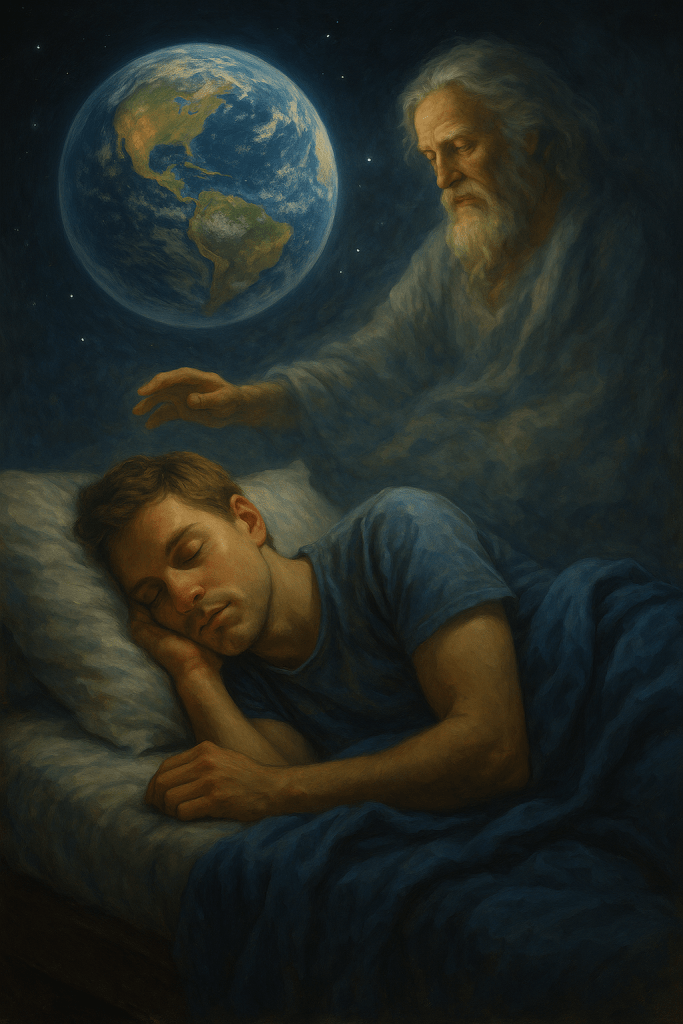
Everything that lives, sleeps. From the slow pulse of a whale to the silent flicker of a hummingbird’s eyelid, from the human mind to the soil’s microbial life, creation pauses. In that pause, it surrenders. In that surrender, it is renewed. Yet nothing in the vocabulary of chemistry anticipates such a thing. Molecules do not tire; they do not dream. Energy neither slumbers nor sighs. So how did matter learn to rest? If the story of life is a sequence of physical reactions, how did it acquire the wisdom to stop reacting?
This question lies at the fault line between biology and metaphysics. It suggests that res, the capacity to cease doing and yet continue being, reveals more than evolutionary adaptation; it reveals ontology. To rest is to know that being is good, that motion need not be endless, that existence is more than production. Sleep, that quiet cathedral of vulnerability, is the most subversive confession of faith in a world of perpetual striving.

The Biological Frame: Sleep as Life’s Signature
Modern science has come to regard sleep not as idleness but as life’s sustaining rhythm. Matthew Walker observes that every function of the human body depends upon it, immunity, memory, learning, and emotional regulation.¹ “Add the above health consequences up,” he writes, “and a proven link becomes easier to accept: the shorter your sleep, the shorter your life span.”² Walter Cannon’s concept of homeostasis identified this oscillating equilibrium, the balance between activity and restoration, as the central law of biological stability.³ Emmanuel Mignot writes, “Sleep is as necessary as water and food, yet it is unclear why it is required and maintained by evolution.”⁴ Evolutionary explanations describe sleep as an adaptive advantage, energy conservation, memory consolidation, synaptic pruning, yet none explain the awareness that precedes sleep.
To sleep is not merely to power down; it is to yield. The organism recognises exhaustion, seeks safety, and voluntarily releases control. That gesture of surrender is foreign to chemistry. A rock does not “decide” to cool; it merely loses heat. A neuron, by contrast, participates in a rhythm of withdrawal and renewal that presupposes self-regulation and an internal sense of boundary.
Rest, then, is not a mere lapse in function but a structured act of self-relation. It belongs to a level of being where matter knows itself, where life interprets its limits. Evolution can describe this pattern but not account for its meaning. It can trace the pathway of melatonin but not the mystery of trust.
The Philosophical Crossroads: Consciousness, Awareness, and the Hard Problem
Thomas Nagel argued in Mind and Cosmos that materialism cannot explain consciousness, for there is something it is like to be a living organism.⁵ This what-it-is-likeness, subjectivity itself, resists reduction to physical processes. David Chalmers called this the “hard problem”: why do certain brain states produce experience at all?⁶ Why is there something it is like to feel fatigue, to long for rest, to close the eyes and relinquish wakefulness?
If consciousness cannot be explained by chemistry, neither can rest, for rest presupposes consciousness. To rest is to know oneself as limited, to act upon that knowledge, and to orient one’s being toward restoration. Such reflexivity, knowing that one knows, choosing to yield, is the mark of mind, not matter.
Aquinas anticipated this centuries earlier. For him, the soul is the form of the body, the organising principle by which matter participates in divine reason.⁷ “The soul,” he writes, “is not harmony but the cause of harmony.”⁸ Life, then, is not a mechanical sum of parts but a participation in Logos, order, reason, meaning. The very act of rest implies an ordering mind within creation.
Chemicals cannot imagine rest because they know only reaction. If all life arises from unknowing matter, whence comes the notion of enough? Matter does not tire of being matter. But we, who are embodied spirit, know the ache of limitation. The awareness of that ache is itself metaphysical evidence.
The Theological Resolution: Rest as Revelation
In Genesis 2, God rests on the seventh day. The Creator does not slumber from exhaustion; He rests to bless completion. Creation’s rhythm begins with divine activity but culminates in holy stillness. Abraham Heschel, in The Sabbath, calls this “the architecture of time,” in which rest becomes a sanctuary for being itself.⁹ Augustine intuited the same when he confessed, “Our hearts are restless until they rest in You.”¹⁰ In divine rest, existence discovers its source and its end.
John Paul II expanded this vision, writing that human embodiment participates in the divine rhythm of work and repose, that to rest is to affirm the Creator (Genesis 2:2-3).¹¹ The cycle of sleep mirrors this cosmic pattern. Each night, as consciousness folds into darkness and returns at dawn, the body rehearses death and resurrection. Sleep thus becomes a sacrament of dependence, a nightly confession that the world continues without us because God sustains it.
Even science unwittingly echoes this truth. When researchers describe circadian rhythms as “entrainment to light,” they affirm what theology already knew: life is ordered by light. “I have come as light into the world,” Jesus declares in John 12:46, “that whoever believes in Me should not remain in darkness.” Every creature’s daily passage from wakefulness into sleep re-enacts that movement, from light to darkness to light again.
Rest, therefore, is revelation. It exposes that creation is not self-sufficient. It reminds humanity that autonomy is illusion. In yielding to sleep, we acknowledge a boundary that no technology can erase: we are not infinite.
The Metaphysical Implication: Sleep as the Signature of Grace
Sleep reveals a universe governed not merely by survival but by grace. Evolution may explain how rest functions, but theology explains why rest exists, because love requires trust, and trust requires surrender. The act of sleeping is the body’s liturgy of faith: a return to dependence, a rhythm written into the flesh by the Creator who first breathed rest into being.
Aquinas’s metaphysics of participation allows this synthesis. All creatures share analogically in God’s being; thus, even the most biological necessity bears theological meaning. To rest is to imitate God’s own peace, to inhabit the Sabbath woven into creation. Augustine called this “ordered love” (ordo amoris), love that knows its limit and finds joy in alignment with divine will.¹²
In this light, sleep is not evolutionary failure but metaphysical fidelity. The animal curls into instinctive trust; the human bows into conscious trust. Both act according to design, echoing the Logos that sustains the cosmos.
Conclusion: When Matter Knelt
If evolution wrote sleep into the fabric of life, it wrote theology by accident. Every living thing bears witness to a truth older than biology: being is not perpetual motion but rhythmic participation in divine rest. Sleep stands as the soft rebellion against the tyranny of production, the nightly reminder that existence depends upon grace.
When matter learned to rest, it learned to worship.
And in every breath that pauses, creation still repeats the first Sabbath, a world exhaling, a soul remembering that it was never self-made.
Practical Application: Learning to Rest as Worship
Sleep is not weakness; it is worship. Every night, when we lay down the tools of our own making and close our eyes to a world that keeps spinning without us, we rehearse a sacred truth: we are not God. The same hands that shaped the stars cradle us in that surrender.
To rest is to practice humility, a deliberate stepping out of the illusion of control. It is to trust that life continues because the Creator sustains it, not because we do. For leaders, thinkers, and believers alike, this means that renewal begins not in greater effort, but in holy dependence.
Tonight, when you turn out the light, see your bed not as an escape from exhaustion, but as an altar of trust. Whisper gratitude for the day you could not hold together, and let your final act before sleep be surrender. The first breath you take when you wake will be resurrection’s gentle rehearsal.
Prayer
Father of all creation,
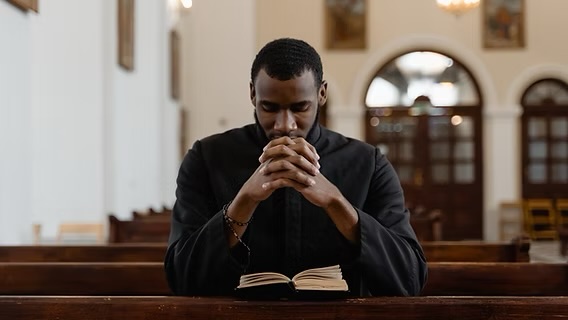
You who spoke rest into being and called it holy, teach me the art of stillness. Forgive me for believing the world depends upon my striving. Heal my addiction to motion and my fear of silence.
Let me find in sleep not an end, but a returning, to Your rhythm, Your peace, Your sustaining love. When I wake, may my heart remember: I am not kept by effort, but by grace.
As the sun rises, let me rise renewed, ready once more to serve, to love, and to rest in You.
In Your Holy Name Lord Jesus,
Amen.

Bibliography
1) Matthew Walker, Why We Sleep: Unlocking the Power of Sleep and Dreams (New York: Scribner, 2017), chaps. 1, 5, 8, 12.
2) Ibid., 9.
3) Walter B. Cannon, The Wisdom of the Body (New York: W. W. Norton, 1932), 59.
4) Mignot E. (2008). Why we sleep: the temporal organization of recovery. PLoS biology, 6(4), e106. https://doi.org/10.1371/journal.pbio.0060106.
5) Thomas Nagel, Mind and Cosmos: Why the Materialist Neo-Darwinian Conception of Nature Is Almost Certainly False (Oxford: Oxford University Press, 2012), 8.
6) David J. Chalmers, The Conscious Mind: In Search of a Fundamental Theory (Oxford: Oxford University Press, 1996), xi.
7) Thomas Aquinas, Summa Theologica, I, Q. 75, a. 6.
8) Ibid.
9) Abraham Joshua Heschel, The Sabbath: Its Meaning for Modern Man (New York: Farrar, Straus & Giroux, 1951), xiii.
10) Augustine, Confessions, trans. Henry Chadwick (Oxford: Oxford University Press, 1991), I.I.I.
11) John Paul II, Laborem Exercens (Vatican City: Libreria Editrice Vaticana, 1981), 6.
12) Augustine, On Christian Doctrine, I.27.
 #Hayibo