

There are moments when the digital winds carry our words far beyond the borders we imagined. This week, in a single day in fact, 676 readers in Germany engaged with a blog rooted in Scripture, experience, and global hope. Why Germany? And why now? Perhaps, as God often does, He is opening spiritual eyes through unexpected channels, inviting nations and individuals alike to wrestle with sight, identity, and truth. This is not only a letter to Germany but to a world, fractured by ideology, overwhelmed by identity crises, and haunted by its own moral entropy. The Gospel speaks today as it always has: with clarity, mercy, and confrontation.
As always, God’s Holy Spirit confirms the radical metaphysical promise of Jesus in John 16:7–15: the arrival of the Spirit would mean divine conviction, about sin, righteousness, and judgment, and the unveiling of truth not yet bearable. The Comforter would not only guide us into truth but glorify Christ in the very act of disclosure. This is what the Spirit has done in my own living room, cream blanket, coffee in hand, early light warming the quiet, as John 9:28–34 burst open anew, speaking not only of ancient controversy but of today’s cultural tremors across Germany and the globe.
So many speak of “God” these days, as if the word were malleable clay for personal philosophy. But the God revealed in Scripture is not ours to define. He is the Creator, not a creature of consensus. Proverbs 6:16–19 reminds us that God hates certain things, just as 1 John 4:8 tells us God is love. To truly know God requires unlearning our ego and allowing God to tell us who He is. That process, at times bruising, is love.
When I first became a Christian twenty-one years ago, I was what Germans might call völlig durch den Wind, a mess, scattered like leaves in a storm. Drug addiction, promiscuity, suicide attempts, I had absorbed too much pain, too many falsehoods. When I discovered Jesus was real, I had to relearn everything. The Holy Spirit showed me how deeply my view of “truth” had been shaped by trauma, politics, and people. That reorientation brought me not to perfection, but to devotion. I’ve debated with God often. He always wins. And strangely, in losing, I’ve fallen more deeply in love with Him.
John 9:28–34 is a startling mirror. In this passage, religious leaders berate a formerly blind man now healed by Jesus. Their theology was rigid, but their hearts were closed. When the man defends Jesus, they retort with searing pride: “You were completely born in sins, and are you teaching us?” And they cast him out. The healed man’s vision, physical and spiritual, stood as a threat to their institutional power.
Haven’t we all, at times, cast out what we don’t understand?
I have. Choosing celibacy to honour Christ was one of the most painful and liberating decisions of my life. It meant laying down a gay identity that once defined me. And yet, Jesus fills my life so profoundly that I would make the same decision again a thousand times. Like the man in John 9, I would rather be cast out with Christ than welcomed into comfort without Him.
Germany today stands at a similar crossroads. As Douglas Murray observes, the grand narratives that once gave societies coherence, religion, politics, progress, have unravelled. “The explanations for our existence that used to be provided by religion went first… Then over the last century the secular hopes held out by all political ideologies began to follow in religion’s wake.”¹ Without these unifying truths, postmodern pluralism offers nothing but fragmentation and ideological fatigue.

Blindness in the Age of Ideology
This erosion of shared meaning leads to what Charles Taylor has described as the “buffered self,” an individual closed off from transcendence, left only with internal fragments and no grand horizon of being.² Germany’s history is deeply familiar with such fractures. The 20th century bore witness to ideologies that promised meaning and justice but delivered destruction: Nazism, Communism, and more subtly, the modern ideological cults of identity without God.
Karl Barth, writing after the devastation of war, warned that when theology becomes captive to cultural or national dogma, it loses its prophetic witness.³ Faith must always be theologia crucis, cross-shaped, humbled, rooted not in man’s ambition, but in God’s revelation.⁴
Wolfgang Huber, former chair of the EKD (German Protestant Church), echoes this in our century. In the face of growing secularism and liberal relativism, he argues that Christian theology must not retreat into privatised faith or performative ethics. It must confront violence, ideology, and truth with the full resources of the Gospel.⁵
Today, Germany wrestles with profound questions: How do we remain democratic in a world that now distrusts all meta-narratives?⁶ What does it mean to welcome difference while holding onto coherent national identity? How does one oppose antisemitism and xenophobia without caving to ideological capture? The religious leaders in John 9 clung to the form of faith while denying its power. Germany, and the world, must not do the same.
The Cost of Sight: Being Cast Out for Truth
When the healed man in John 9 stood his ground before the religious elite, he wasn’t merely defending Jesus; he was exposing a spiritual system more interested in preserving its power than pursuing the truth. “You were completely born in sins, and are you teaching us?” they scoffed, before casting him out. Their response is more than personal insult; it is institutional rejection. What threatens them is not only Jesus, but the power of testimony unfiltered by their frameworks.
In our day, truth-telling remains a costly act. Philosopher Charles Taylor notes that we now live in “a secular age” where belief in God is no longer the default, and “faith is embattled,” not only outside religious institutions but often within them as well.⁷ Institutions, academic, political, and even ecclesial, often protect their own narratives with the same defensiveness found in John 9. Truth that disrupts the dominant story, whether biblical or empirical, is swiftly sidelined or shamed.
Douglas Murray calls our cultural moment a crisis of collapsing “grand narratives.” For centuries, religion and philosophy gave meaning to human existence, but in recent decades, those explanations have either been dismissed or dismantled by our delusions of God’s non-existence. This falsehood is driven by our ego’s need to make gods of ourselves by justifying our perception and calling it agency and autonomy. “One by one the narratives we had were refuted, became unpopular to defend or impossible to sustain,” he writes. “We have been living through a period of more than a quarter of a century in which all our grand narratives have collapsed.”⁸ In such a vacuum, identity becomes ideology, and ideology demands blind loyalty, ironically echoing the very blindness that Jesus heals.
The German theologian Wolfgang Huber warns of the danger when pluralism turns relativistic. “The rejection of every truth claim,” he writes, “leads not to tolerance, but to a new form of absolutism, one that pretends to have no foundation.”⁹ This is not unlike the blind man’s accusers: claiming authority while denying revelation. Their “certainty” was not faith, it was fear disguised as tradition. And so, he is cast out not for sin, but for sight.
We may ask, like the man in John 9: “Why, this is a marvellous thing.” When did vision become the scandal?
Germany – and the World – at a Crossroads
Germany today finds itself at a cultural inflection point. With a legacy shaped by both Christian theology and post-war secular humanism, it now confronts the challenges of pluralism, mass immigration, liberal ideology, and disillusionment with institutional trust. To be “German” is no longer a simple ethnic or national category; it is a contested idea shaped by layers of historical guilt, global responsibility, and moral confusion.
This tension is not uniquely German. It is the global condition. But Germany, as it often has in history, acts as a mirror to the world’s moral anxieties. What happens in Berlin is echoed in Paris, Johannesburg, New York, and São Paulo.
Theologian Karl Barth, writing from within Germany’s darkest historical hour, warned that the Church loses its prophetic power when it serves culture instead of Christ. “Where the Church is ashamed of the name of Jesus Christ… she loses her own substance.”¹⁰ Barth’s prophetic stance reminds us that theological clarity must not be sacrificed on the altar of political expedience or academic fashion.
Likewise, Wolfgang Huber has urged Germany to resist collapsing into relativism or moral neutrality. In post-unification Germany, he writes, “truth must not be replaced by tolerance as the highest virtue.”¹¹ A society that silences uncomfortable truths in the name of harmony does not become just, it becomes unstable.
It is precisely here that the global Church must recover its role, not as cultural chaplain, but as courageous witness. As the blind man in John 9 discovered, seeing truly will not earn you applause; it will often get you expelled. But it will also bring you closer to Jesus.
Prophetic Love, Not Performative Virtue
The blind man’s confession in John 9 is more than a medical testimony; it is a theological provocation. His clarity threatens the religious order not because it is irrational, but because it is righteous. Similarly, Cornel West warns us that when prophetic Christianity is silenced, liberalism becomes impotent, reduced to a “bourgeois nihilism” devoid of moral fire. “Justice,” West says, “is what love looks like in public.”¹² He reminds us that justice requires not simply feeling but fidelity, a willingness to suffer for the sake of truth, even when culture reviles or expels you.
Hans Urs von Balthasar, a Swiss Catholic theologian with deep resonance in German thought, would agree, but pushes the argument into the metaphysical: “Only love is credible,” he insists, because it is the very form of divine revelation.¹³ Christianity becomes irrational when separated from its source, divine love made manifest in the crucified and risen Christ.
But what kind of love are we speaking of? In Islamic mystical theology, Sa’diyya Shaikh draws from Ibn ʿArabi to argue that authentic liberation comes not through dominance or autonomy, but through sacred intimacy. This intimacy “necessitates a recovery of moral imagination,” a re-seeing of self and other as bound up in divine relation, not commodified identity politics.¹⁴ It is a necessary counterbalance to secular feminism’s obsession with agency without transcendence.
Similarly, Serene Jones calls us to a theology of wound and witness. Speaking as both a theologian and womanist, she reminds us that “the cross speaks not only of suffering, but of the kind of love that stays, through betrayal, through abandonment, through the silence of death.”¹⁵ Love, to be just, must be cruciform. And justice, to be loving, must endure.
Conclusion: Sight, Silence, and the Saviour
When the blind man in John 9 was cast out for telling the truth, it was not just a moment of expulsion, it was the birth of clarity. Those who claimed to see were, in fact, blind. And the one who had been blind now saw not just with his eyes, but with his soul. In a fractured age like ours, where moral certainty is branded as intolerance, and truth is often bartered for sentiment, the question of sight remains. Who really sees? And who has merely inherited blindness under the illusion of progress?
Germany, like the global West, stands at an inflection point. The spiritual cost of liberal pluralism, when it becomes detached from truth, can no longer be ignored. As Charles Taylor warned, when transcendence is bracketed out of public life, all that remains is the immanent frame of flattened meanings, therapeutic identities, and institutionalised confusion masquerading as freedom.¹⁶ But John 9 is a call to spiritual resistance: to refuse both the pride of the elite and the paralysis of the fearful, and to say with courage, “Once I was blind, but now I see.”
It is a call not just to Germany, but to every “Germany,” every nation or soul wrestling with the blinding ideologies of our time. Whether religious or secular, wounded or defensive, grieving or searching, Jesus still heals, still confronts, still saves. But as He did with the Pharisees, He will also expose the idols of certainty, power, or ideology that keep us from real sight.
In the end, the Gospel is not safe. But it is true. And as the Spirit bears witness, not on social media, but in the still, convicting intimacy of the heart, we are reminded again that the truest sight begins with humility, and that excommunication for Christ may just be the beginning of our truest belonging.¹⁷

Practical Application: Living With Eyes Wide Open
To those reading from Germany, and to every soul navigating the noise of this globalised age, the question is not just Do you see? but What do you do with the sight Christ offers?
Like the healed man in John 9, the invitation is not to join another ideological tribe, but to step out in courageous clarity, even when it costs.
Here are some practical ways to live with spiritual eyes wide open:
Ask deeper questions: Like Jesus, don’t get distracted by surface-level ideologies. Ask, “What do you need from me?” not “What should I say to stay safe?” Choose faith over fear: Speak the truth in love, even when it gets you “cast out” of echo chambers or cultural institutions. Pray for discernment: Daily ask the Holy Spirit to reveal where you’ve unknowingly inherited blind assumptions about God, justice, or self. Walk alongside the rejected: Jesus found the man after he was cast out (John 9:35). Be the kind of believer who goes after the outcast, not the platformed.
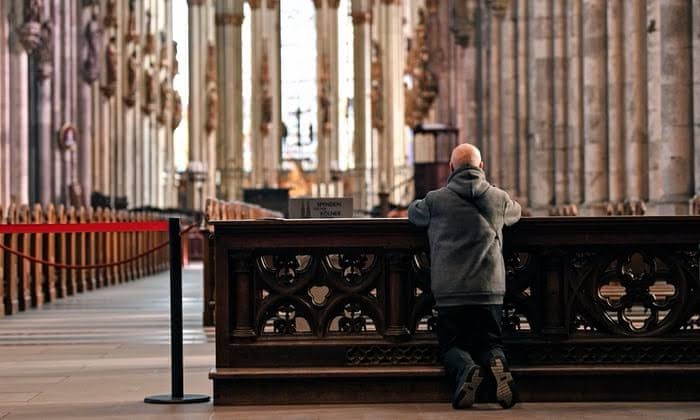
A Prayer for Sight and Courage
Father God,
We come before You as people who often do not see clearly. Our vision is fogged by pain, pride, culture, and confusion. Yet You, Jesus, open the eyes of the blind, not just to see the world, but to see You.
Heal our assumptions. Strip away our borrowed identities. Restore in us a hunger for Your truth that is louder than the ideologies of our age.
Holy Spirit, convict our hearts of where we serve to serve self. Give us courage like the man born blind, to speak truth even when it costs us our comfort. Let us follow Christ, not crowds. Let us carry grace, not pride.
And when the world casts us out, meet us again, as You always do.
In the name of the One who is the Light of the World, Mighty Messiah King Jesus,
Amen.

References
1. Douglas Murray, The Madness of Crowds: Gender, Race and Identity (London: Bloomsbury Publishing, 2019), xii.
2. Charles Taylor, A Secular Age (Cambridge, MA: Harvard University Press, 2007), 299.
3. Karl Barth, Church Dogmatics I/1, ed. G. W. Bromiley and T. F. Torrance (London: T&T Clark, 2004), 55.
4. Ibid., 125.
5. Wolfgang Huber, “Truth, Guilt, and Reconciliation: Christian Faith in a Violent World,” Prism Papers on Reconciliation, no. 1 (Geneva: WCC, 2002), 2.
6. Murray, The Madness of Crowds, xii.
7. Charles Taylor, A Secular Age (Cambridge, MA: Belknap Press, 2007), 3.
8. Douglas Murray, The Madness of Crowds: Gender, Race and Identity (London: Bloomsbury Continuum, 2019), Introduction.
9. Wolfgang Huber, “Truth, Guilt, and Reconciliation: Christian Faith in a Violent World,” Public Philosophy for a Globalising World, 2002, 4, https://berkleycenter.georgetown.edu/publications/truth-guilt-and-reconciliation-christian-faith-in-a-violent-world.
10. Karl Barth, The Church Dogmatics: An Introduction and Reader, ed. Michael Allen (London: T&T Clark, 2012), 94.
11. Wolfgang Huber, “Truth, Guilt, and Reconciliation,” 5.
12. Cornel West, Democracy Matters: Winning the Fight Against Imperialism (New York: Penguin Press, 2004), 19.
13. Hans Urs von Balthasar, Love Alone Is Credible, trans. D. C. Schindler (San Francisco: Ignatius Press, 2004), 9.
14. Sa’diyya Shaikh, Sufi Narratives of Intimacy: Ibn ʿArabi, Gender, and Sexuality (Durham: University of North Carolina Press, 2012), 18.
15. Serene Jones, Trauma and Grace: Theology in a Ruptured World (Louisville, KY: Westminster John Knox Press, 2009), 89.
16. Charles Taylor, A Secular Age (Cambridge, MA: Belknap Press of Harvard University Press, 2007), 543.
17. John 9:35–38. See also David Guzik, “John 9 – Jesus Gives Sight to the Blind,” Enduring Word Commentary, https://enduringword.com/bible-commentary/john-9/.
 #Hayibo