

Personal Reflection
I have been a follower of Jesus for 22 years.
Am I great at being a disciple?
Well, that answer depends on who you ask.
If you ask the LGBTQ community who live with Christian cognitive dissonance, they would say that I am homophobic and a bigot.
Why?
Because I used to live that toxic lifestyle, and chose Jesus and Biblical Truth instead.
It took 13 years for me to give up that way of life, choose to practise celibacy to honour Jesus for saving me, and to realise that God (Yahweh, Jesus, Holy Spirit) is the love of my life. Am I a bigot, and homophobic? Not even in the slightest. I am called derogatory names now, simply because I advocate for a lifestyle I know to be the fruit of healing. I have seen and learned the academic machinations behind identity, and I know that the love we all seek is maximally found in God.
Giving up a lifestyle is not the loss of something. It is the gain of the most prolific relationship we could ever have, a relationship with the only living God Himself. And man, is God mind-blowing. Not a day goes by that He doesn’t surprise me, humour me, reveal my broken humanness that needs redeeming, and catch me when I feel I cannot go on. But I remember that the same God who brought me out of my LGBTQ-Egypt has got me.
Yes, for 13 years I struggled with so much guilt and shame, guilt for not being able to let go of a lifestyle that was thrust upon me by childhood sexual abuse and other psychological violations. But Jesus remained faithful. Step by step, He helped me trust Him more. Guilt and shame made me quit church more times than I can count. I felt it was impossible to let go of a lifestyle that had become my identity. But those first 13 years with God were incredible.
Like Peter, I learned that my denial of God said more about where I was at than it ever did about how Jesus felt about me. I learned that my rejection was no match for Jesus’ forgiveness, mercy, and unrelenting will to keep seeking, calling, and healing me.

The Weight of Moral Injury
The second stage of Post-Traumatic Growth (PTG) as defined by psychologists Richard Tedeschi and Lawrence Calhoun is moral injury and guilt. This stage arises when individuals confront the emotional aftermath of having transgressed their own ethical standards, whether by action or omission. The shame is not merely social; it is existential.¹
Clinical psychologist Jonathan Shay famously described moral injury as “a betrayal of what’s right, by someone who holds legitimate authority, in a high-stakes situation.”² The pain isn’t just what happened, it’s who you became in the moment. Whether it is a soldier agonising over wartime choices, or a child wondering why they didn’t cry for help, the wound is deeply moral.
Bessel van der Kolk goes further, identifying how trauma-induced shame embeds itself in the body, altering not only how we think, but how we exist.³ Guilt says “I did something bad,” but shame says “I am bad.”⁴
This, then, is the weight that Peter carried.
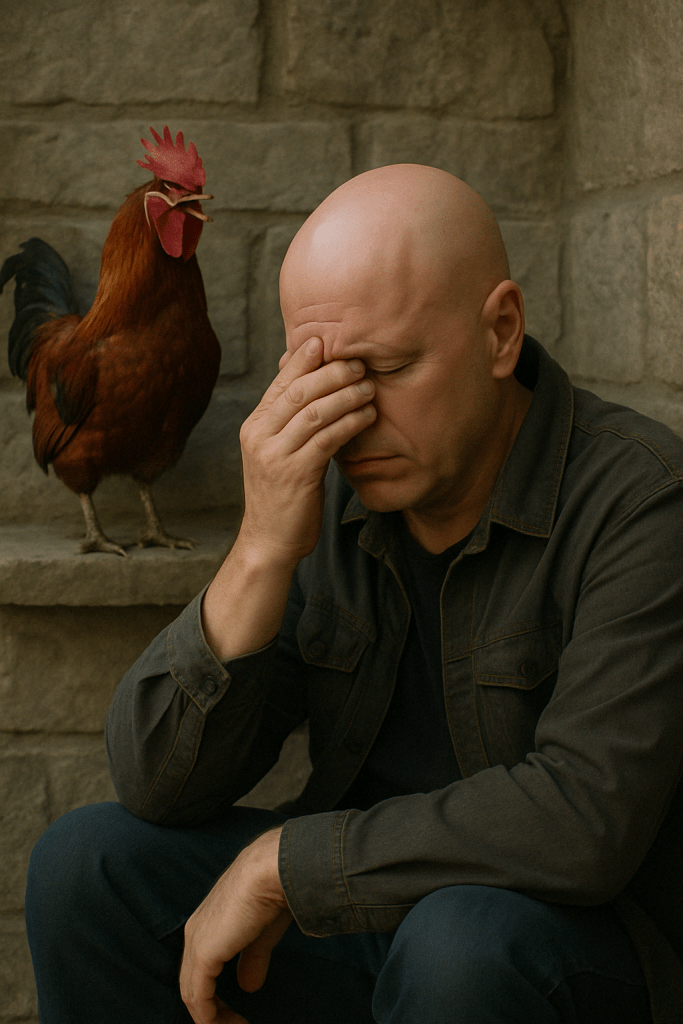
When the Rooster Cries: Peter’s Denial (Luke 22:54–62)
Luke’s account is stark. Peter, having promised his undying loyalty to Jesus, follows the arrest from a distance. Then, three denials, escalating in fear and fervency. The final one erupts: “Man, I do not know what you are talking about!” (Luke 22:60).
And then…
The rooster crows.
In one of the most haunting moments in the Gospels, Jesus turns and looks at Peter. That look breaks him. Luke writes, “And he went out and wept bitterly” (v. 62). Peter’s shame is total.
According to Esau McCaulley, this moment speaks to a communal experience of failure, the kind known to all who have walked through spiritual disorientation and betrayal.⁵ Fleming Rutledge sees in the look of Jesus not condemnation but grace, an invitation to restoration even before the cross is borne.⁶
What distinguishes Peter from Judas is not the weight of their guilt, it’s what they did with it.
Judas turned inward, ending his life.
Peter, though broken, stayed within reach.
And after resurrection, Jesus reinstated him, not through punishment, but through love (John 21:15–19).⁷
Questions for the Wounded Soul
Have you ever denied what you most loved? I have. Jesus forgave and restored me. Your turn?
Have you ever replayed a moment where you wish you had been brave, but weren’t? Definitely. I used to be ashamed to be a Christian, often denied it, because of mock and ridicule. Then I realised, “Hey, others live what they choose, so can I.” Yourself?
Do you believe Jesus looks at you, not with condemnation, but with redemptive love? Yes. Most days. Some days, I get in my head and those voices still try sabotage me to look at what I am not, yet forgetting what Jesus has made me so far. You?
Like Peter, we can carry our guilt to the shoreline where Jesus cooks breakfast.
But first, we must weep.

Practical Reflection: When You’re Not Proud of Who You Were
In the haze of guilt, it is easy to mistake failure for finality. But the bitter weeping of Peter is not his ending, it is the beginning of growth. Moral injury can become the root of humility. As South African theologians have noted in post-apartheid studies of communal shame, healing begins with facing, not fleeing, what we’ve done.⁸
Whether it’s the guilt of denying Christ in public or the shame of private compromise, there is space at the fire where Jesus waits.
Restoration is not for the sinless.
It is for the honest.

Prayer
Father God, Jesus, Holy Spirit,
We have failed You. Denied You. Distanced ourselves when we should have stood close.
But still You look for us. Still You love.
We confess our moral wounds, our self-betrayals, our silences.
Heal our shame. Transform our guilt into grace. Make us whole again, not by hiding our past, but by redeeming it.
In Jesus’ Holy Name,
Amen.

References
- Richard G. Tedeschi and Lawrence G. Calhoun, Posttraumatic Growth: Conceptual Foundations and Empirical Evidence, Psychological Inquiry 15, no. 1 (2004): 1–18.
- Jonathan Shay, “Moral Injury,” Intertexts 16, no. 1 (2012): 57–66.
- Bessel van der Kolk, The Body Keeps the Score: Brain, Mind, and Body in the Healing of Trauma (New York: Viking, 2014).
- Rita Nakashima Brock and Gabriella Lettini, Soul Repair: Recovering from Moral Injury After War (Boston: Beacon Press, 2012).
- Esau McCaulley, Reading While Black: African American Biblical Interpretation as an Exercise in Hope (Downers Grove: IVP Academic, 2020).
- Fleming Rutledge, The Undoing of Death (Grand Rapids: Eerdmans, 2002).
- N. T. Wright, John for Everyone: Part Two (London: SPCK, 2004).
- Dion Forster and Ernst Conradie, “Public Theology and Moral Formation in Post-Apartheid South Africa,” In die Skriflig 57, no. 1 (2023), https://indieskriflig.org.za/index.php/skriflig/article/view/2578/6779.
- Nontando Hadebe, “Moral Injury and African Feminist Theologies,” Theologia Viatorum 47, no. 2 (2023): https://scielo.org.za/scielo.php?pid=S2413-94672023000200008&script=sci_arttext.
 #Hayibo