

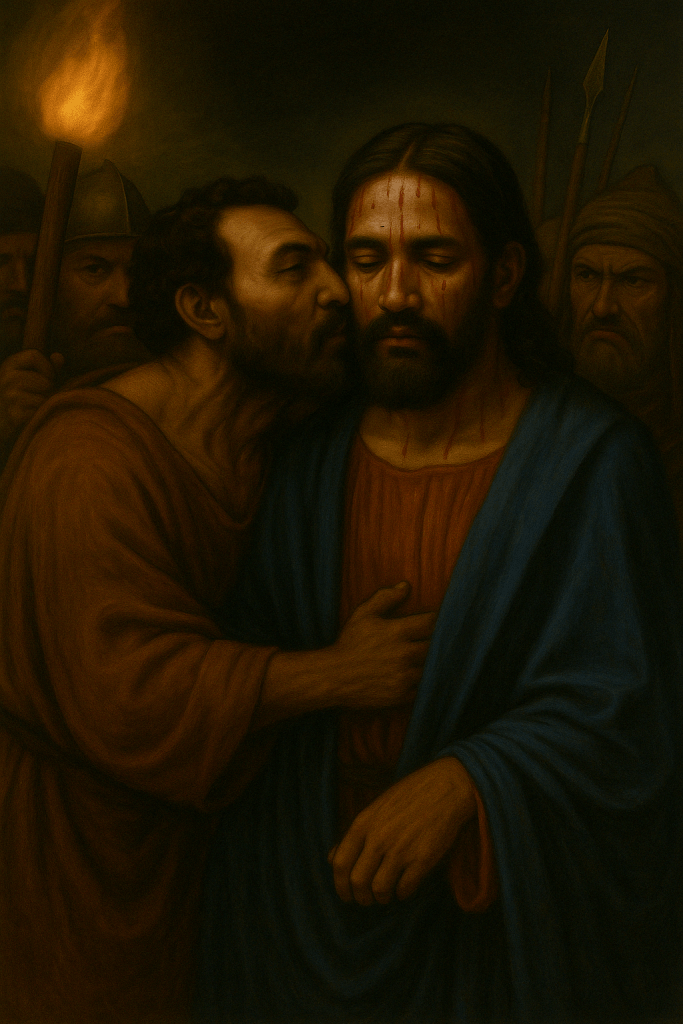
It wasn’t a dagger that pierced Him first.
It was a kiss.

Post-Traumatic Growth and the Passion
Post-Traumatic Growth (PTG) is a psychological concept developed by Richard Tedeschi and Lawrence Calhoun to describe the positive changes that can emerge in the aftermath of trauma.¹ Rather than viewing suffering only through the lens of pathology, PTG recognises that some individuals experience deeper appreciation of life, strengthened relationships, personal resilience, spiritual transformation, and new possibilities precisely because they endured adversity.² Yet growth is not linear, and it rarely begins with clarity. It often starts in chaos.
This week, we trace five stages of PTG mirrored in the Passion of Christ: Shock & Betrayal, Moral Injury & Guilt, Grief & Despair, Ruminative Silence, and Transformation & New Life. Today is Wednesday. The day of the kiss.
{Note: While this post focuses on the kiss of betrayal as part of Wednesday’s reflection, I am aware that the Last Supper preceded it chronologically. This is a thematic, not strictly historical sequence; structured around the five stages of post-traumatic growth during Passion Week.}
What happens when pain comes not from a stranger, but a companion? Can holiness emerge from a wound so intimate?
Shock and Betrayal: The Psychological Rupture
The first stage of PTG is often marked by stunned disbelief. In cases of betrayal trauma, particularly when the harm is inflicted by someone trusted, the experience can shatter what psychologist Ronnie Janoff-Bulman called the “assumptive world”: the internal framework by which a person believes the world is safe, people are trustworthy, and life has meaning.³ This betrayal is not simply emotional pain; it is the collapse of psychological architecture.
Jennifer Freyd identifies betrayal trauma as distinct from other forms of trauma in that it undermines core relational trust.⁴ It causes internal disintegration, cognitive dissonance, and often self-blame, especially when survival depends on continued attachment to the betrayer.⁵ In biblical terms, betrayal is not just a human act, it is a spiritual rupture.
Why does betrayal hurt more than violence?
Because it weaponises love.
Judas’s Kiss (Mark 14:43–46): The Night It Began
In the Gospel of Mark, we are given the most haunting image of betrayal in Scripture: Judas, one of the twelve disciples, leads an armed crowd into Gethsemane. He approaches Jesus, calls Him “Rabbi,” and kisses Him, not in affection, but as a signal to identify Him for arrest:
“Going at once to Jesus, Judas said, ‘Rabbi!’ and kissed him. The men seized Jesus and arrested him.” (Mark 14:45–46)
Matthew’s Gospel records Jesus’ reply: “Friend, do what you came to do” (Matthew 26:50). Even in betrayal, He calls him “friend.” What does it mean that Jesus still used that word?
Psalm 41:9 is fulfilled in this moment: “Even my close friend, someone I trusted, one who shared my bread, has turned against me.”⁶ Judas was not a vague acquaintance. He had walked with Jesus, broken bread with Him, witnessed miracles. His kiss was the corruption of intimacy.
The disciples’ response to this betrayal reveals their own trauma: “Then everyone deserted Him and fled” (Mark 14:50). Their world unravelled. Flight is a classic response to shock.⁷ The assumption that their group was loyal, united, and divinely protected had just been obliterated.
This moment of betrayal is not peripheral, it sets the stage for the atonement. Some theologians interpret the cross as penal substitution: Jesus takes the punishment for sin. Others emphasise moral influence: Jesus suffers to reveal the depth of divine love. Regardless of the model, the betrayal is essential, it initiates the suffering that saves.
Is it possible to experience divine purpose and human devastation in the same moment?
Theological Integration: Jesus and the Trauma of Knowing
Theologically, Judas’s betrayal was not a surprise. Jesus had foretold it. Yet foreknowledge does not eliminate pain. Jesus walks into the pain fully aware, and fully surrendered. This is the mystery of the Incarnation, that Jesus, being fully God and fully man, experienced betrayal not with detached divinity but with real human vulnerability.¹³ His divinity did not cancel His agony; it consecrated it. Chalcedon (451 AD), affirms Christ as “truly God and truly man… in two natures, without confusion, without change, without division, without separation.” He allows betrayal to be the opening act of redemption. This was not merely a moment of personal heartbreak, it was a cosmic confrontation. In allowing Himself to be handed over, Jesus disarmed the powers of darkness, exposing and triumphing over them through the very act of surrender (Colossians 2:15). Betrayal was the doorway, but victory was the destination.
Yet between those two lies the hard, holy work of remembering and living it presently. Jesus didn’t flinch. Miroslav Volf reminds us that memory is not redeemed by erasure but by truth-telling.⁸
Henri Nouwen describes Christ as the “wounded healer,” the one who ministers from His own scars.⁹ Here, in Gethsemane, that wound is opened not by whip or nail, but by the lips of a companion. Jesus, who sweated blood under pressure, bears the prophetic weight of knowing the betrayal was coming, and loving anyway.¹⁰
How do we process pain when God knew it was coming?
When the Wound Is Personal: My Story
I cannot even pretend to imagine what it must have been like for Jesus to be betrayed by Judas. The Gospels tell us He sweat blood from distress as He prayed, “Father, if it be your will, take this cup from me, but not my will, yours be done.”¹¹ Medically, hematidrosis (sweating blood) is rare, triggered only by extreme psychological pressure. Psychological pressure is something I know something about.
I remember the moment the person I believed was the love of my life told me they wanted to move intimacy outside of our relationship. The heartbreak was physical. A snapping feeling inside my chest. I had no words. It was as if everything I had believed in collapsed in an instant. And yet, I didn’t sweat blood. I cannot imagine the immense pain of the Creator being betrayed by one He created which lead to Him dripping blood-sweat. Can you?
But I know betrayal. My own father tried to kill me. Twice. That wound redefined my childhood. That breach of safety set me on a path of self-sabotage and pain. I didn’t get the therapy I needed as a kid. I made destructive choices. I lived, many times, in the echo of Jesus’ cry from the cross: “My God, my God, why have you forsaken me?” (Matthew 27:46).¹²
I know theologians teach that Jesus wasn’t actually abandoned by the Father, that His words echo Psalm 22, and the moment was cosmic, not relational. But when you’re carrying your cross abandonment feels real.
Through time, therapy, and the patient comfort of the Holy Spirit, I’ve learned not only to forgive others, but to forgive myself.
Have you ever been kissed by someone who would later abandon you?
What Betrayal Begins
Wednesday is not the end of the story. The betrayal begins the Passion, but it does not finish it. In Jesus, betrayal is not only felt, it is transformed. The wound becomes a door. The kiss that wounds becomes the spark that lights resurrection’s flame.
We may not choose betrayal. But we can choose what it births in us.
Jesus said, “For God did not send His Son into the world to condemn the world, but to save the world through Him” (John 3:17). The One who was betrayed saves the betrayers. The One who was abandoned embraces the abandoned. The One who sweat blood now offers redemption to those who bleed.
Could your betrayal be the beginning of something holy?
Practical Steps: When Betrayal Breaks You

Betrayal doesn’t just bruise the heart, it confuses the mind, shakes your identity, and often leaves you questioning your worth. If this is your Wednesday, here are a few gentle, theologically grounded steps toward healing:
- Name the betrayal honestly.
Jesus did not deny Judas’s act. He acknowledged it, even while calling him “friend.” Naming what happened is not bitterness, it’s the beginning of clarity. - Avoid interpreting your pain as divine abandonment.
The silence of God is not the absence of God. He is present, even in Gethsemane. Feelings are real, but they are not always the full truth.
Even Jesus’ feelings of abandonment on the cross, “My God, my God, why have You forsaken Me?” were not just emotional; they fulfilled the prophetic arc of Psalm 22. In Scripture, even our rawest emotions can participate in God’s redemptive plan. - Seek safe witnesses.
Just as Jesus took Peter, James, and John into the garden, bring your story to trusted believers, trauma-informed therapists, or spiritual directors who hold space without judgment. - Let your tears lead to trust.
Grief is not a lack of faith. It is often the soil where faith deepens. Allow lament to become prayer. - Turn the wound into witness.
Jesus’ betrayal did not end in the grave. Mostly, nor will yours. Your story, redeemed, is someone else’s survival guide.
Could it be that your healing is not just about you, but about who you will become because of it?
Prayer: From Wound to Witness

Father God, Jesus, Holy Spirit,
I bring You the kiss that broke me.
The one I didn’t see coming.
The one that knew my name, and still chose to wound.
You were betrayed too.
You were abandoned by people too.
You were kissed and pierced in the same breath.
So teach me to breathe again.
To trust, not quickly, but truthfully.
To forgive, not cheaply, but courageously.
And if I must bleed for a while,
Then let it be shaped by Your cross.
Make me, like You, a wounded healer.
Because I believe what You said that You did not come to condemn the world, but to save it.
So save me, even from the ones I loved. Help me to bless as You did, even in the midst of suffering.
In Your Holy Name King Jesus,
Amen.
References

- Richard G. Tedeschi and Lawrence G. Calhoun, Posttraumatic Growth: Positive Changes in the Aftermath of Crisis (Mahwah, NJ: Lawrence Erlbaum Associates, 1995).
- Nancy J. Ramsay, Pastoral Diagnosis: A Resource for Ministries of Care and Counseling (Minneapolis: Fortress Press, 1998).
- Ronnie Janoff-Bulman, Shattered Assumptions: Towards a New Psychology of Trauma (New York: Free Press, 1992).
- Jennifer J. Freyd, Betrayal Trauma: The Logic of Forgetting Childhood Abuse(Cambridge: Harvard University Press, 1996).
- Judith L. Herman, Trauma and Recovery (New York: Basic Books, 1992).
- Charles Spurgeon, The Treasury of David, vol. 1 (Peabody, MA: Hendrickson, 1990), Psalm 41.
- Harold G. Koenig, Spirituality in Patient Care (Philadelphia: Templeton Foundation Press, 2007).
- Miroslav Volf, The End of Memory: Remembering Rightly in a Violent World(Grand Rapids: Eerdmans, 2006).
- Henri Nouwen, The Wounded Healer(New York: Image Books, 1972).
- David Guzik, Enduring Word Bible Commentary, accessed April 16, 2025, https://enduringword.com.
- N.T. Wright, The Day the Revolution Began (New York: HarperOne, 2016).
- Elizabeth Kübler-Ross and David Kessler, On Grief and Grieving (New York: Scribner, 2005).
 #Hayibo