

(And Why My Blood Pressure Thanks Me)
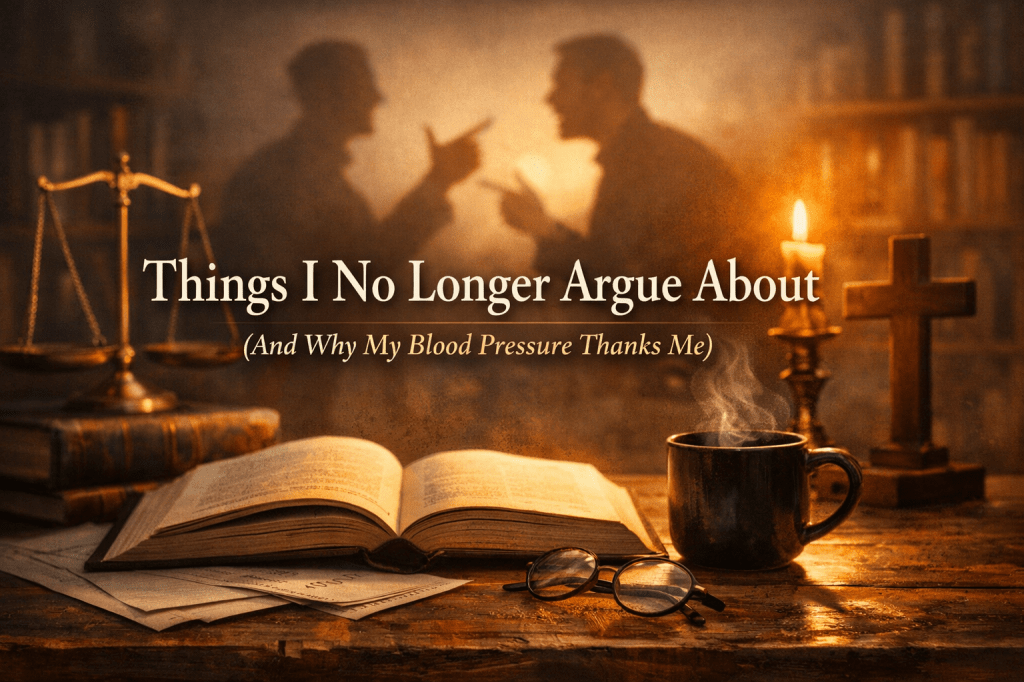
“We’re in a giant car heading towards a brick wall and everyone’s arguing over where they’re going to sit.” – David Suzuki
Introduction
I used to argue a lot. Not because I loved conflict, but because I confused conviction with volume. Somewhere along the way, I picked up the idea that if something was true, it deserved a defence, and if it deserved a defence, then every conversation was a potential courtroom.
That posture is exhausting.
With time, prayer, and a few unnecessary comment-section injuries, I began to notice something: not every disagreement is a threat, not every question is an attack, and not every silence is a concession. Wisdom, it turns out, is not the ability to answer everything, but the discernment to know what does not require argument at all.
This is not a manifesto against truth, nor a retreat into relativism. It is a confession of maturity. I still care deeply about truth. I still teach, write, persuade, and defend what I believe. What I no longer do is mistake loudness for faithfulness or assume that persuasion requires pressure.
Some arguments do not need winning. Some truths do not need shouting. And some conversations are better approached as acts of presence rather than performances of intellect.
What follows are a few things I no longer argue about, and why letting them go has made both my thinking and my living more honest.

God’s Existence
I do not argue about God’s existence.
I will speak about God. I will witness, explain, and invite. I will even defend the coherence of faith when asked. But I no longer enter arguments whose hidden premise is that God is anxiously awaiting a verdict, as though divine reality hinges on my rhetorical agility or someone else’s intellectual assent.
Arguing about God’s existence often assumes that certainty is produced by syllogisms alone. Yet some forms of knowing precede articulation. Michael Polanyi famously observed that “we know more than we can tell,” highlighting that much of human knowledge is tacit, embodied, and indwelt before it is ever argued into propositions.¹ Faith, like trust or love, is not first inferred. It is recognised, lived, and only later defended if required.
This does not mean belief is irrational. Alvin Plantinga has argued that belief in God can be properly basic, grounded in the normal functioning of human cognition rather than dependent upon inferential proof.² In other words, belief may be warranted without being the conclusion of an argument. To insist that God’s existence must always be debated before it can be believed is not intellectual rigour. It is a philosophical prejudice.
Internet debates rarely acknowledge this. They proceed as if God is an abstract hypothesis, detachable from lived reality, moral experience, beauty, suffering, or meaning. But no one argues their way into grief, awe, or conscience. These are encountered, not deduced.
If God exists, He does not need me to shout Him into being. And if He does not exist, no amount of shouting will summon Him. Either way, volume is irrelevant.
What I have learned is this: certainty is not produced by argument. It is clarified by faithfulness. And there is a great deal of peace in no longer mistaking the two.
Arguing with God
I do argue with God.
Not because I think I will win, but because He invites it. And because losing, in this case, is strangely life-giving.
One of the quiet surprises of Christian maturity is discovering that prayer is not a monologue of compliance but a space of reasoning. Scripture does not portray God as threatened by questions or offended by protest. On the contrary, God repeatedly summons His people into dialogue: “Come now, let us reason together” (Isa. 1:18). The invitation assumes that faith is not the absence of tension, but the willingness to bring it honestly into God’s presence.
Augustine understood this well. His Confessions are not a tidy record of doctrinal certainty but a prolonged argument with God, marked by resistance, confusion, desire, and surrender. Yet Augustine’s wrestling is never adversarial. It is relational. God is not treated as an object to be mastered but as a presence who corrects without crushing and persuades without coercion.³
Karl Barth sharpens this further. For Barth, revelation is not the confirmation of human reasoning but its interruption. God does not submit Himself to our terms of debate; He addresses us. And yet, this address does not silence thought. It provokes it. Theology, Barth insists, is “faith seeking understanding” precisely because faith has already been encountered, not because it has been logically secured.⁴
This changes the nature of argument entirely. When I argue with God, I do not do so to establish authority. I do so because I trust His. The argument is not about winning but about alignment. And alignment often feels like loss: loss of certainty, loss of control, loss of cherished misreadings of myself.
There is a peculiar safety in this. God is the only being who can dismantle your argument and leave your dignity intact. He does not humiliate the one He corrects. He restores them.
That is why I no longer argue against God, but I still argue with Him. The former assumes rivalry. The latter presupposes relationship.
And here is the paradox: I expect to lose every argument with God, and that expectation is precisely why I trust Him enough to speak freely.
Bias
I no longer argue about whether I am biased.
I assume I am.
This is not an admission of defeat, but a refusal of pretence. The most corrosive illusion in modern discourse is not disagreement but neutrality. We are taught to imagine that clear thinking begins from nowhere, as if the mind could hover above history, language, culture, trauma, affection, and interest. It cannot. And pretending otherwise does not make us objective, only unaware.
Hans-Georg Gadamer names this condition with precision. Understanding, he argues, is always situated. We do not approach truth as detached observers but as historically affected beings whose horizons shape what can be seen and said.⁵ Bias, in this sense, is not a moral failure but a structural condition of understanding. The danger is not having prejudgments, but refusing to examine them.
This reframes conversation entirely. If bias is inevitable, then confession becomes more honest than defence. “I see this from somewhere” is a more trustworthy posture than “I see this as it really is.” The latter usually means “as I have learned to see it, without realising how.”
Cognitive science quietly confirms this. Daniel Kahneman’s work on heuristic thinking shows that much of our reasoning is fast, automatic, and shaped by prior associations long before reflective judgement engages.⁶ We do not begin with conclusions because we are irrational, but because the brain is efficient. The trouble begins when we mistake efficiency for objectivity.
This is why denying bias is the most biased move of all. It closes the door to correction. It hardens opinion into identity. Once disagreement is experienced as threat, conversation gives way to defence, and defence to caricature.
I am not neutral. I am located.
And once that is acknowledged, something curious happens. Listening becomes possible. Humility becomes rational. And truth, instead of being something I wield, becomes something I am still learning to receive.
Knowledge
I no longer argue about how much I know.
This is not false modesty. It is relief.
There was a time when I treated knowledge like territory. The more I acquired, the more I felt obliged to defend it. Degrees became receipts. Citations became shields. Every unanswered question felt like a personal failure. Somewhere along the way, learning quietly mutated into control.
Age has been corrective.
Socrates’ famous confession, that he was wise only in knowing that he did not know, was not a rhetorical flourish but a philosophical posture.⁷ Knowledge, for him, was not possession but orientation. The moment one claims to have arrived, inquiry collapses. Certainty, when mistaken for completion, strangles curiosity.
Nicholas of Cusa later gave this posture a name: docta ignorantia, learned ignorance.⁸ This was not ignorance as absence, but as disciplined awareness of finitude. To know truly is to recognise the disproportion between the human mind and reality itself. Mystery is not an embarrassment to knowledge but its horizon.
This reframes education. Learning becomes spacious rather than anxious. Questions are no longer threats but invitations. The task shifts from mastering reality to remaining teachable within it.
There is also a quiet moral effect. When knowledge is no longer something to perform, conversation softens. Disagreement no longer feels like erosion. One can say “I don’t know” without collapse, and “I may be wrong” without humiliation.
I used to want answers.
Now I want better questions.
And occasionally, the grace to sit with one longer than my pride would prefer.
Conclusion: On Not Needing the Last Word
Somewhere along the way, I stopped believing that truth required me to be exhausted.
I no longer feel compelled to attend every argument I’m invited to, especially the ones where nobody is listening, definitions are doing parkour, and the goalposts have already booked an Uber to somewhere else. I have learned, slowly and with much inner resistance, that not every disagreement is a summons, and not every silence is a surrender.
This is not apathy. It is triage.
Wisdom, it turns out, is not omniscience with better branding. It is knowing where faithfulness matters more than fluency, where presence matters more than precision, and where love quietly outperforms being right.
Truth does not panic when it is misunderstood. It does not require me to be loud, clever, or perpetually online. It does not need me to win.
It only asks me to be honest, attentive, and occasionally willing to put the phone down before my soul files a formal complaint.
These days, I still care deeply about truth.
I just no longer confuse caring with arguing.
My blood pressure is grateful.
My relationships are improving.
And God, I suspect, is not worried.
“Truth doesn’t need me to be loud.
It needs me to be faithful.”
Prayer
God,
Deliver me from the need to be impressive.
Teach me when to speak, and when to stop explaining.
Give me courage to witness without coercion, humility to learn without defending, and peace to trust that You are not fragile.
Free me from the burden of always being right, and form in me the patience to love well instead.
Let my words be fewer, my listening deeper, and my faith quieter but truer.
In Your Holy Name Lord Jesus,
Amen.
TRACK TO ENJOY:

Footnotes
1. Michael Polanyi, Personal Knowledge: Towards a Post-Critical Philosophy (London: Routledge & Kegan Paul, 1958), 4, 49–65.
2. Alvin Plantinga, Warranted Christian Belief (Oxford: Oxford University Press, 2000), 170–186.
3. Augustine, Confessions, trans. Henry Chadwick (Oxford: Oxford University Press, 1991), esp. Books I–VIII.
4. Karl Barth, Church Dogmatics, I/1, trans. G. W. Bromiley (Edinburgh: T&T Clark, 1975), 15–18.
5. Hans-Georg Gadamer, Truth and Method, 2nd rev. ed., trans. Joel Weinsheimer and Donald G. Marshall (London: Continuum, 2004), 300–307.
6. Daniel Kahneman, Thinking, Fast and Slow (London: Penguin Books, 2012), esp. chaps. 1–4.
7. Plato, Apology, 21d–23b, in Plato: Complete Works, ed. John M. Cooper (Indianapolis: Hackett, 1997).
8. Nicholas of Cusa, On Learned Ignorance, trans. Jasper Hopkins (Minneapolis: Arthur J. Banning Press, 1981), bk. I, chaps. 1–3.
 #Hayibo