
Prologue
Before sound was ever uttered, there was a silence that could see.
The silence watched unformed humanity with the patience of eternity, observing how the creatures made in God’s image would build temples to their own reflections. Humanity searched the stars and the soil for what they had once known face to face. Yet every discovery became another veil.
And then the Word took flesh, entering not through the might of intellect, but through the humility of birth. The Spirit followed, unseen yet perceiving, offering vision to eyes that no longer believed in light.
Even now, the silence wonders: how can beings so obsessed with seeing miss the One who sees them?

The Vision of Seeing and Not Seeing
Sometimes I see. I see the words behind the voiceless faces in my chair in the salon. Sometimes, I see straight through the self-glorifying small talk and performed bravado. Sometimes, I even see spiritual things. As uncomfortable as that sounds, it is true. I’ve seen demons climbing in and out of people in nightclubs, experienced angelic encounters where peace brought me to my knees, and God has shown me incredible spiritual visions.
But today, I am seeing something far more profound than all of those. I almost see the tragedy of the words of Jesus in John 14. I can almost feel the ache of our loving God as He lives in the perpetual cycle of His dissonant creation.
I see, too, how blind I am. There is so much more work for Jesus to do in me, and it annoys me immensely that I cannot be perfect enough for Him that He should desire to infuse Himself with a sinner like me. Don’t misunderstand me, I am, definitely, on my sanctification journey. Happily so. But John 14 breaks me because of the profound depth of Jesus discussing seeing and knowing.

As we lead up to Christmas, a deep sense of gratitude overcomes me that such a wonderful gift, undeserving as we are, is bestowed upon us by God: the gift of the Holy Spirit to commune with us, and to infuse Himself into us. What pure joy.
What I do know is that, if it were me who had created the world, I would have chosen personal peace over the willful defiance of humanity long ago. Thank goodness I, and none of us, am God, despite what our internalised god-complex nefariously leads us to believe.
As N. T. Wright observes:
“Paul’s exposition of love receives its classic expression in the great poem we know as 1 Corinthians 13. Paul here places love at the center of his eschatological epistemology:
‘We know, you see, in part; We prophesy in part; but, with perfection, the partial is abolished. As a child I spoke, and thought, and reasoned like a child; when I grew up, I threw off childish ways.’
Why, in a poem about love, does he take this time to contrast an earlier phase of life with the later maturity? Because love is the mode of knowing that provides continuity between the present age and the age to come. Love is the constant between our present incomplete knowledge and the full knowledge yet to come.”¹
Why the World Cannot Receive Him
Across history, humanity has sought to see God. Yet the world’s religions, while profound in moral wisdom, cannot offer what Christ describes in John 14: “He will dwell with you and be in you.”
1. Hinduism and Pantheism
Hinduism’s divine is infinite but impersonal; Brahman as the all-pervading essence dissolves the self rather than redeems it. Relationship disappears into absorption. Huston Smith notes that:
“union between the two is tightened to the point where separateness vanishes: ‘The subject and the object are completely merged so that the self-consciousness of the individual subject has disappeared altogether.’”²
This is union, but not communion.
2. Buddhism
In Buddhism, liberation is achieved through anatta, the negation of self. The path of enlightenment extinguishes desire, but not through relational reconciliation. Masao Abe remarks that:
“There is nothing whatsoever behind or beyond the individual. The individual is not manipulated or ruled by anything whatsoever – not by absolute Spirit and not by God. In Zen’s realization of absolute Nothingness, an individual is determined by absolutely no-thing. To be determined by absolutely no-thing means the individual is determined by nothing other than itself in its particularity – it has complete self-determination without any transcendent determinant.”³
The divine is neither lover nor indweller.
3. Islam
Islam magnifies God’s transcendence and mercy, yet relationship is framed as submission, not indwelling. Seyyed Hossein Nasr writes that the
“God at once judges us according to His Justice and forgives us according to His Mercy. He is far beyond our reach, yet resides at the center of the heart of the faithful. He punishes the wicked, but also loves His creatures and forgives them. The doctrine of God the One, as stated in the Quran, does not only emphasize utter transcendence, although there are powerful expressions of this truth such as Allahu akbar, usually translated as ‘God is great,’ but meaning that God is greater than anything we can conceive of Him,” and “direct address from God, the One, to each human being in its primordial state requires total surrender to the Majesty of the Absolute, before whom ultimately nothing can in fact exist.” Furthermore, Nasr writes that, “Islam states that a person must be the perfect servant of God.”⁴
William Lane Craig contrasts this with Christian theology, stating that:
“It is tremendously liberating to be able to show an unbeliever that our faith is true without being dependent upon the vagaries of argument and evidence for the assurance that our faith is true; at the same time we know confidently and without embarrassment that our faith is true, as can the unbeliever as well, without our falling into relativistic subjectivism.
This view also underlines the vital importance of cultivating the ministry of the Holy Spirit in our lives. For though all Christians are indwelt by the Spirit, not all are filled with the Spirit. The New Testament teaches that we can grieve the Holy Spirit of God by sin (Eph. 4:30) and quench the Spirit by repressing his working in our lives (1 Thess. 5:19). The Christian who is not filled with the Spirit may often be wracked with doubts concerning his faith. I can testify personally that my intellectual doubts seem most poignant when I am in a carnal condition. But when a Christian is walking in the Spirit, then, although his intellectual questions may remain, he can live with those questions, without their robbing his faith of its vitality. As the source of the assurance that our faith is true, the Holy Spirit’s ministry in our lives needs to be cultivated by spiritual activities that help us to walk close to God, such as Bible study, prayer, devotional reading, inspirational music, evangelism, and Spirit-filled worship.”⁵
4. Secular Humanism
Humanism replaces transcendence with autonomy, the god of the modern age is self-sufficiency. As Charles Taylor explains:
“A very different existential condition. The last example about melancholy and its causes illustrates this well. For the modern, buffered self, the possibility exists of taking a distance from, disengaging from everything outside the mind. My ultimate purposes are those which arise within me, the crucial meanings of things are those defined in my responses to them. These purposes and meanings may be vulnerable to manipulation in the two ways described above; but this can in principle be met with a counter-manipulation: I avoid distressing or tempting experiences, I don’t shoot up the wrong substances, etc.
This is not to say that the buffered understanding necessitates your taking this stance. It is just that it allows it as a possibility, whereas the porous one does not. By definition for the porous self, the source of its most powerful and important emotions are outside the ‘mind’; or better put, the very notion that there is a clear boundary, allowing us to define an inner base area, grounded in which we can dis-engage from the rest, has no sense.
As a bounded self I can see the boundary as a buffer, such that the things beyond don’t need to ‘get to me,’ to use the contemporary expression. That’s the sense to my use of the term ‘buffered’ here. This self can see itself as invulnerable, as master of the meanings of things for it.”⁶
In this, humanity mirrors its ancient fall: attempting to know good and evil apart from the One who is good.
5. Christianity
In Christianity, God does not wait for humanity to ascend, He descends. Alister McGrath writes that, “the truth that God is loving is a disclosure of revelation, not a natural human insight.” McGrath argues earlier that:
“Yet it has become increasingly clear that reason can actually imprison humanity within a rigid and dogmatic worldview that limits reality to what can be proved rationally. As Isaiah Berlin pointed out, it is significant that the dominant mood in western culture from the late nineteenth century onward has been ‘the rejection of reason and order as being prison houses of the spirit.’ To limit oneself to what reason and science can prove is merely to skim the surface of reality and fail to discover the hidden depths beneath.”⁷
Thus, the world’s religions look upward in reverence, but only the Gospel reveals the God who looks inward, through incarnation, crucifixion, and the Spirit’s indwelling.
The Spirit of Truth and the Blindness of Sight
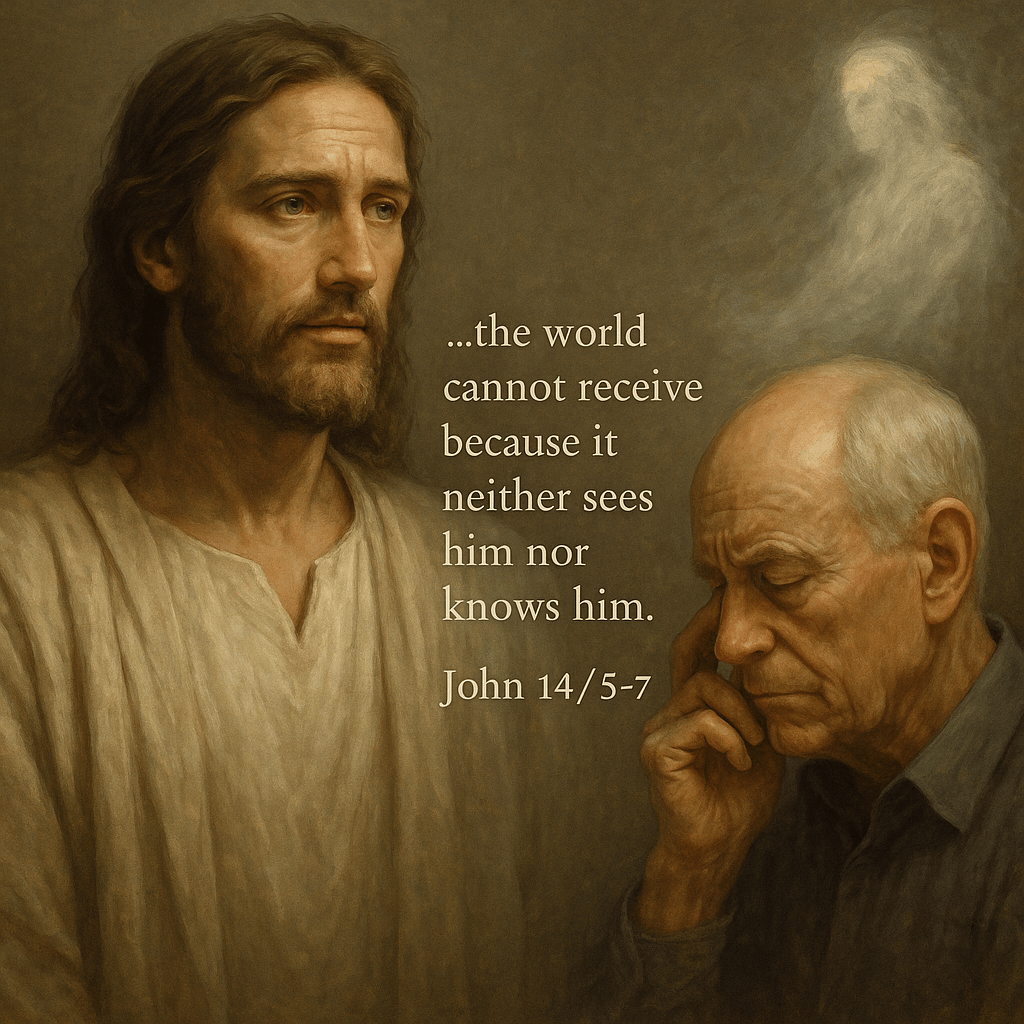
Jesus’ words, “the world cannot receive Him, because it neither sees Him nor knows Him,” unveil a deeper truth: blindness is not the absence of evidence but the presence of dissonance.
Modern theology and psychology agree.
McNeill, Rybicki, and Jastrzębski describe spiritual blindness as
“Another argument in favour of eyesight is the fact that, in his theological reflections, St Thomas Aquinas uses the metaphor of seeing in a cognitive context, which he does not do when talking about hearing or any other sensory experience. In St Thomas’ description of the external senses, eyesight is the best and, indeed, the only sense that does not require any natural or physical change in an organ nor in its subject; therefore, seeing is the best metaphor, because its immaterial nature makes it the closest of all the senses to immaterial intellectual cognition (Aquinas, Summa theologica, Suppl., q. 92).
The Greek name for sight disorders comes from the word tyflos (blind). Greek dictionaries indicate different nuances of this concept, indicating that it can be understood literally, but also metaphorically. In this sense, what blinded was also called blind, for example, wealth, or the god of wealth (Plutos), of love (Eros) or of war (Ares). One could also become blind through one’s pride or ignorance. The broad, metaphorical meaning (e.g. intellectual or moral) of the concept of tyflos is also pointed out by etymology researchers of contemporary concepts (Scharge 1985).”⁸
Kok, concurs, studying John’s healing of the blind man, notes that:
“John’s healing narratives are all presented as semeia or spiritual signs in the Gospel. It therefore always has two levels of meaning: the one level narrates a biological and socio-cultural healing act, and at the same time the narrative functions as a vehicle to illustrate ‘divine’ truths in John’s Gospel.”⁹
R. S. Tamang’s integrative study shows that light in John’s Gospel is relational, writing:
“Koester gave three meanings of the symbol of light while interpreting this text. He connects the meaning of light with God, life, and knowledge. Firstly, according to him, ‘light manifests the power and presence of God which emanates from the Logos, a term that could designate the creative and sustaining power of God, and the presence of God self.’ Secondly, Light manifests the life given to people through God’s Word/Torah. But as per John, life has a physical dimension, but this text emphasises the theological dimension of live god’s relationship to human beings. Finally, light means knowing God through faith in Christ.”¹⁰
To see, therefore, is to belong.
Schumm and Stoltzfus argue that John’s rhetoric of blindness portrays the self’s refusal to confront truth that threatens its autonomy, a definition indistinguishable from modern cognitive dissonance.¹¹
In psychology, Jonathan Haidt observes that moral reasoning often serves not truth but belonging.¹² Daniel Kahneman similarly demonstrates that for humans “the pattern of associated ideas comes to represent the structure of events in your life, and it determines your interpretation of the present as well as your expectations of the future.”¹³
Jesus’ diagnosis is therefore not archaic mysticism, it is phenomenological accuracy. The world’s blindness is the product of its self-protective reasoning. The Spirit of Truth cannot be received where truth threatens identity.
The Ache of a Seeing God
And so we return to the beginning, the salon, the conversations, the fragile bravado of human hearts. We are a world both seen and blind. We see only ourselves reflected in the mirror, while the Spirit waits in the periphery, patient and radiant.
C. S. Lewis wrote that “we are half-hearted creatures, fooling about with drink and sex and ambition when infinite joy is offered us.¹⁴ God’s ache in John 14 is not the ache of rejection alone, it is the grief of unreceived love.
Karl Barth reminds us that revelation is not information about God but God Himself coming to us.¹⁵ And as McGrath puts it:
“A Christian natural theology rests on the premise that, although nature may be publicly observable, the key to its proper interpretation is not given within the natural order itself. The key to the ‘mystery’ of the true significance of nature is mediated through the Christian tradition. Those who are ‘outside’ – to use the language of Mark 4 – will never ‘see’ the true meaning of the open secret of nature. The Christian notion of a self-disclosing God is neither a necessary nor sufficient condition for nature to be able to point to that God, nor for it to be denied that function. Yet when the specific content – as opposed to the mere act – of divine self-disclosure is considered, a conceptual framework emerges which has the potential to allow nature to be ‘read’ in this highly significant manner. This approach stands in contrast to the Enlightenment approach to the interpretation of nature, which held that this publicly accessible reality could be understood in a clear, distinct, and objective manner.”¹⁶
So the question remains, as uncomfortable as it is necessary:
If the Spirit of Truth stands before us, invisible only to our pride, how long will we choose dissonance over reality?

Practical Application
Seeing and knowing are not intellectual achievements but relational postures.
To “see” the Spirit of Truth is to surrender the self’s obsession with certainty and control, and to cultivate a disposition of love that listens.
So this week, practise perceiving.
Pause in conversation and ask silently, “Lord, help me to see this person as You do.”
In moments of frustration, whisper, “Spirit of Truth, help me discern what is real, not merely what is comfortable.”
And when doubts rise, as they inevitably will, remind your heart that faith is not the absence of questions but the presence of the indwelling Comforter.
We grieve and quench the Spirit not by ignorance but by inattention.
To walk in awareness is to allow the light of John 14 to fill the corners of our everyday lives, in salons, offices, classrooms, and quiet prayers before sleep.

Prayer
Holy Spirit, Spirit of Truth,
You dwell within the fragile hearts of those You love. Open our eyes where we have chosen blindness. Quiet the noise of our self-made certainties, and teach us to see through the eyes of Christ.
Where pride blinds us, humble us.
Where fear deafens us, reassure us.
Where dissonance divides us, harmonise us with Your voice.
May we walk in the awareness that You are nearer than breath, and that every act of love is a moment of revelation.
Help us to live as those who see, not by sight alone, but by light.
In Your Holy name Jesus, who was and is the Light of the world.
Amen.
TRACK TO ENJOY:

Footnotes
1. N. T. Wright, Loving to Know (2020), 7, https://inters.org/files/lovingtoknow.pdf
2. Huston Smith, The World’s Religions (San Francisco: HarperOne, 1991), 49.
3. Masao Abe, Zen and Western Thought (Honolulu: University of Hawaii Press, 1985), 20.
4. Seyyed Hossein Nasr, The Heart of Islam (New York: HarperCollins, 2002), 5, 7-8.
5. William Lane Craig, Reasonable Faith (Wheaton: Crossway, 2008), 58-59.
6. Charles Taylor, A Secular Age (Cambridge: Harvard University Press, 2007), 38.
7. Alister McGrath, Mere Apologetics (Grand Rapids: Baker Academic, 2012), 81, 169.
8. M. McNeill, A. Rybicki, and A. Jastrzębski, “Blindness: Physical or Spiritual?” Verbum et Ecclesia 41, no. 1 (2020): see section ‘The philosophical perspective’.
9. Jacobus Kok, “The Healing of the Blind Man in John,” Journal of Early Christian History 2 (2012): 36, https://doi.org/10.1080/2222582X.2012.11877264.
10. Ram Singh Tamang, Light Symbolism in the Gospel of John: Christological Interpretation from an Integrative Approach (Master’s thesis, MF Norwegian School of Theology, Religion, and Society, 2022), 49, https://hdl.handle.net/11250/3029487.
11. Darla Schumm and Michael Stoltzfus, Disability in Judaism, Christianity, and Islam (New York: Palgrave Macmillan, 2011), 206, 215, 220.
12. Jonathan Haidt, The Righteous Mind (London: Penguin, 2012), 290, 316-317.
13. Daniel Kahneman, Thinking, Fast and Slow (London: Allen Lane, 2011), 72.
14. C. S. Lewis, The Weight of Glory (New York: HarperOne, 1949), 2.
15. Karl Barth, Church Dogmatics I/1 (Edinburgh: T&T Clark, 1936), 1-3.
16. Alister McGrath, The Open Secret (Oxford: Blackwell, 2008), 139.
 #Hayibo