

Becoming Human Again: Why Colossians 3 Rewrites Who You Are

“I wanted movement and not a calm course of existence. I wanted excitement and the chance to sacrifice myself for my love. I felt it in myself a superabundance of energy which found no outlet in our quiet life.” – Leo Tolstoy

Introduction
For years, in my anti-God phase, I lived an anthropology shaped by a song that is still a clubbing anthem: “I did it my way.” At the time, I had no idea that I was making an anthropological decision. In fact, I did not even know anthropology was a thing, despite being a person fully embedded in culture, language, and society.
Looking back, I can see that my rejection of God had very little to do with God Himself. It had everything to do with a wounded heart trying to punish Him for my pain by excluding Him from my life. The irony is that my understanding of God was shallow and distorted. I knew He was “big,” beyond the world itself. And somehow, I believed that if I shut Him out, He would feel the weight of my sorrow, confusion, and anger in all of His bigness.
My anthropology became hedonistic. But beneath the reckless, high-risk lifestyle was not freedom. It was desperation. A boy trying to save himself from pain, quietly hoping someone else would step in and do it for him. Anyone but God.
So I tried on identities. I squeezed myself into:
work culture,
party culture,
linguistic cultures, from slang to subcultural speech,
fashion-driven identities,
and class-based social structures.
And yet, none of them fit. Not truly. If I am honest, I did not belong to them. I was performing them.
Then the Jesus thing happened.
Now, 22 years later, still following Jesus, still learning, still not great at it, but increasingly aware that I am deeply loved, I find myself reading Colossians 3 in a Bible-in-a-Year plan.
And I laugh.
Because what I once tried to construct through effort, identity performance, and self-definition, God quietly offers as a gift. What I once called freedom was actually fragmentation. And what I once resisted is, in fact, an anthropology that simply works.
Let’s walk out the anthropology waiting for us in Colossians 3…
Section 1: What Makes Colossians 3:13–17 Anthropology
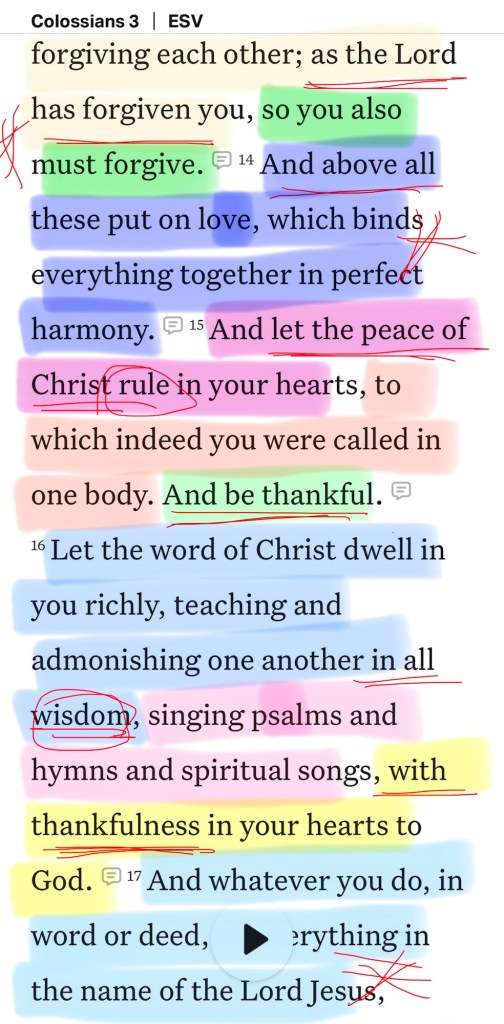
At first glance, Colossians 3:13–17 may appear to be a list of moral instructions. Forgive. Love. Be thankful. Sing. Teach. Yet this reading is too shallow. Paul is not merely telling people how to behave. He is describing what a human being looks like when rightly ordered in Christ. This is not ethics alone. This is anthropology.
The passage assumes that the human person is not self-contained, but fundamentally relational. “You were called in one body” is not a poetic flourish. It is a statement about what a human being is. Identity, in this vision, is not discovered in isolation, nor constructed through self-expression, but received and lived within a people. Forgiveness, patience, and love are not optional virtues added onto an otherwise complete self. They are constitutive of what it means to be human in Christ.
This aligns closely with Paul’s broader vision of the church. As N. T. Wright observes, “the ekklēsia and especially its unity stand at the centre of Paul’s newly framed symbolic universe.”¹ The human being, in Paul’s thought, cannot be understood apart from this communal reality. To belong to Christ is to be incorporated into a single family, where “you are all one in the Messiah, Jesus.”² This unity is not sociological convenience. It is theological necessity. “God is one, and therefore desires a single family.”³
What emerges, then, is an anthropology that is irreducibly communal. The self is not autonomous but incorporated. Identity is, thus, not invented but received within a body. Human flourishing is not an individual achievement but relational coherence.
This immediately challenges modern assumptions. If the human person is fundamentally relational, then isolation is not merely unfortunate. It is deformative.
But Colossians goes even deeper than social belonging. It speaks to the very nature of being itself. When Paul commands, “let the peace of Christ rule in your hearts” and “let the word of Christ dwell in you richly,” he is not describing surface-level behaviour. He is describing an internal reordering of the human person. This is ontological language.
Here the work of John Zizioulas is illuminating. He argues that personhood is not an accessory to being but its very mode of existence. He writes that, “The person is no longer an adjunct to a being… It is itself the hypostasis of being.”⁴ In other words, to be is to exist in relation. Being itself is personal and relational. This reframes Colossians entirely. Paul is not asking individuals to adopt better habits. He is describing what it means to become a different kind of being.
Zizioulas continues, “Entities no longer trace their being to being itself… but to the person.”⁵ This insight resonates profoundly with Paul’s language. The human person is not grounded in abstract existence or self-definition, but in relational participation. To be “in Christ” is not metaphorical. It is ontological. It is a new mode of existence.
This gives us a second layer of anthropology: The human being is not a static entity but a relational mode of being. Identity is grounded not in essence alone, but in participation with God’s reality. Transformation in Christ is not behavioural adjustment but total ontological renewal.
However, Paul does not leave this at the level of abstract theology. He immediately grounds this anthropology in practice. “Let the word dwell.” “Teach and admonish.” “Sing psalms, hymns, and spiritual songs.” “Give thanks.” These are repeated, embodied actions. They are formative.
James K. A. Smith captures this dynamic with striking clarity: “we are loving, desiring, affective, liturgical animals.”⁶ Human beings are not primarily thinkers who occasionally act. We are creatures shaped by what we repeatedly do. Formation happens through practice. Even more provocatively, Smith argues that “we worship before we know.”⁷ Our loves are trained before our beliefs are articulated.
Colossians 3 reads almost like a liturgical script:
forgiveness as a repeated relational practice,
love as the binding structure of community,
peace as the governing authority of the inner life,
Scripture as an indwelling presence,
song as a means of formation,
and gratitude as a cultivated posture.
This is anthropology through liturgy. The human being is formed not merely by ideas, but by habits of worship, speech, and relationship.
Taken together, Colossians 3:13–17 presents a profoundly integrated vision of what it means to be human. It refuses to separate being from relationship, identity from community, belief from practice, and inner life from outward expression.
Instead, it offers a unified account. The human person is a relational, ontological, and liturgically formed being whose life is ordered in and through Christ.
This is why the repeated command “let” is so significant. Paul does not say, “become by force.” He says, “let.” Let peace rule. Let the word dwell. Let gratitude rise. This is not passive resignation, but active surrender. It is the recognition that true humanity is not self-generated, but received.
And this sets the stage for everything that follows. If Colossians 3 is anthropology, then the question is unavoidable, “What kind of human are you becoming, and what are you letting form you?”
Section 2: What Is Anthropology?
Anthropology is commonly defined as the study of what makes us human. At its broadest level, it seeks to understand human beings across time, culture, biology, language, and social organisation. The American Anthropological Association defines anthropology as a discipline that draws upon the social sciences, biological sciences, humanities, and physical sciences to grasp “the full sweep and complexity of cultures across all of human history.”⁸
Yet this definition, while accurate, is incomplete. Anthropology does not merely describe humanity. It interprets it. And every interpretation already assumes something deeper: where meaning comes from.
At its surface, anthropology answers questions such as:
What is a human being?
How do humans live together?
Why do cultures differ?
What shapes identity and behaviour?
But beneath these questions lies a more fundamental issue. Anthropology is not only about what humans do, but what humans are for. Even when unspoken, every anthropological framework carries an assumption about purpose, value, and meaning.
Clifford Geertz famously reframed anthropology by shifting attention away from behaviour alone to meaning. He writes that “man is an animal suspended in webs of significance he himself has spun,” and therefore anthropology is “not an experimental science in search of law but an interpretive one in search of meaning.”⁹ This insight is decisive. Human beings do not merely act. They interpret their actions. They assign significance to relationships, symbols, language, and events. A gesture, a ritual, or even a word is never just a behaviour. It is a carrier of meaning.
This leads to an important anthropological conclusion, humans do not simply live in the world. Humans live in interpreted worlds. Every human life is therefore shaped not only by reality, but by the meaning attributed to that reality.
Geertz develops this further by describing culture itself as a system of meaning. Culture is not merely customs or traditions. It is a framework through which reality is understood.
He argues that “to rework the pattern of social relationships is to rearrange the coordinates of the experienced world.”¹⁰ In other words, when cultural structures shift, reality itself is experienced differently. What people perceive as normal, moral, or meaningful is altered.
Even more strikingly, Geertz suggests that culture can be treated as “an assemblage of texts,” requiring interpretation much like literature.¹¹ Human life becomes something to be read, not merely observed.
From this perspective, culture is not decorative. It is interpretive. Society does not just organise life. It gives it meaning. Human identity is shaped within symbolic systems, not outside them.
Anthropology, therefore, is not just the study of human behaviour. It is the study of how meaning is constructed, embodied, and lived.
While earlier traditions often located meaning in the world, in God, or in an ordered cosmos, modern anthropology increasingly relocates meaning within the individual.
Charles Taylor traces this shift in the development of the modern self. He notes that “something recognisably like the modern self is in process of constitution,” marked by a deep inward turn.¹² This shift fundamentally alters how identity is understood.
Where premodern thought saw meaning as embedded in reality, modernity internalises it. Taylor explains that “thought and feeling… are now confined to minds,” and therefore “the valuation is now unambiguously… in minds.”¹³ This produces a radical transformation.¹⁴ Meaning moves from objective reality to subjective experience. Identity becomes something discovered within rather than received from without. The self becomes the primary source of interpretation.
The consequences of this shift are immense. If meaning originates within the self, then perception replaces obedience, expression replaces alignment, and inner feeling outranks external order. Anthropology, in this modern frame, becomes a project of self-definition rather than discovery of a given nature.
Anthropology is never neutral. It always carries assumptions about where meaning comes from. At its deepest level, every anthropology must answer:
Is meaning received from outside the self?
Is meaning constructed through culture and practice?
Or is meaning projected from within the individual?
These are not abstract questions. They determine how we understand identity, purpose, morality, and ultimately, what it means to be human. And once that question is answered, everything else follows.
Section 3: Christological vs Secular Anthropology
At this point, the distinction becomes unavoidable. If anthropology asks what it means to be human, then the deeper question is this: where does meaning originate?
Secular anthropology, in its dominant modern forms, constructs meaning either from within the individual or through shared cultural systems. Christological anthropology, by contrast, receives meaning from God, disclosed and fulfilled in Christ. This is not a minor difference. It is a total reorientation of what a human being is.
Modern anthropology is marked by a decisive inward shift. Identity is no longer primarily received from an external order, whether divine, natural, or communal. It is generated within.
As Carl Trueman observes, modern identity increasingly revolves around “the purpose of my life,” coupled with “a prioritisation of the individual’s inner psychology.”¹⁵ This signals a profound transformation. The self becomes the primary site of meaning. Charles Taylor similarly notes that “something recognisably like the modern self is in process of constitution,” while “thought and feeling… are now confined to minds.”¹⁶ The self, in this modern frame, no longer stands in continuity with a meaningful external order. Rather, “the valuation is now unambiguously… in minds.”¹⁷
The result is a new anthropological paradigm:
identity is internal,
identity is psychological,
identity is self-defined.
This inward turn is often celebrated as liberation. Yet it comes at a cost. When the self becomes the source of meaning, it also becomes its burden. The individual must now generate purpose, justify existence, and sustain coherence without reference to any stable external telos.
If meaning is no longer received, it must be constructed. This construction often takes place not only at the individual level, but through shared cultural narratives. Yuval Noah Harari argues that large-scale human cooperation depends upon “shared myths.”¹⁸ Societies function because people collectively believe in imagined orders. These may include political systems, moral frameworks, or economic structures. He further notes that “to change an existing imagined order, we must first believe in an alternative imagined order.”¹⁹ Meaning, therefore, is not discovered but negotiated and reconfigured.
However, this flexibility introduces instability. Harari offers a striking diagnosis of the modern condition: “we have advanced… but nobody knows where we’re going.”²⁰ Humanity has gained unprecedented power, yet lacks a coherent sense of purpose. The result is deeply unsettling. We have become, in his words, “dissatisfied and irresponsible gods.”²¹
This exposes a critical tension within secular anthropology, meaning becomes constructed rather than given, identity becomes negotiable rather than grounded, and power expands faster than purpose.
Without transcendence, human beings gain the ability to reshape the world, but lose clarity about why they should.
At the heart of this crisis lies the loss of telos. Classical thought assumed that human life was oriented toward a given end. Modernity increasingly rejects this assumption. Alasdair MacIntyre captures this shift by describing the disappearance of “a view of human life as ordered to a given end.”²² When telos is removed, moral and existential coherence begins to fragment.
Without a shared understanding of what life is for ethical systems become unstable, identity becomes fragmented, and meaning becomes provisional. Human beings are left navigating existence without a clear destination. The result is not freedom in any meaningful sense, but disorientation.
In contrast, Christological anthropology begins not with the self, but with God. Meaning is not constructed or projected. It is revealed.
Oliver O’Donovan argues that “the resurrection of Christ from the dead” is “the reaffirmation of creation.”²³ This is not merely a theological claim about life after death. It is an ontological claim about the structure of reality itself. In the resurrection, “creation is restored and the kingdom of God dawns.”²⁴ This restoration is crucial. It means that the world is not a blank canvas for human projection. It is an ordered reality, grounded in God’s purposes. Furthermore, O’Donovan insists that “any certainty we may have about the order which God has made depends upon God’s own disclosure.”²⁵ Human beings cannot generate ultimate meaning. They must receive it.
This epistemological humility is echoed by Esther Lightcap Meek, who writes, “I simply cannot know him if I refuse to submit in reverence to him.”²⁶ Knowledge, in this framework, is not detached observation but relational participation. It requires posture, not merely cognition. She goes on to argue that “Good, responsible knowing brings blessing… irresponsible knowing brings curse.”²⁷ Knowledge is therefore moral as well as intellectual. How we know is inseparable from how we live.
Christological anthropology thus restores what secular anthropology cannot sustain:
order, grounded in creation and reaffirmed in Christ,
knowledge, received through revelation rather than constructed autonomy,
purpose, directed toward communion with God,
identity, anchored in participation rather than self-definition.
In this vision, the human being is not an isolated self attempting to generate meaning, but a creature called into relationship, alignment, and fulfilment in Christ. The contrast could not be sharper.
Secular anthropology constructs meaning, centres the self in itself, and treats identity as internal and negotiable.
Christological anthropology receives meaning, centres Christ, and understands identity as given, relational, and fulfilled in Him.
The question is not whether we have an anthropology. It is which one we are living by.
Section 4: How Anthropology Affects Our Lives
Anthropology is not an abstract discipline reserved for lecture halls and textbooks. It is lived, embodied, and expressed in the ordinary rhythms of daily life. Every person operates from an anthropology, whether consciously or not. The question is not whether we have a view of what it means to be human. The question is how that view is shaping us.
Colossians 3:13–17 makes this unmistakably practical. It does not present anthropology as theory, but as lived reality. Forgiveness, love, peace, teaching, singing, and gratitude are not disconnected behaviours. They are expressions of a particular vision of the human person.
If anthropology answers the question, “What is a human being?”, then daily life answers the question, “What do you actually believe about that?”
One of the clearest ways anthropology manifests is through habit. What we repeatedly do is not random. It reflects what we believe about ourselves, even if we have never articulated it.
James Clear notes that “your identity emerges out of your habits.”²⁸ He goes further, stating that identity is not something we simply possess, but something we embody through repeated action. “Every action you take is a vote for the type of person you wish to become.”²⁹
This insight is profoundly anthropological. It reveals that identity is not only believed but enacted, behaviour is not incidental but formative, and repetition reinforces self-understanding. In other words, your life is already discipling you into a particular anthropology.
Colossians 3 reframes this process. Instead of unconsciously forming identity through scattered habits, Paul calls believers to intentional formation:
“let the peace of Christ rule,”
“let the word of Christ dwell,”
“teach and admonish one another,”
“sing… with gratitude.”
These are not isolated commands. They are practices that shape a person over time. Anthropology becomes visible in habit. Anthropology is not only formed individually. It is reinforced collectively through culture.
Clifford Geertz reminds us that humans live within “webs of significance” that they themselves have spun.³⁰ Culture is not neutral background. It is a meaning-making environment that shapes perception, value, and behaviour.
He further explains that to alter social relationships is to “rearrange the coordinates of the experienced world.”³¹ This means that culture does not merely influence what we do. It influences what feels true, normal, and even obvious.
From this perspective culture shapes what we perceive as reality, social patterns reinforce particular identities, and meaning is perceived as stabilised through shared practices. This has profound implications. If culture trains perception, then immersion in a particular culture will normalise its anthropology.
This is why Colossians places such emphasis on communal practices. Teaching, singing, and mutual exhortation are not decorative religious activities. They are counter-formational. They retrain perception. They reshape what feels real by aligning to what is indeed real.
Beneath both habit and culture lies something even deeper: desire. James K. A. Smith argues that human beings are not primarily thinking creatures, but desiring ones. “We are loving, desiring, affective, liturgical animals.”³² Before we articulate beliefs, we are already oriented by what we love. This has significant anthropological consequences, we do not move toward what we think is true we move toward what we love. Our loves, however, are trained by repeated practices.
Smith makes the striking claim that “we worship before we know.”³³ In other words, our desires are shaped prior to our reasoning. This means that anthropology is not merely cognitive. It is liturgical.
Colossians 3 reflects this reality. It does not begin with abstract doctrine. It begins with practices that shape desire. Gratitude reorients the heart toward gift, song embeds truth within affection, forgiveness reshapes relational instincts, and peace governs internal responses. These are not behavioural add-ons. They are reordering mechanisms. They train desire toward its proper end.
When habit, culture, and desire converge, they form a trajectory. Anthropology is not static. It directs movement.
Viktor Frankl observed that human beings are fundamentally oriented toward meaning. He writes that “the true meaning of life is to be discovered in the world rather than within man.”³⁴ Human existence is inherently self-transcending. It points beyond itself.
This stands in sharp contrast to modern inward anthropology. If meaning is located solely within the self, direction becomes unstable. But if meaning is discovered in relation to something beyond the self, then life gains coherence.
Frankl further argues that “being human always points… to something, or someone, other than oneself.”³⁵ This insight aligns closely with the logic of Colossians 3. The human person is not fulfilled through self-focus, but through orientation toward Christ and others.
This leads to a crucial conclusion, anthropology determines direction, yet direction determines destiny.
If your anthropology is inward, your life curves inward.
If your anthropology is Christ-centred, your life moves toward Him.
Anthropology is not theoretical. It is lived. It is revealed in our habits, our culture, our desires, and our direction. Colossians 3 does not merely describe a better way to behave. It presents a different way to be human. And it does so with a simple but profound invitation, “Let”:
Let peace rule.
Let the word dwell.
Let gratitude rise.
Because what you let shape you will ultimately define you.
Conclusion
Isaiah shows us a city that rises too high, only to be brought low. Not because ambition is wrong, but because its aim is misplaced. False height cannot sustain real weight.
Anthropology asks a simple but unavoidable question, “What is a human being for?”
And how we answer that question determines everything.
Modernity has offered a compelling alternative. Look within. Define yourself. Construct meaning. Become who you feel you are. Yet as we have seen, this inward turn carries a hidden cost. When meaning is generated from within, it becomes unstable. When identity is self-authored, it becomes fragile. When purpose is constructed, it can always collapse under pressure.
We have not, thus, removed teleology, rather, we have relocated it. And in doing so, we have placed the weight of ultimate meaning onto a self that cannot bear it.
The result is not freedom, but exhaustion.
Not clarity, but confusion.
Not fulfilment, but fragmentation.
Scripture offers a different vision.
Colossians does not tell us to invent ourselves. It tells us to let.
Let peace rule.
Let the word dwell.
Let gratitude rise.
This is not passivity. It is alignment.
Because the Christian claim is not that life has no meaning.
It is that meaning has already been given.
In the resurrection of Christ, creation is not abandoned but restored. The end toward which all things move is not hidden in the depths of the self, but revealed in the person of Jesus Christ. He is not merely a guide to the end. He is the end in person. As Colossians 1:15 (AMP) states so profoundly of Jesus, “He is the exact living image [the essential manifestation] of the unseen God [the visible representation of the invisible], the firstborn [the preeminent one, the sovereign, and the originator] of all creation.”
This reframes everything.
Identity is not constructed, but received. Purpose is not invented, but revealed. Meaning is not projected, but discovered in relationship with God.
You are not a self in search of a purpose.
You are a creature called toward a Person.
And this leads us to the real issue.
You are not lost because life has no meaning.
You are lost because you are aiming at an end that cannot hold your weight.
So the question is not whether you have a telos.
You do.
The question is whether your telos can sustain you.
If God has already revealed what life is for, why do we keep insisting on aiming elsewhere?

Practical Application
If anthropology is lived, then this is where it becomes real. Colossians 3 does not ask you to theorise your humanity. It asks you to examine what is already forming you. Start here:
Ask what your habits reveal about your telos What do your daily patterns say your life is for? Not what you say. What you repeatedly do.
Identify your “lofty city” Where are you building too high on something that cannot sustain you? Achievement, approval, control, identity, desire?
Pay attention to what is forming your desires What you watch, listen to, repeat, and rehearse is not neutral. It is shaping what you love.
Practise “letting” instead of forcing Where are you trying to manufacture outcomes instead of receiving formation? Replace striving with surrender:
let peace rule,
let the Word dwell,
let gratitude rise.
Re-centre your life around Christ, not self-definition This is not about losing yourself. It is about finally becoming who you were created to be.
Prayer
Father God, Lord Jesus Christ, Holy Spirit,
We come before You as people who have tried, in so many ways, to define ourselves without You. We have aimed at things that could not hold us, built identities that could not sustain us, and carried burdens we were never meant to bear.
Forgive us for the ways we have turned inward and called it freedom, when all along it has been confusion. Forgive us for trusting our own understanding above Your revealed truth.
Lord Jesus, thank You that You are not only the way, but the end toward which our lives are meant to move. Thank You that in You, meaning is not lost, but fulfilled. That in You, we are not abandoned to construct ourselves, but invited to receive life as a gift.
Holy Spirit, teach us to let.
Let Your peace rule in our hearts.
Let Your Word dwell richly within us.
Let gratitude reshape our vision.
Reorder our desires.
Realign our thinking.
Restore our identity in Christ.
Humble every false height within us. Tear down every “lofty city” we have built apart from You. And in its place, establish a life that is grounded, steady, and true.
Make us a people who do not strive to become, but who learn to abide.
Who do not invent meaning, but who receive it.
Who do not centre ourselves, but who centre Christ.
And for every person reading this, Lord, meet them where they are. In confusion, bring clarity. In striving, bring rest. In fragmentation, bring wholeness.
We trust You with our becoming.
In the name of Jesus Christ,
Amen.
TRACK TO ENJOY:

Footnotes
1. N. T. Wright, Paul and the Faithfulness of God (Minneapolis, MN: Fortress Press, 2013), section “ii) The Symbols which Say: ‘We Are the One People of the One God.’”
2. Ibid.
3. Ibid.
4. John D. Zizioulas, Being as Communion: Studies in Personhood and the Church (Crestwood, NY: St Vladimir’s Seminary Press, 1985), 39-40.
5. Ibid., 39.
6. James K. A. Smith, Desiring the Kingdom: Worship, Worldview, and Cultural Formation (Grand Rapids, MI: Baker Academic, 2009), section “Picturing Education as Formation in Orwell’s Road to Wigan Pier.”
7. Ibid.
8. American Anthropological Association, “What Is Anthropology?” (accessed March 2026), https://americananthro.org/practice-teach/what-is-anthropology/?fbclid=IwZnRzaAQznIlleHRuA2FlbQIxMQBzcnRjBmFwcF9pZAo2NjI4NTY4Mzc5AAEeqDL-sh_O9m0hNBZcKPdw2egEsVfffbvwLA_w6tAHFvTXTl2BgmlDdlD1joQ_aem_1JHPbUWCZBZcntoiGMzPpw
9. Clifford Geertz, The Interpretation of Cultures (New York: Basic Books, 1973), 5.
10. Ibid., 27-28.
11. Ibid., 448-449.
12. Charles Taylor, Sources of the Self: The Making of the Modern Identity (Cambridge, MA: Harvard University Press, 1989), 185.
13. Ibid., 186.
14. Ibid., 187.
15. Carl R. Trueman, The Rise and Triumph of the Modern Self (Wheaton, IL: Crossway, 2020), 22-23.
16. Taylor, Sources of the Self, 185-187.
17. Ibid., 186-187.
18. Yuval Noah Harari, Sapiens: A Brief History of Humankind (London: Harvill Secker, 2014), chap. 6, “The Prison Walls.”
19. Ibid.
20. Ibid., Afterword: “The Animal that Became a God.”
21. Ibid.
22. Alasdair MacIntyre, After Virtue, 3rd ed. (Notre Dame, IN: University of Notre Dame Press, 2007), 33-34.
23. Oliver O’Donovan, Resurrection and Moral Order: An Outline for Evangelical Ethics, 2nd ed. (Grand Rapids, MI: Eerdmans, 1994), 15.
24. Ibid.
25. Ibid., 19.
26. Meek, Longing to Know, 372–375.
27. Ibid.
28. James Clear, Atomic Habits: An Easy and Proven Way to Build Good Habits and Break Bad Ones (London: Penguin Random House, 2018), section “The Two-Step Process to Changing Your Identity.”
29. Ibid.
30. Geertz, The Interpretation of Cultures, 5.
31. Ibid., 27-28.
32. Smith, Desiring the Kingdom, section “Picturing Education as Formation in Orwell’s Road to Wigan Pier.”
33. Ibid.
34. Frankl, Man’s Search for Meaning (Boston: Beacon Press, 2006), section “The Essence of Existence.”
35. Ibid.
 #Hayibo