

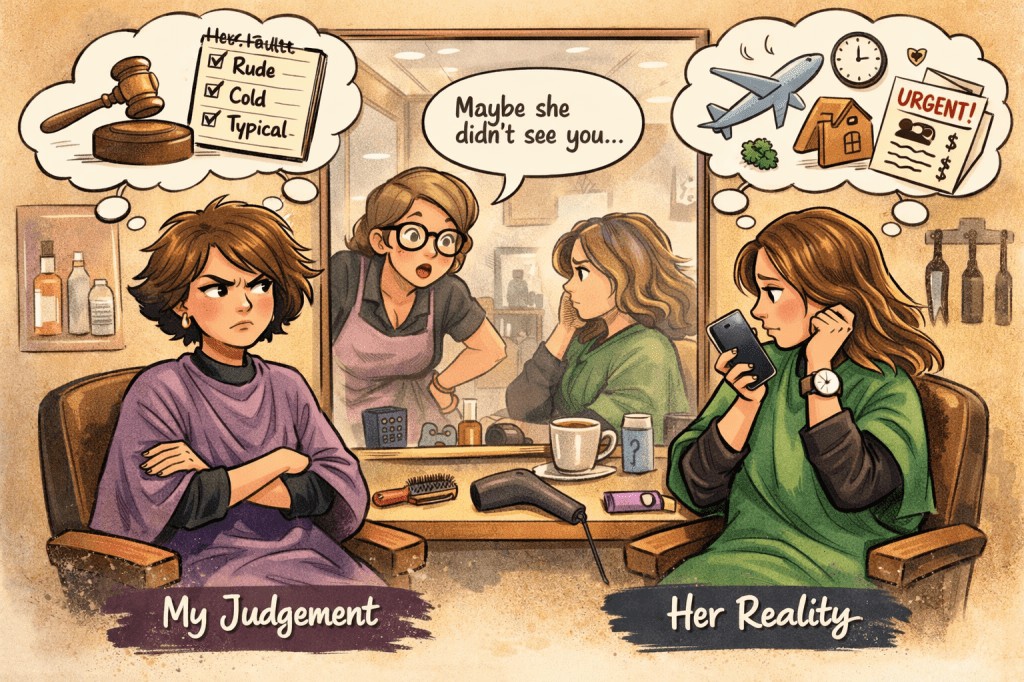
Introduction: The Hair Salon Incident
Imagine it. Sicily, 1964.
Like an episode of The Golden Girls, the scene unfolded with that familiar scripted “oopsie daisy” energy.
It happened in a hair salon. Which is to say, it happened in the United Nations of human emotion.
Blow dryers roared like small jet engines. Foils flashed disco silver. Someone was mid an ugly divorce at basin three. Someone else was reinventing herself with TikTok curtain bangs, despite the stylist gently suggesting this might be “ambitious” for ultra curly hair. The receptionist was juggling phones, complaints, and a booking that went: Tuesday, no Wednesday, actually next Sunday, unless five works.
Client Butterfly-cut walked in. She smiled at Client Balayage.
Balayage did not smile back.
No nod. No eye contact. Nothing.
Butterfly-cut froze.
You could see it in the mirror. The internal monologue began assembling a legal brief.
“Oh. So we’re not greeting now?”
“Right. That’s how it is.”
“Interesting.”
By the time her roller set was drying drier than a desert storm, Balayage had already been downgraded in the internal character file.
Arrogant.
Cold.
Passive aggressive.
The stylist leaned in. “You okay?”
Butterfly-cut sighed in wounded righteousness. “Some people.”
Later, as capes were removed and gloss was paid for, the unprocessed truth emerged.
Balayage was late. Dangerously late. A school pickup. A flight. A client whose contract fed three households. Bills wait for no one.
She had not ignored Butterfly-cut.
She had not seen her.
Nothing changed except information.
But the verdict had already been delivered.
And that, is how most of our conflicts begin.

Presumption, Attribution, and the Speed of the Verdict
What happened in the salon has a name.
Actually, it has several.
Psychologists call it the fundamental attribution error: the tendency to explain someone else’s behaviour by appealing to their character, while explaining our own behaviour by appealing to our circumstances.¹
If I ignore you, it is because I am overwhelmed.
If you ignore me, it is because you are arrogant.
Same behaviour. Different courtroom.
Lee Ross, who helped develop the concept, demonstrated that we consistently overestimate dispositional causes in others and underestimate situational pressures.² We assume stable traits where there may simply be stress, distraction, or fear.
Add to this foreclosure bias, our tendency to close interpretation prematurely, and you have a perfect storm. Once Butterfly-cut decided Balayage was cold, all subsequent data would be filtered accordingly. The human mind prefers coherence over patience.³
Daniel Kahneman describes this as fast thinking, the rapid, intuitive system that constructs a narrative before evidence is fully processed.⁴ It is efficient. It is automatic. It is frequently wrong.
And here is the uncomfortable part.
We do not merely misread behaviour. We moralise it.
A missed greeting becomes a commentary on character. A delayed response becomes disrespect. A distracted face becomes hostility.
Nothing changed except information. But our conclusions often harden before information arrives.
Hans-Georg Gadamer reminds us that we never approach another person from nowhere. We always stand within a horizon shaped by history, memory, and prior assumptions.⁵ That horizon silently interprets before we consciously reflect.
In other words, we do not simply hear what was said.
We hear what we are prepared to hear.
This is why two people can witness the same moment in a salon and leave with entirely different stories about what happened. The external event is shared. The internal narrative is not.
And because narratives feel immediate and coherent, we rarely pause to ask the simplest question:
Where were they at?
The Mirror Test: A Brief Questionnaire for the Courageous
Before we scale this up to politics and theology, we need to do something slightly uncomfortable.
We need to admit that we are all Butterfly-cut at some point.
Consider the following, and answer without performing virtue for yourself.
1. Do you get irritated when people misunderstand you?
Of course you do. We all do. Being misheard feels like erasure.
But now the harder question:
2. When was the last time you misunderstood someone else?
Did you pause?
Did you ask for clarification?
Or did you quietly downgrade them in your internal character file?
Research on self serving bias shows that we instinctively protect our own intentions while scrutinising the intentions of others.⁶ We grant ourselves nuance. We grant others verdicts.
3. When someone reacts strongly to something you said, do you assume they are overreacting, or do you ask what history might be sitting behind that reaction?
Human cognition is deeply shaped by affective memory. Emotional salience alters how information is encoded and retrieved.⁷ What appears disproportionate to you may be proportionate to an earlier wound you cannot see.
4. Have you ever told someone to “get over it” while quietly refusing to get over your own grievances?
We call this cognitive asymmetry. We interpret our responses as reasonable outcomes of context, while interpreting theirs as personal flaws.⁸
5. When you walk into a room and feel ignored, what story do you immediately tell yourself?
The human mind is a narrative machine. It does not tolerate ambiguity for long. It fills gaps quickly, often inaccurately, and then defends the story as though it were fact.⁹
Now return to the salon.
Nothing changed except information.
Balayage’s silence was reinterpreted the moment new data emerged. The character judgement dissolved instantly when context was supplied.
This is the quiet tragedy of misattribution: we often deliver moral sentences before gathering situational evidence.
And because the brain privileges coherence over accuracy, once the verdict is delivered, we become lawyers for our own assumptions.
The question beneath all of this is simple and searching:
Do I want to understand, or do I want to be right?
Because those are rarely the same pursuit.
When Misattribution Goes National
The salon is funny.
Politics is not.
What happened between Butterfly-cut and Balayage happens daily between tribes, parties, movements, and nations.
One group says something.
Another group hears something else entirely.
And before clarification, the verdict is delivered.
Contemporary political psychology shows that people do not primarily reason their way into political positions. They identify first, and then reason in defence of that identity.¹⁰ Once identity is engaged, disagreement feels like threat. When disagreement feels like threat, the brain shifts from curiosity to defence.
Social media algorithms quietly exploit this reflex. They reward outrage. They amplify misinterpretation. They monetise moral alarm.¹¹
The more we misattribute motive to the other side, the more cohesive our own side feels.
Consider how quickly phrases are translated across ideological lines:
“Concern for national borders” becomes “hatred of foreigners.”
“Concern for inclusion” becomes “erasure of tradition.”
Sometimes those critiques are fair. Often they are caricatures.
The fundamental attribution error scales beautifully at the political level. We explain our actions as necessary responses to circumstance. We explain their actions as proof of character deficiency.¹²
This is why political debate so often feels like two monologues delivered at increasing volume. Each side believes it sees clearly. Each side assumes the other must be malicious, ignorant, or dangerous.
But here is the deeper danger.
When we misattribute motive at scale, we justify hostility. When hostility becomes normalised, civility feels naïve. When civility erodes, coercion becomes thinkable.
And yet, if the salon taught us anything, it is this, sometimes the person you have morally downgraded is simply late for a flight. Or terrified about a contract. Or carrying something you cannot see.
Political divisiveness thrives on the assumption that the other side’s blindness is moral rather than contextual.
It rarely asks, “Where are they at?”
It prefers, “What is wrong with them?”
The difference between those two questions is the difference between dialogue and demolition.
And if we are honest, we have all asked the second one more often than the first.
Scripture and the Discipline of Seeing
Long before cognitive psychology named attribution bias, Scripture addressed the problem of misjudged perception.
In 1 Samuel 16:7, when Samuel evaluates Eliab by outward appearance, the Lord corrects him:
“The Lord does not look at the things people look at. People look at the outward appearance, but the Lord looks at the heart.“¹³
Samuel was certain.
He was wrong.
Certainty is not the same as insight.
The Biblical narrative repeatedly exposes how quickly humans misread what they see.
In John 7:24, Jesus commands:
“Stop judging by mere appearances, but instead judge correctly.“¹⁴
The Greek implies judging according to what is true rather than what merely seems apparent.
Correct judgement requires more than reaction. It requires discernment.
James sharpens this further:
“Everyone should be quick to listen, slow to speak and slow to become angry.“¹⁵
Notice the order.
Listening precedes speaking.
Slowness precedes judgement.
James does not assume anger is always wrong. He assumes premature certainty usually is.
Even the disciples repeatedly misread Jesus’ intentions. They assumed triumph when He spoke of suffering. They assumed status when He spoke of servanthood.¹⁶ Their problem was not lack of devotion. It was interpretive foreclosure.
The most striking example may be the Emmaus road in Luke 24. The disciples walk beside the risen Christ and fail to recognise Him.¹⁷
Nothing about Jesus’ identity changed.
Only their understanding did.
And what corrected it?
Explanation.
Patient unveiling.
Context restored.
This pattern runs throughout Scripture:
Humans judge too quickly.
God sees more deeply.
Revelation reorders perception.
The Biblical solution to misattribution is not cynicism.
It is humility.
It is asking, before assuming:
“What might I be missing?”
The same question that could have saved Butterfly-cut a great deal of emotional cardio.
The Salon Mirror
Let us return to the hair salon.
Butterfly-cut did not lack intelligence.
She lacked information.
Balayage did not lack kindness.
She lacked bandwidth.
Nothing about either woman’s character was objectively revealed in that moment. What was revealed was speed. Speed of interpretation. Speed of attribution. Speed of internal prosecution.
The mirror did not distort their faces. It distorted their assumptions.
Cognitive science tells us that the brain is wired for efficiency rather than accuracy. We fill gaps rapidly because ambiguity is uncomfortable.¹⁸ Kahneman’s System 1 thinking makes snap judgements before System 2 has even located its spectacles.¹⁹
But Scripture reminds us that haste and wisdom are rarely twins.
Proverbs 18:13 warns:
“To answer before listening, that is folly and shame.“²⁰
Notice how ordinary that sounds.
Not heresy. Not catastrophe.
Folly.
Most relational damage is not born from malice.
It is born from incomplete information married to confident interpretation.
Political division capitalises on this. Social media monetises it. Algorithms reward outrage because outrage is efficient.²¹ Nuance is slow. Reflection does not trend.
The result?
We downgrade entire human beings on the basis of partial data.
Just like Butterfly-cut.
But here is the quiet grace in the story: once the new information surfaced, the judgement dissolved instantly. Nothing supernatural occurred. No personality transplant. No moral conversion. Only context.
Where they were at changed the story.
And perhaps that is the point.
The problem was never morality first. It was mislocation.
We speak from where we are at.
We hear from where we are at.
We judge from where we are at.
Until humility interrupts the speed.
Conclusion: Mirrors, Mercy, and Mild Embarrassment
If we are honest, most of us have been Butterfly-cut. We have stood before the mirror of our own interpretation and felt entirely justified. The arithmetic added up. The tone was off. The silence was suspicious. The timing was convenient. The evidence, we believed, was overwhelming.
Until new information arrived.
And suddenly the entire case collapsed like a badly set perm in unexpected rain.
The importance of where they are at is not sentimental advice. It is cognitive discipline. It is moral restraint. It is theological humility. Because none of us occupies omniscient altitude. We interpret through fatigue. Through wounds. Through political loyalties. Through upbringing. Through fear. Through ego. Through unfinished arguments from 2009 that still sting. And yet we expect others to meet us at our clearest, calmest, most informed selves.
Scripture does not command us to agree with everyone. It does command us to understand before we pronounce. James writes,
“Everyone should be quick to listen, slow to speak and slow to become angry.“²²
Slow.
Not silent.
Not spineless.
Slow.
Perhaps wisdom is not about having better arguments. Perhaps it is about increasing the delay between stimulus and certainty.
Imagine what would shift in marriages, churches, boardrooms, parliaments, and comment sections if we simply paused long enough to ask: Where are they at right now?
Hungry?
Scared?
Late?
Overwhelmed?
Grieving?
Fighting for survival in a way we cannot see?
None of this excuses harm. But it does complicate easy condemnation.
And so the next time someone fails to greet you, respond warmly, or understand you at first pass, resist the urge to draft the character indictment.
Maybe they are not cold.
Maybe they are catching a flight.
Maybe they are carrying something invisible.
Maybe, one day, someone will extend the same interpretive mercy to you.
After all, mirrors are unforgiving things.
But people do not have to be.
And if you ever find yourself building a silent courtroom in your head, complete with judge, jury, and dramatic soundtrack, take a breath.
Check the information.
And perhaps whisper to yourself:
“Ah. I see. I did not know where they were at.”
Then smile.
And try not to downgrade anyone in your internal character file before the conditioner has even rinsed out.

Practical Application: Before You Draft the Verdict
Theory is lovely.
Mirrors are humbling.
Salons are chaotic.
So what do we actually do with this?
Here are a few small, concrete practices that may save both relationships and blood pressure.
1. Insert a Three-Second Delay
When you feel the sting of offence, misunderstanding, or dismissal, pause.
Not dramatically.
Not performatively.
Just internally.
Ask:
What else could be true?
This single question interrupts foreclosure. It widens the interpretive frame. It reintroduces humility into the room before certainty takes over.
Three seconds is often the difference between wisdom and regret.
2. Replace Assumption with Curiosity
Instead of:
“You ignored me.”
Try:
“Hey, I wasn’t sure if you saw me earlier. Everything alright?”
Curiosity invites clarification.
Assumption invites escalation.
You are not surrendering discernment. You are seeking data.
3. Separate Impact from Intent
Something may have hurt you. That does not automatically mean it was intended to hurt you.
Say:
“When that happened, I felt dismissed. Was that your intention?”
This approach preserves both truth and dignity. It allows correction without condemnation.
4. Audit Your Internal Courtroom
Notice when your inner dialogue starts using words like:
Always.
Never.
Typical.
Of course.
These are rarely evidence-based conclusions. They are emotional accelerants.
Before sentencing someone in your mental high court, verify the facts.
5. Practise Interpretive Mercy
This does not mean naïvety. It does not mean excusing abuse. It means granting the possibility of unseen context before defaulting to character judgment.
Most people are not villains.
They are tired.
6. Zoom Out Before You Zoom In
If the interaction will not matter in five years, consider whether it deserves five hours of rumination.
Some misunderstandings are not moral crises. They are simply human misfires.
7. Remember Your Own Blind Spots
Ask yourself honestly:
When have I been misread?
When have I been judged unfairly?
When have I wished someone had asked one more question before deciding who I was?
Offer that same grace outward.
None of this requires perfection.
It requires posture.
The importance of where they are at is not about managing others. It is about disciplining ourselves.
And perhaps the most practical application of all is this:
Before you downgrade someone in your internal character file, make sure you are not reading from a mirror that only reflects you.
Because sometimes the only thing that needs adjusting…
…is not their attitude.
It is our interpretation.

Prayer
Father God,
Lord of truth and mercy, you who see what we do not see and know what we do not know, slow our reflex to judge and quicken our reflex to listen. Teach us to remember that every person stands somewhere we have never stood, carrying weights we have never carried.
Where we have mistaken distraction for disdain, silence for hostility, or difference for threat, grant us gentler interpretations. Guard us from the arrogance of assuming we understand fully, and free us from the insecurity that needs to win. Form in us a patient curiosity, a steady humility, and a courage that seeks clarity without condemnation.
May we speak truth without sharpness, listen without defensiveness, and love without presumption. And when we misread, as we surely will, give us the grace to laugh at ourselves, apologise quickly, and begin again.
In Your Holy Name Lord Jesus,
Amen.
TRACK TO ENJOY:

Footnotes
1. Lee Ross, “The Intuitive Psychologist and His Shortcomings: Distortions in the Attribution Process,” in Advances in Experimental Social Psychology, vol. 10, ed.
2. Leonard Berkowitz (New York: Academic Press, 1977), 173–220.
3. Ibid., 183–187. Raymond S. Nickerson, “Confirmation Bias: A Ubiquitous Phenomenon in Many Guises,” Review of General Psychology 2, no. 2 (1998): 175–220.
4. Daniel Kahneman, Thinking, Fast and Slow (New York: Farrar, Straus and Giroux, 2011), 20–30.
5. Hans-Georg Gadamer, Truth and Method, 2nd rev. ed., trans. Joel Weinsheimer and Donald G. Marshall (London: Continuum, 2004), 301–307.
6. Daniel Kahneman, Thinking, Fast and Slow (New York: Farrar, Straus and Giroux, 2011), 220–233.
7. Antonio Damasio, The Feeling of What Happens: Body and Emotion in the Making of Consciousness (New York: Harcourt Brace, 1999), 168–175.
8. Lee Ross and Richard E. Nisbett, The Person and the Situation: Perspectives of Social Psychology (London: Pinter and Martin, 2011), 23–30.
9. Jonathan Haidt, The Righteous Mind: Why Good People Are Divided by Politics and Religion (London: Penguin, 2013), 45–56.
10. Jonathan Haidt, The Righteous Mind: Why Good People Are Divided by Politics and Religion (London: Penguin, 2013), 52–75.
11. Shoshana Zuboff, The Age of Surveillance Capitalism (London: Profile Books, 2019), 395–403.
12. Lee Ross and Richard E. Nisbett, The Person and the Situation: Perspectives of Social Psychology (London: Pinter and Martin, 2011), 56–62.
13. 1 Samuel 16:7, New International Version.
14. John 7:24, New International Version.
15. James 1:19, New International Version.
16. Mark 8:31–33; Mark 10:35–45, New International Version.
17. Luke 24:13–32, New International Version.
18. Daniel Kahneman, Thinking, Fast and Slow (New York: Farrar, Straus and Giroux, 2011), 20–28.
19. Ibid., 31–38.
20. Proverbs 18:13, New International Version.
21. Jonathan Haidt and Tobias Rose-Stockwell, “The Dark Psychology of Social Networks,” The Atlantic, December 2019.
22. James 1:19, New International Version.
 #Hayibo